 Vin
What Is Odometer Rollback and How to Spot It
By VinCheck Editorial Team, Editorial Standards & Review · Published 2026-09-14 · Updated 2026-09-14 · Reviewed by VinCheck Editorial Standards
Odometer rollback is the illegal alteration of a vehicle's recorded mileage to make it appear less worn, and NHTSA estimates that more than 450,000 vehicles are sold each year with false odometer readings. In the United States, a federal preliminary report found a 3.47% incidence rate over the first 11 years of a vehicle's life, with confidence bounds from 2.68% to 4.26%.
You're standing beside a used car that looks clean, drives smoothly, and seems priced below comparable listings. The dashboard shows only 30,000 miles, so the bargain feels obvious. Before you sign, though, the important question isn't whether the number looks low. It's whether the vehicle's entire mileage history supports that number.
Table of Contents
- What Odometer Rollback Means and Why It Matters
- How Fraudsters Roll Back an Odometer
- The Cost of Mileage Fraud in the U.S.
- Physical and Dashboard Warning Signs
- How VIN and Mileage History Reports Catch Rollback
- What to Do Before and After You Buy
- A Simple Rollback Detection Checklist
- Common Questions Buyers Ask About Rollback
- Can newer digital cars still have rollback?
- Does a module mismatch prove fraud?
- Is a professional inspection better than a DIY check?
- Are imported or cross-border vehicles riskier?
- Is a free VIN lookup enough?
- What if the seller refuses the odometer statement?
- Do insurance companies treat rollback as material misrepresentation?
What Odometer Rollback Means and Why It Matters
Odometer rollback means tampering with a vehicle's recorded mileage to make the car appear less used than it really is. Someone might alter the dashboard display, replace an instrument cluster without properly disclosing the change, or manipulate stored mileage data in the vehicle's electronic systems. The result is the same: the buyer evaluates the car using a false measure of wear.
That makes rollback more than a dishonest sales tactic. The National Highway Traffic Safety Administration's odometer fraud guidance describes rollback as a long-recognized form of vehicle fraud, and federal law treats odometer tampering and false mileage disclosure as illegal. NHTSA estimates that more than 450,000 vehicles are sold each year with false odometer readings. A federal preliminary report also recorded a 3.47% incidence rate during the first 11 years of a vehicle's life, with bounds from 2.68% to 4.26%.
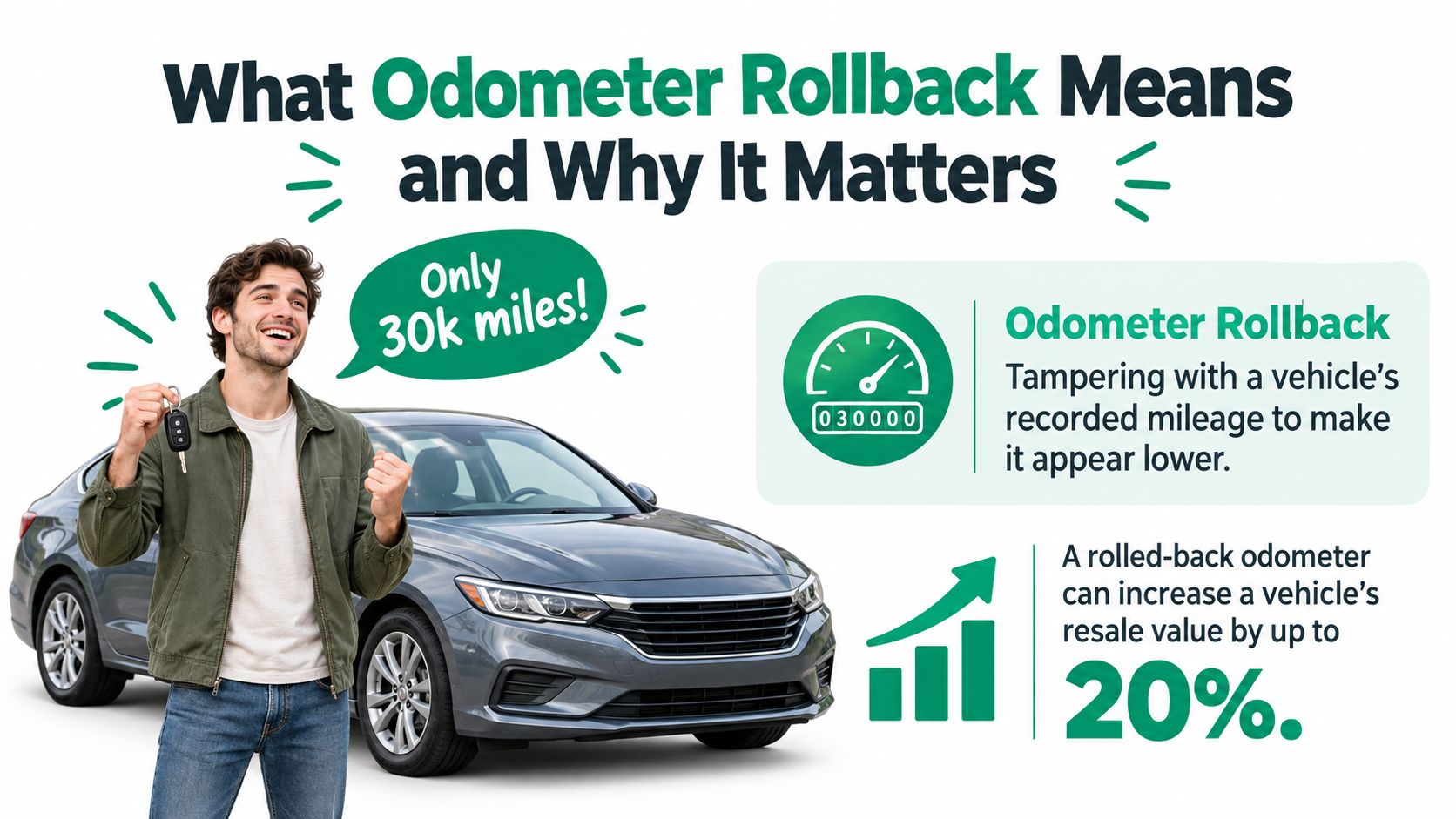
A corrected reading is not automatically fraud
A legitimate mileage correction can happen after an instrument cluster is replaced or repaired. The problem begins when someone changes the recorded mileage to conceal the vehicle's true use and fails to make the required disclosure. A repair record, title notation, and written explanation create a traceable history. A mysteriously lower number with no supporting paperwork creates suspicion.
Mileage influences much more than a listing headline. Dealers and buyers use it when estimating resale value, maintenance timing, warranty eligibility, and expected component life. A vehicle presented as low mileage may cause its new owner to postpone service that should already be due.
Practical rule: Treat mileage as a claim that needs evidence, not as a fact proven by the dashboard alone.
The hidden cost can include worn brakes, suspension components, tires, belts, drivetrain parts, and other maintenance needs. Rollback transfers those costs, along with potential safety risk, from the person who created the false reading to the person who buys the car.
How Fraudsters Roll Back an Odometer
Older vehicles commonly used mechanical odometers. Their mileage appeared on numbered drums connected to gears and cables. A person with the right equipment could disassemble the cluster or use a specialized device to spin the drums backward. That process may leave clues, including scratches, uneven spacing, or misaligned digits, although a careful alteration can be difficult to see.
Modern vehicles use digital displays, but digital doesn't mean tamper-proof. A fraudster may use an OBD-II programmer, an EEPROM reader, or other specialized equipment to rewrite mileage stored in the instrument cluster. Depending on the vehicle, related data may also exist in a body control module, gateway, engine computer, transmission module, or another control unit.
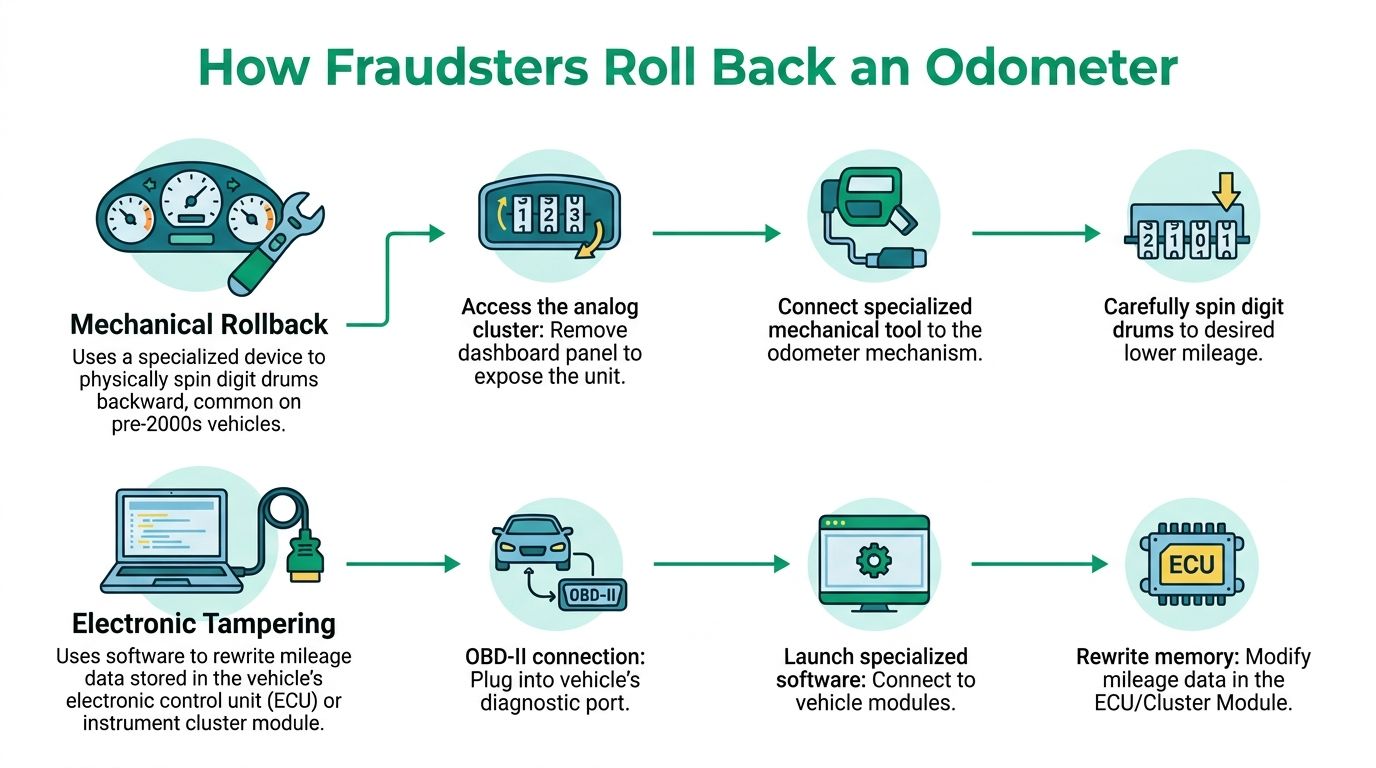
Why electronic systems can expose a false dashboard number
Many vehicles preserve mileage information in more than one location. If someone changes only the dashboard, another module may retain a higher reading. A diagnostic scan can then reveal a mismatch between the displayed mileage and the values stored elsewhere.
That doesn't mean every mismatch proves fraud. A control module may have been replaced, reset, or incorrectly programmed during a legitimate repair. The mismatch is still important because it tells you to demand documentation and investigate before purchasing.
Federal law focuses on intent. Under 49 U.S.C. § 32703(2), as discussed in a federal appellate opinion, liability can attach when a person disconnects, resets, or alters an odometer intending to change the mileage registered. Title histories and transaction records matter because they preserve mileage at points in the vehicle's ownership history.
A lawful cluster replacement requires accurate disclosure. The precise paperwork depends on the state and situation, so buyers should confirm requirements with the state titling agency. The safe buying principle is simple: a replacement part should produce a documented repair trail, not a conveniently lower number.
The Cost of Mileage Fraud in the U.S.
A sedan advertised at 70,000 miles may look like a sensible purchase. The interior is tidy, the seller describes a careful owner, and the price matches moderate use. Later, a service record or earlier title shows a much higher reading. The buyer has not only overpaid. They have also received a false picture of the car's maintenance needs and remaining component life.
The problem affects vehicles across the U.S. A 2024 report estimated that more than 2.14 million vehicles on U.S. roads might have rolled-back odometers, an increase of 18% since 2021, with consumer losses of about $4,000 per affected vehicle. A later 2025 report estimated roughly 2.45 million suspected rollback vehicles, a 14% year-over-year increase, and average value loss around $3,300 per vehicle. These figures appear in Auto Remarketing's reporting on CARFAX data.
U.S. Mileage Fraud by the Numbers
| Metric | Estimate |
|---|---|
| Vehicles sold each year with false readings | More than 450,000 |
| Vehicles on U.S. roads, 2024 estimate | More than 2.14 million |
| Suspected vehicles in the later 2025 estimate | Roughly 2.45 million |
| Estimated loss per vehicle in the 2024 report | About $4,000 |
| Average value loss in the later 2025 report | Around $3,300 |
The financial harm extends beyond the gap between the advertised price and fair value. Higher actual mileage can bring maintenance forward. A car presented as ready for routine ownership may soon need work on braking, suspension, tires, timing components, cooling systems, or drivetrain parts.
Mileage fraud can also hide in the vehicle's paper trail. A dashboard number is only one entry in a larger record that may include titles, inspection entries, service invoices, auction records, and registration events. Reports that cross-check those records, such as NMVTIS-grade history reports from VinCheck, help connect separate clues and expose a mileage story that does not line up.
Risk varies by market. Reporting has highlighted large states such as California and Texas, where high transaction volume and movement between jurisdictions can leave records fragmented. A vehicle from a large state is not automatically risky. A clean cabin and low dashboard number mark the start of verification.
For a practical valuation reference, compare the claimed mileage and condition with this Toyota Camry value example. A price estimate cannot prove mileage accuracy, but it can show how a false reading may affect negotiations.
Physical and Dashboard Warning Signs
Start your inspection before opening the glovebox or discussing financing. Sit in the driver's seat and study the cluster in daylight. On an analog display, look for misaligned number wheels, inconsistent spacing, scratches, missing fasteners, or marks around the cluster bezel. On a digital display, look for a clean number that conflicts with the rest of the vehicle.
Then compare wear with the claimed mileage. A steering wheel with heavy smoothing, pedals with worn rubber, a compressed driver's seat, and damaged floor mats can suggest extensive use. None of these signs proves rollback by itself. Owners replace interiors, commercial drivers use vehicles differently, and some cars receive unusually hard use.
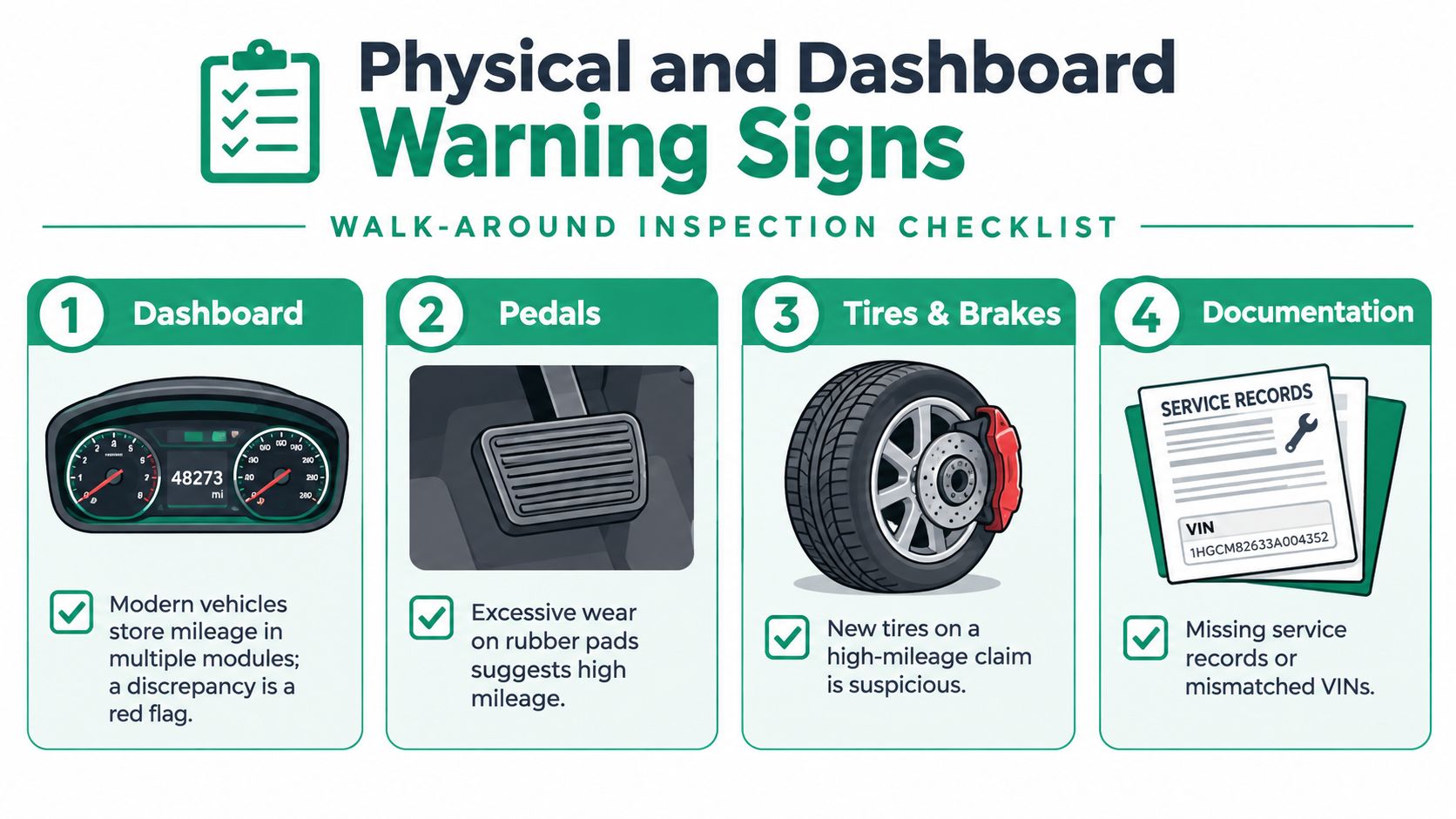
Match the cabin to the number
Look for contradictions rather than a single “magic” clue:
- Pedals and controls: Excessive wear can conflict with a low-mileage claim.
- Tires and brakes: Fresh replacement parts aren't proof of fraud, but they deserve an explanation when the seller describes the car as barely used.
- Service stickers: Oil-change or inspection stickers may show a mileage that doesn't fit the dashboard.
- Cluster condition: A faded background, loose trim, or disturbed screws can indicate cluster work.
- Cold start behavior: Ask to start the vehicle cold, then observe idle quality, warning lights, smoke, and unusual noises.
NHTSA's technical report explains that investigators can cross-check service and inspection records, manufacturer warranty data, and independent mileage counters stored in some vehicle computers. The NHTSA technical report on odometer fraud identifies these differences as useful indicators when they diverge from the dash reading.
An OBD-II scan can strengthen the inspection, but scanner access depends on the vehicle and the tool. Ask an independent mechanic to read relevant modules rather than relying on a cheap code reader that only checks for engine fault codes.
A dashboard tells you what the vehicle wants you to believe. The inspection tells you whether the rest of the car agrees.
How VIN and Mileage History Reports Catch Rollback
A mileage report works like a timeline. Each title transfer, inspection, service visit, emissions test, auction entry, or warranty event may create a new mileage point. One entry can be incomplete or wrong. A sequence of independent entries that rises steadily is much harder to dismiss.
That's why an NMVTIS-grade history report can be more useful than a single odometer check. It connects the VIN to records from different stages of the vehicle's life. When an earlier record shows a higher mileage than the current dashboard, the discrepancy becomes a concrete question for the seller.
What each record contributes
| Data Source | What It Shows | Reliability for Catching Rollback |
|---|---|---|
| Title and registration records | Mileage reported during ownership or transfer | Strong when the sequence is complete |
| Service invoices | Mileage recorded during repairs or maintenance | Useful, especially when issued by established shops |
| Inspection or emissions records | Mileage captured during compliance checks | Helpful independent comparison |
| Warranty records | Mileage submitted for covered work | Useful when manufacturer records are available |
| Auction or dealer records | Mileage documented during wholesale transactions | Valuable for vehicles that changed commercial hands |
| Current dashboard | The vehicle's present displayed reading | Necessary, but insufficient alone |
Some sources show an actual reading taken on a specific date. Others show only the last mileage reported to that system. That distinction matters. A gap doesn't automatically prove tampering, and a clean sequence doesn't guarantee that every prior record is genuine. The strongest finding comes from multiple VIN-linked records that disagree with the current display.
A report can also reveal context that changes how you interpret mileage. Salvage events, branded titles, prior auction activity, fleet use, and cross-border movement may explain why records are incomplete or why the vehicle changed hands frequently. They don't prove rollback, but they tell you where to ask harder questions.
You can review a VIN history example for a Toyota Camry to see how a buyer can organize vehicle identity and history information before negotiating. Use any report as an evidence-gathering tool, then confirm critical discrepancies with the state title agency, the seller, or a qualified mechanic.
What to Do Before and After You Buy
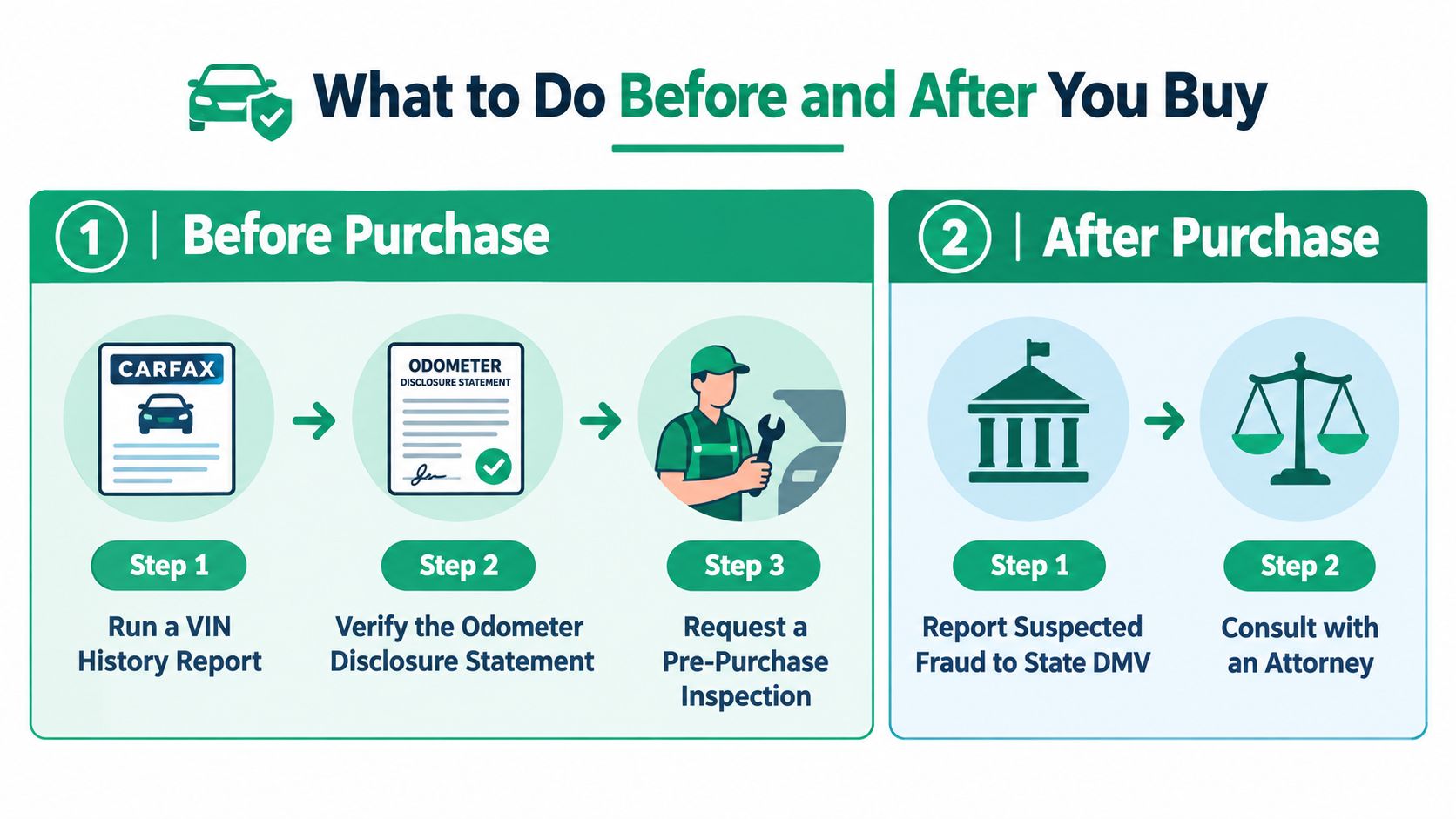
Before purchase, create a small evidence file. Save the listing, photograph the dashboard, record the VIN, and keep every message in which the seller discusses mileage or condition. Request the title, odometer disclosure statement, service records, and any paperwork relating to a cluster replacement.
Before signing
- Run the VIN: Compare the current display with title, service, inspection, warranty, and auction entries.
- Read the title carefully: Look for brands, corrections, transfer history, and mileage disclosures.
- Ask direct questions: Request a written explanation for every mileage gap or module mismatch.
- Book an independent inspection: Ask the mechanic to scan available modules and inspect the vehicle mechanically.
- Make the contract reflect the deal: Ensure the mileage representation and any disclosures appear in writing.
A seller who refuses a required disclosure or avoids basic history questions has given you useful information. You don't need to prove fraud before walking away. Unresolved contradictions are enough reason to stop the transaction.
For an additional vehicle-specific research step, review the Toyota Camry vehicle listings and information, then compare the target car's records and condition rather than relying on a listing's mileage description.
After purchase
If you discover a likely rollback, stop altering or repairing the evidence until you've documented it. Photograph the odometer, save the report, obtain a written scan from a dealer or qualified mechanic, and request copies of relevant title and service records.
Contact the state titling agency about correcting the mileage record and ask how to report a suspected false disclosure. NHTSA also accepts reports involving odometer fraud through its vehicle safety channels. For financial recovery, possible routes can include small claims court for lower-value disputes or a civil action under the federal Motor Vehicle Information and Cost Savings Act, depending on the facts and applicable law.
Preserve the vehicle purchase agreement, payment records, advertisements, messages, inspection results, and repair invoices. Speak with a consumer-protection attorney before making legal threats, because state fraud rules, filing periods, and title procedures vary.
A Simple Rollback Detection Checklist
Save this list before you visit a seller. It pairs every visual observation with a document or diagnostic check, because rollback often hides in the gaps between them.
Before you pay
- Record the basics: Write down the VIN, displayed mileage, seller's name, and asking price.
- Photograph the cluster: Capture the odometer and dashboard warning lights before the test drive.
- Check the history: Compare the display with title, service, inspection, warranty, and auction mileage.
- Inspect the cabin: Look at pedals, steering wheel, seat bolsters, floor mats, shifter, and cluster trim.
- Ask for paperwork: Request the title, odometer disclosure statement, repair invoices, and cluster replacement records.
- Scan the vehicle: Have an independent mechanic check available control modules, not only engine fault codes.
- Start it cold: Observe warning lights, idle, smoke, noises, and any behavior inconsistent with the claimed use.
- Put discrepancies in writing: Ask the seller to explain each mismatch in the purchase documents.
If suspicion appears afterward
- Preserve evidence: Keep the advertisement, contract, messages, photographs, report, and inspection results.
- Obtain confirmation: Request a written mileage reading from a dealer or qualified diagnostic technician.
- Contact the title agency: Ask how to correct the record and submit a suspected fraud complaint.
- Report the seller: Provide the available evidence through NHTSA's odometer fraud reporting channel.
- Get legal guidance: Discuss potential recovery with a consumer or automotive fraud attorney.
A single dashboard check can miss a carefully altered reading. The reliable habit is to compare the physical car, the electronic modules, and the VIN-linked paper trail before you negotiate.
Common Questions Buyers Ask About Rollback
Can newer digital cars still have rollback?
Yes. Digital displays make the number harder to alter casually, but they don't eliminate tampering. A technician or fraudster with specialized equipment may target the instrument cluster or other electronic modules. The useful question isn't whether the car has a digital dashboard. It's whether stored readings and historical records agree.
Does a module mismatch prove fraud?
No. A mismatch can follow a legitimate control-module replacement, repair, reset, or programming error. It becomes more concerning when the seller can't explain it, the title history shows a higher reading, or the vehicle's wear strongly conflicts with the displayed mileage.
Is a professional inspection better than a DIY check?
A DIY inspection can catch obvious clues, such as worn pedals, disturbed cluster trim, inconsistent service stickers, or a suspicious history gap. A qualified mechanic can add diagnostic access, module comparison, lift inspection, and a written assessment. Neither method guarantees certainty, but professional evidence is more useful when the vehicle's history is disputed.
Are imported or cross-border vehicles riskier?
The risk can be harder to evaluate when a vehicle moved between countries or markets because one jurisdiction's records may not appear in another jurisdiction's history. Research in the Czech used-car market found suspicious patterns were more prevalent in imported cars than domestically registered cars, as summarized by NPR's reporting on odometer rollback concerns. Treat that as a reason to demand broader documentation, not as proof that every import has a false reading.
Is a free VIN lookup enough?
A free lookup can help confirm the vehicle's identity and basic specifications. It may not include every title, service, auction, or mileage event. A more detailed NMVTIS-grade report can provide additional VIN-linked records, but you should still compare the report with the physical car and original documents.
What if the seller refuses the odometer statement?
Pause the purchase. A refusal prevents you from establishing a clear written record and may violate disclosure requirements that apply to the transaction. Ask the state titling agency what documentation is required, and don't accept verbal assurances as a substitute.
Do insurance companies treat rollback as material misrepresentation?
Potentially, depending on the policy, the claim, and the facts. Mileage can affect valuation, underwriting, maintenance expectations, and the assessment of a loss. If you suspect intentional misrepresentation, preserve the records and ask the insurer and a qualified attorney how the issue affects your situation.
The safest workflow remains layered verification: inspect the vehicle, compare its modules when possible, review the VIN history, and resolve contradictions before money changes hands.
VinCheck provides VIN decoding and vehicle history reports that can surface mileage anomalies alongside title brands, salvage events, theft records, liens, recalls, and prior sales or auction activity. Run the vehicle's VIN through VinCheck before you negotiate, then use any discrepancy as a reason to request records or an independent inspection.
About the author
VinCheck Editorial Team — Editorial Standards & Review
The VinCheck Editorial Team reviews every published article against NMVTIS data accuracy and NHTSA recall validity. This byline appears on collaborative pieces and quick-update posts.