 Vin
What Is a Vehicle History Report and How to Read It
By VinCheck Editorial Team, Editorial Standards & Review · Published 2026-09-19 · Updated 2026-09-19 · Reviewed by VinCheck Editorial Standards
A vehicle history report is a VIN-based summary of a car's title and risk status built around five NMVTIS indicators: title history, odometer reading, brand history, salvage or total-loss status, and theft or junk records. For a used-car buyer, it's a fraud-screening tool first, not a full report card on the car.
You're probably looking at a used car that seems fine on the surface. The paint shines, the seats look clean, the seller says it has a “clean history,” and the price feels close enough to market that you're tempted to move fast.
That's exactly when people get tripped up.
A car can look excellent in a driveway or dealer lot and still carry a paper trail that changes the deal completely. A title brand tied to salvage, flood, junk, or total loss can affect whether the car is worth the asking price, whether an insurer will cover it normally, and whether you'll want to own it at all. The point of a vehicle history report isn't to tell you whether the cupholders are scratched or whether the tires will last another season. Its job is narrower and more important. It helps you catch legally meaningful events attached to that vehicle's identity before you hand over money.
A lot of buyers think of these reports as a long feature list, almost like a car-shopping add-on. That misses the idea. The most useful way to think about a vehicle history report is as an evidence trail tied to the VIN, which is the car's unique identifier. It gathers certain records from reporting systems so you can screen for fraud, theft concerns, branding, and major status changes.
Table of Contents
- Introduction Why That Clean Car Still Needs a Paper Trail
- What a Vehicle History Report Really Is
- Inside the Report What Data You Will Actually See
- Where the Data Comes From and Why NMVTIS Grade Matters
- What a Vehicle History Report Cannot Tell You
- How to Read and Use the Report Before You Buy
- Making a Confident Decision With History and Inspection Together
Introduction Why That Clean Car Still Needs a Paper Trail
You find a used sedan that seems right. The paint still shines, the cabin is clean, the test drive feels normal, and the seller says it has a clean history. For a first-time buyer, that can feel like enough evidence.
It is not enough.
A used car can present well and still carry a record that changes what it is worth, how easy it is to insure, or whether you want to own it at all. What matters here is not just what you can see in a parking lot. It is the paper trail attached to the VIN, the vehicle identification number that works like the car's fingerprint.
That paper trail is why a vehicle history report matters. Under the federal National Motor Vehicle Title Information System, or NMVTIS, the report is built to surface a small set of federally defined warning signs tied to ownership records and legal status. The goal is practical. Help buyers spot fraud risks, title problems, theft concerns, and other serious record issues before money changes hands.
A useful way to view the report is as an evidence trail, not a glossy feature sheet. It does not exist to describe every scratch, every oil change, or how carefully the last owner drove. It exists to collect certain records from reporting sources and tie them to one VIN, so you can check whether the car's story on paper matches the story you are being told in person.
That difference trips up many buyers.
A clean exterior answers one question: how the car looks today. A history report answers a different question: whether the vehicle's identity has passed through events that affect value, ownership risk, or legal standing. Just as a house can look freshly painted while still having permit or title issues in public records, a car can look tidy while its paperwork tells a harder story.
The missing parts matter too. If a report does not mention routine maintenance or mechanical condition, that absence does not mean those areas are fine. It means the report was never designed to serve that purpose. Reading it well starts with knowing both what it includes and what it leaves out on purpose.
By the end, you should be able to answer three practical questions with confidence:
- What is a vehicle history report really for
- What does it show
- What should you do if the report is clean, incomplete, or raises a red flag
What a Vehicle History Report Really Is
A lot of first-time buyers hear the phrase “vehicle history report” and picture a full biography of the car. That expectation causes trouble. The report is narrower than that, and its value comes from understanding that narrow role.
A useful comparison is a medical record tied to the VIN.
A medical file does not describe every hour of a person's life. It records certain events that entered a reporting system and mattered enough to document. A vehicle history report works the same way. It connects selected records to the car's VIN, or Vehicle Identification Number, so a buyer can check the paper trail behind the vehicle's identity.
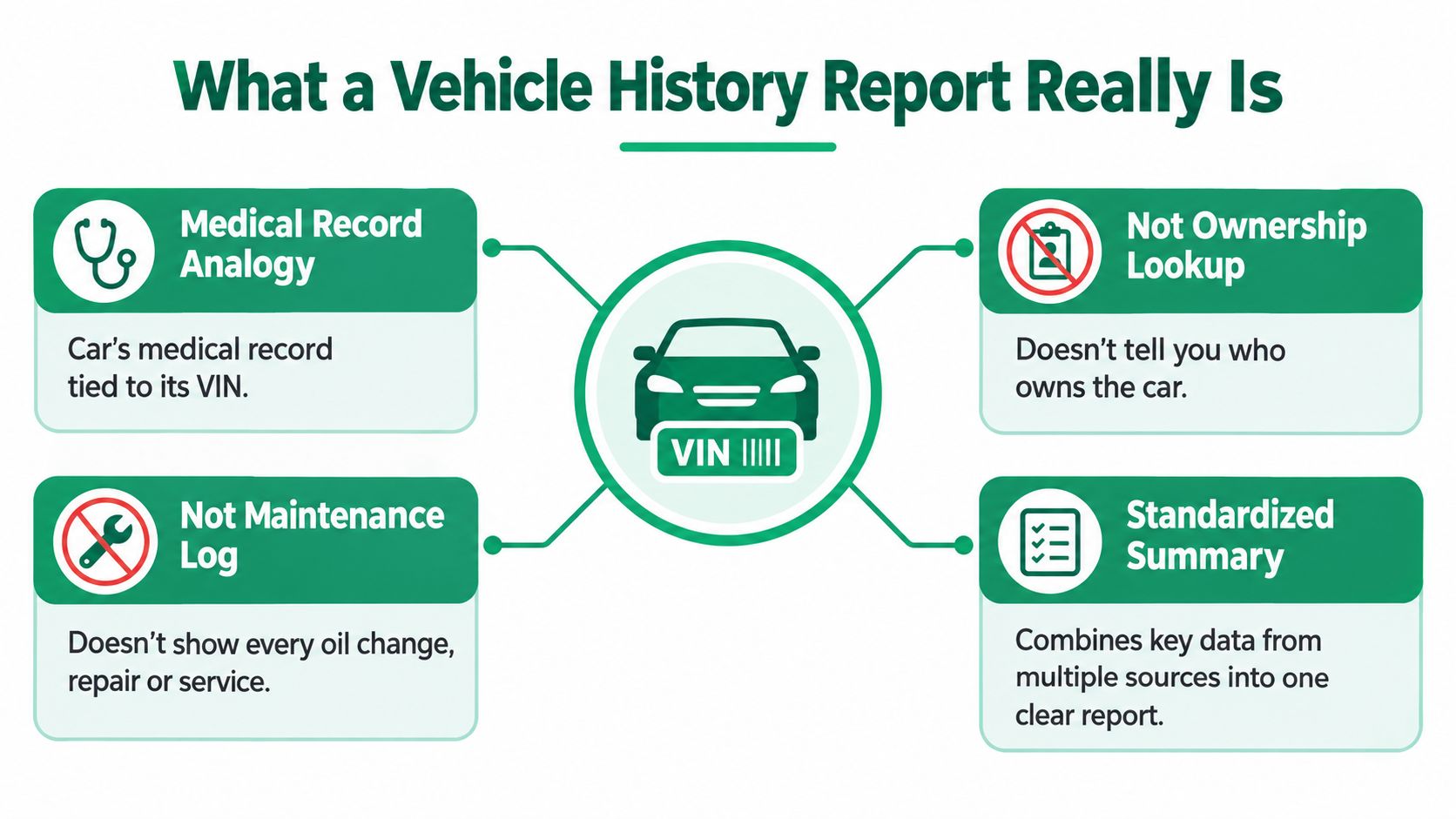
That distinction matters because the report is not a dealer convenience or a branded feature list. The main public framework behind these reports, NMVTIS, was created under the Anti-Car Theft Act of 1992 and is federally supervised. As noted earlier, it is designed to collect regular reporting from sources such as state titling agencies, insurance carriers, salvage yards, junk yards, and auto recyclers.
That federal structure changes how you should read the document. You are not looking at marketing copy about the car. You are looking at an evidence trail built to reduce title fraud, catch stolen vehicles, and flag legally meaningful status changes that can follow a vehicle across state lines.
That also explains why some things are present and some are intentionally missing.
A vehicle history report usually does not function as:
- An ownership directory. It is not built to give you a simple name-by-name list of private owners.
- A maintenance diary. Routine service, tire rotations, and small repairs may never appear.
- A mechanical verdict. It cannot tell you how the engine, transmission, or suspension feels today.
- A guarantee. A clean report means no matching problem was found in the reporting stream used for that report.
For a first-time buyer, the easiest way to frame it is this: the report screens for record-based risk. It helps you ask, “Has this vehicle passed through events that affect legal status, value, insurance, theft risk, or mileage credibility?”
The consumer version of an NMVTIS-based report usually centers on five high-signal areas:
- Current and previous title information
- Latest odometer reading
- Brand history
- Salvage or total-loss status
- Limited theft or junk or salvage transfer records
Those categories are not random. They focus on events that leave a meaningful paper trail and can change what the car is worth, how easy it is to insure, or whether its identity story makes sense.
A short definition helps: a vehicle history report is a VIN-linked evidence trail that lets you screen a used car for documented identity, title, theft, brand, and mileage risks before you buy.
That is the question behind “what is a vehicle history report.” You are not asking for a list of features. You are asking what evidence entered the system, what never entered it, and what those gaps mean before you hand over money.
Inside the Report What Data You Will Actually See
A report often looks crowded the first time you open one. The easiest way to read it is to treat it like a case file tied to the VIN. Each line is a recorded event, and blank spaces matter too because they remind you the report only shows events that entered a reporting system.
Start with title and brand information
Begin at the part of the report that shows title history and brand history. This area usually carries the most legal weight because it tracks status changes recognized by states and other reporting sources. You will often see the current title state, earlier title records, brand labels, the latest reported odometer reading, and sometimes theft, junk, or salvage-related records, as noted earlier in the article.
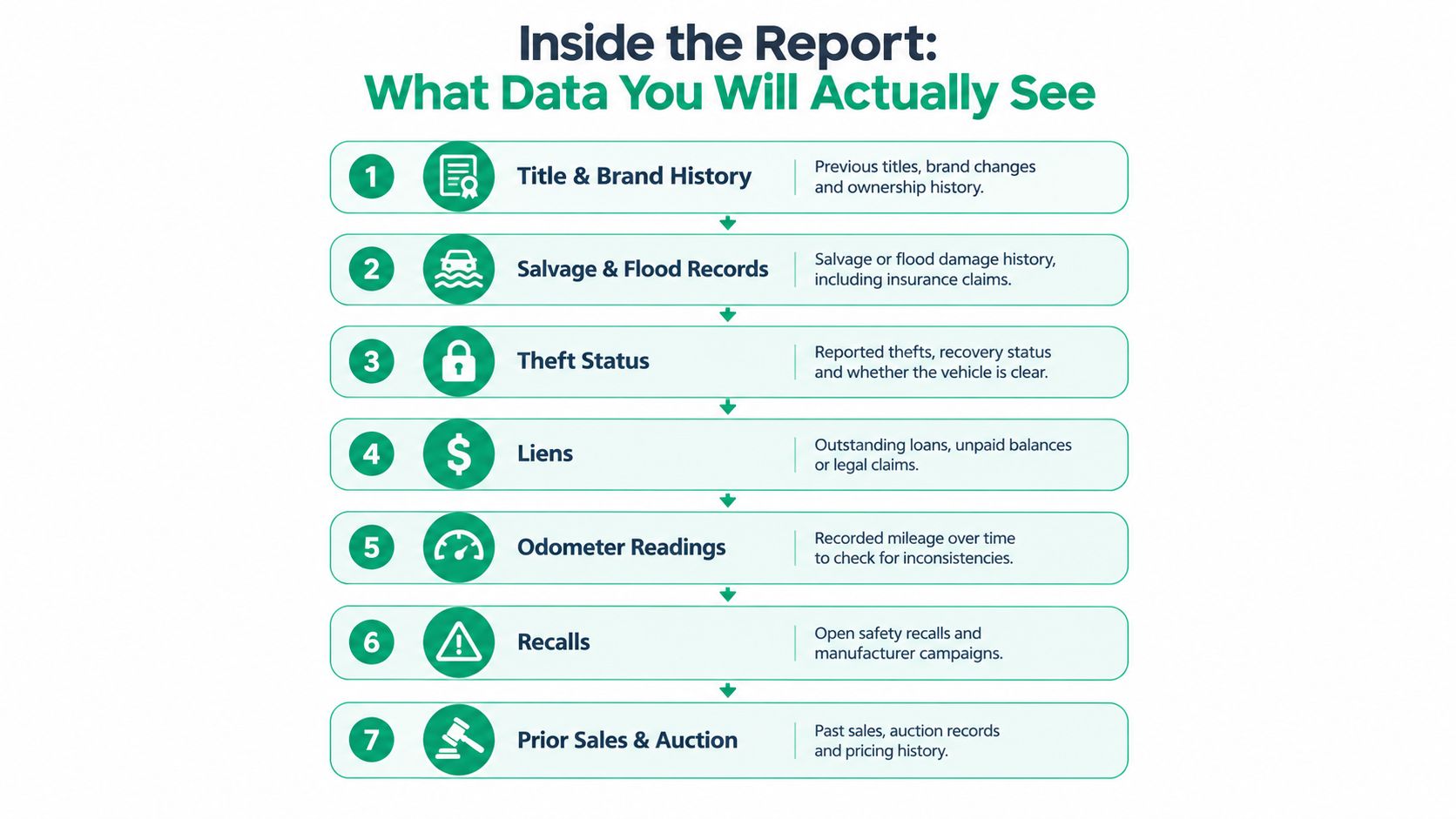
A brand is not a comment or a warning sticker. It is a status marker that can affect title transfer, value, financing, and insurance. If you see labels such as salvage, junk, or flood, slow down and ask for supporting paperwork. Those entries are part of the vehicle's evidence trail.
One point confuses many first-time buyers. A clean-looking car can still carry an old brand, and a rough-looking car may have no brand at all. The report is showing what was recorded, not grading how the car looks today.
Odometer and loss entries deserve extra attention
The odometer section helps you check whether the mileage story holds together over time. The number itself matters less than the pattern. If readings move in a steady direction and line up with the seller's explanation, that is a good sign. If a later reading is lower than an earlier one, or the sequence does not make sense, stop and verify before you go further.
A salvage or total-loss record answers a different question. It shows that somewhere in the reporting chain, the vehicle was treated as a major loss event. Some rebuilt cars return to the road and can be usable. You still need repair records, a close inspection, and a price that matches the risk.
This short video helps show the kind of report details buyers should learn to scan for:
Extra fields can help, but they do not all carry the same weight
Some reports include more than the core title, brand, mileage, and theft-related items. You may see lien information, open recalls, or prior auction and sale references. Those details can help you ask better questions, but they are not equal to a state-issued brand or a salvage record.
A useful way to sort the page is to separate legal-status records from context records. Legal-status records change how the vehicle can be titled, valued, insured, or transferred. Context records help you investigate but usually need confirmation from another source.
Practical rule: treat title brands, salvage records, theft flags, and mileage inconsistencies as items that can change your decision. Treat other entries as follow-up clues until you verify them.
What Each Report Element Tells You
| Report Element | What It Signals | Why It Matters for Buying |
|---|---|---|
| Title history | Where and how the vehicle has been titled | Helps confirm identity and spot status changes over time |
| Brand history | Legal labels such as salvage, junk, or flood | Can affect value, insurance, financing, and resale |
| Salvage or total-loss status | A prior major loss event in the record trail | Calls for repair documents and a careful inspection |
| Theft or junk records | Theft history or movement through junk or salvage channels | Raises ownership and transfer questions |
| Odometer readings | Reported mileage at certain points in time | Helps you spot rollback risk or an inconsistent story |
| Liens | A lender or other financial interest may exist | Matters for clear transfer of ownership |
| Recalls | Manufacturer safety work may still be open | Tells you what safety issues still need attention |
| Prior sales or auction activity | Past market movement or disposition context | Useful for follow-up questions, not proof by itself |
Read the report one line at a time and ask three simple questions. What happened. Who likely recorded it. What does the absence of other records leave unanswered.
That habit turns a busy report into something much more useful: a federally supervised paper trail with clues, limits, and gaps you can act on before you buy.
Where the Data Comes From and Why NMVTIS Grade Matters
A report can look clean, detailed, and professional while still drawing from very different kinds of records. For a first-time buyer, that is easy to miss. The screen may look the same. The evidence underneath may not.
Federally required reporting versus broader aggregation
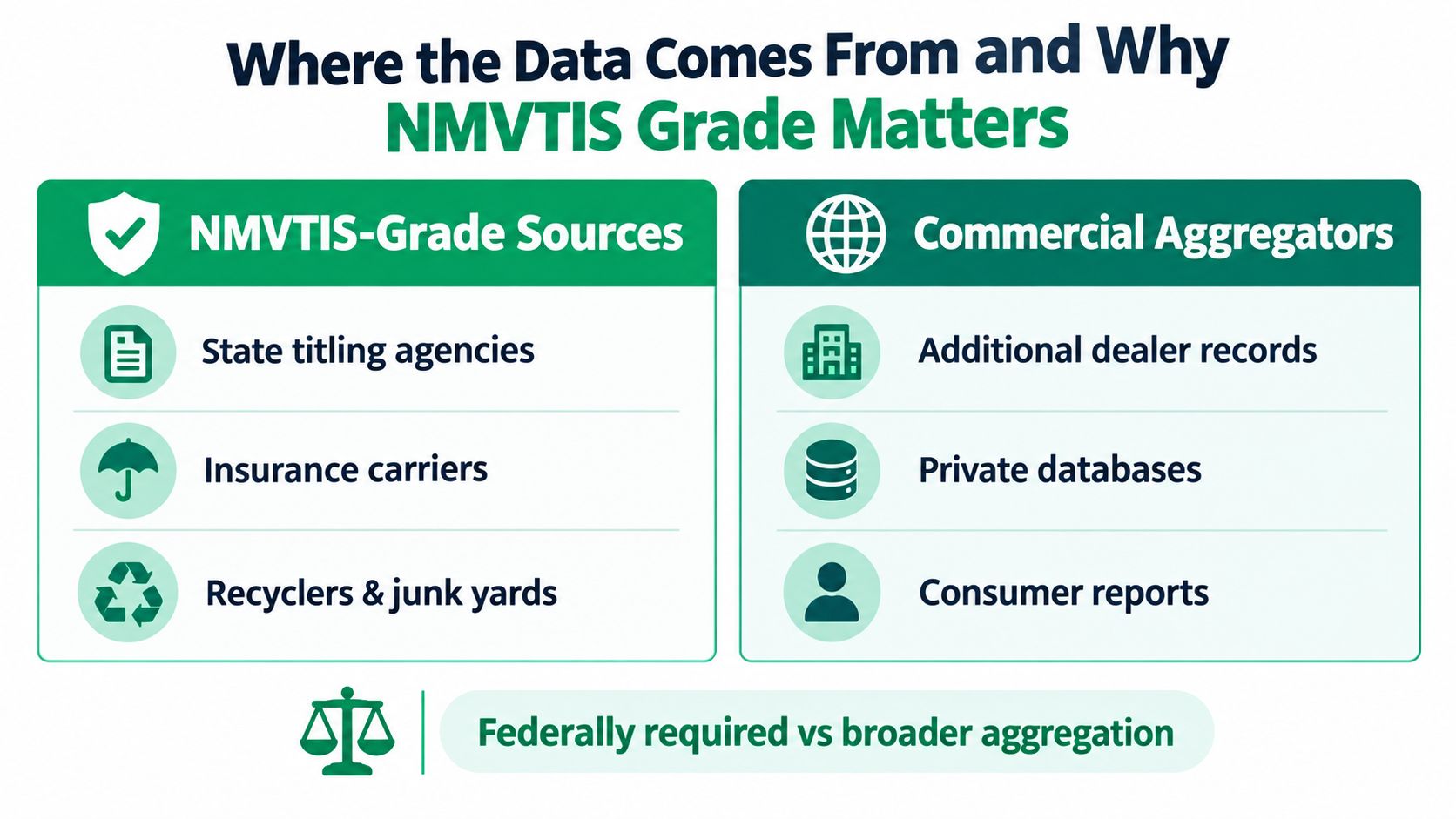
NMVTIS-grade data works more like a courthouse file than a product feature list. It is built around legally meaningful records that certain participants are required to report, rather than optional details collected from wherever a provider can get them.
That distinction matters because the report is answering a narrow question first. Has this vehicle shown up in official title, branding, total-loss, theft, junk, or salvage channels that could change how you value it or whether you should buy it at all. Federal material described earlier explains that the system was designed to focus on those high-risk record types instead of trying to serve as a full life story for the car.
Who has to report
Required reporting gives NMVTIS-grade reports their backbone. The main reporting groups include:
- State titling agencies, which anchor title changes and brand records
- Insurance carriers, which can report certain total-loss information
- Auto recyclers, junk yards, and salvage yards, which record when a vehicle moves into those channels
That is why it helps to read the report as a supervised evidence trail. Each line usually exists because an agency, insurer, or salvage-related business had a reporting duty, not because someone added a convenient detail for shoppers.
Why the NMVTIS label matters when you compare providers
Two providers may both sell a "vehicle history report," but they may not be showing the same core record set. One practical check is simple. Look at the provider's sample report, checkout page, or fee disclosure and confirm whether it clearly says the report includes NMVTIS data or is sourced from an NMVTIS-approved provider. If that language is missing, treat the report as a different product until you verify what records it covers.
Fee disclosures can help here too. A provider that is offering NMVTIS-based access should make the source and charge structure plain to the buyer, rather than hiding the origin behind marketing language.
What commercial add-ons can and can't do
Commercial providers may layer on extra information such as dealer records, auction activity, ownership counts, or newer categories of vehicle data. Kelley Blue Book notes that some reports now include broader aggregated details beyond core title and branding records (Kelley Blue Book discussion of vehicle history reports).
Those additions can help with context. They do not carry the same weight as a record rooted in required reporting.
A simple way to separate the two is to ask, "Was this line created because someone had a legal or formal reporting role, or because a company found additional market data?" The first group helps you verify status. The second group gives supporting clues.
If you are comparing reports, do not judge them by length alone. Check whether the provider shows authoritative title and brand evidence first, then decide whether the extra commercial layers are useful for your follow-up questions.
What a Vehicle History Report Cannot Tell You
You find a used car that looks sharp, drives well on a short test drive, and comes with a clean-looking history report. For a first-time buyer, that can feel like the case is closed.
It is not.
A vehicle history report is better understood as an evidence trail than a full biography. It shows events that entered reporting systems. It does not show every dent, every repair, or every problem developing under the hood. If a report is the car's paper trail, the car itself is the crime scene. You still need to inspect both.
A clean report only means no matching record was found
A major consumer warning from AAA is that vehicle history reports only capture reported events and can miss unreported crashes, DIY repairs, hidden flood or structural damage, and current wear items such as brakes and tires (AAA on what vehicle history reports don't tell you).
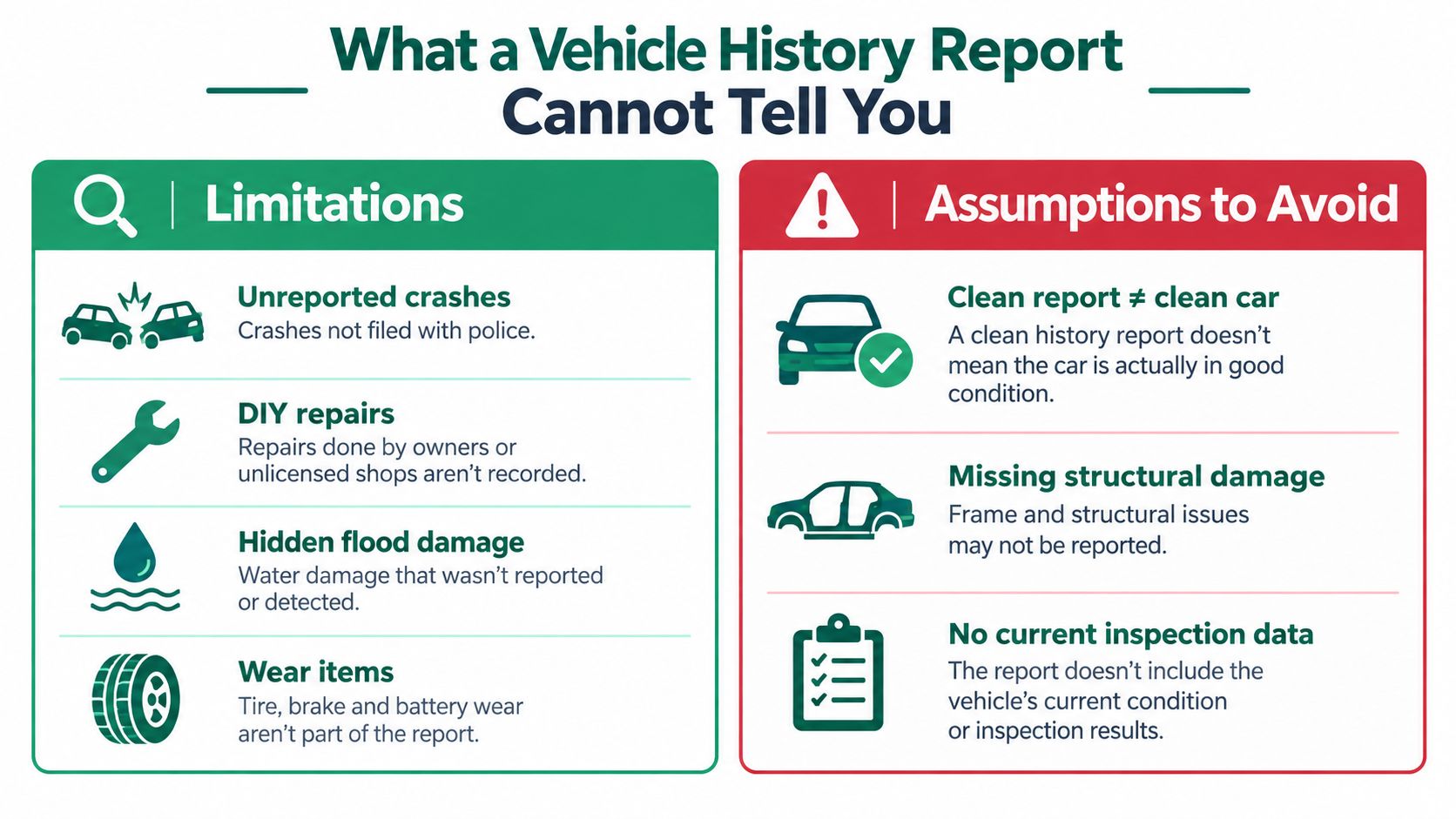
That gap matters because many problems never become formal records. A seller might pay for repairs out of pocket. A body shop might fix visible damage without any insurance claim. Flood exposure might leave electrical trouble months later, after the event that caused it.
So a quiet report should lead to one conclusion only: no matching event appears in the records searched. It should not lead to the stronger conclusion that nothing happened.
The report is a snapshot taken at one moment
History reports are time-stamped views of available records, not live surveillance of the vehicle's whole life.
Some events appear late. Some never make it into the sources your report checks. Some categories are outside the report's purpose altogether, such as routine maintenance quality, current mechanical condition, or whether a past repair was done well. That is why a car can look clean on paper and still have paint mismatch, frame rust, weak brakes, or transmission trouble.
This is also where the missing information matters. If the report does not mention an accident, that silence may mean no accident was reported. It may also mean the event happened recently, happened outside formal channels, or never generated the kind of record this system collects.
Don't ask a history report to answer questions that only an inspection, a road test, and a trained mechanic can answer.
If you also want model-level context, separate that from the vehicle's own record. For example, Toyota Camry safety ratings can help you judge how that model performs in crash testing when it is in proper condition. That answers a different question than whether this specific Camry was damaged, repaired well, or maintained properly.
Common mistakes buyers make
- “No accidents listed means no accidents happened.” It means no matching accident record appears in the report.
- “A clean title means the car has never had serious damage.” Title status and physical condition are not the same thing.
- “A short report means a simple history.” It can also mean fewer events were captured or shared.
- “The report tells me what condition the car is in today.” Current condition has to be checked in person.
The safest approach is simple. Use the history report to identify documented risk, and use an independent inspection to catch the problems paperwork misses.
How to Read and Use the Report Before You Buy
Once you have the report, the goal isn't to admire it. The goal is to make a decision.
A simple reading workflow
Start at the top and work in this order:
- Match the VIN everywhere. Compare the VIN on the report to the dashboard tag, door label, title paperwork, and seller listing.
- Scan for title brands first. If you see salvage, flood, junk, or total-loss language, stop and ask for repair documentation before going further.
- Check the odometer story. Look for a believable sequence. If the mileage picture feels off, don't explain it away.
- Review theft, junk, or salvage transfer references. These are ownership-risk items, not minor notes.
- Use extra entries as prompts. Auction references, recalls, or lien notes should lead to questions and verification.
If the report shows a branded title or loss history, the next step isn't panic. It's verification.
What to do when you find a red flag
A red flag should trigger action, not just concern:
- Request documents. Ask for title paperwork, repair invoices, and any insurer or rebuild records the seller has.
- Book an independent inspection. Tell the mechanic what the report showed so they know where to look.
- Verify the physical VIN. Make sure the identifiers on the vehicle match the paperwork exactly.
- Recalculate value. Prior damage can change what the car is worth even when repairs look decent.
If you're trying to understand how prior damage can affect resale or compensation issues, this plain-English diminished value claim 2026 guide gives useful context on why a damage history can matter financially even after repairs.
Buying habit: use the report as a screening layer, then let inspection and documentation decide whether the car is still worth pursuing.
When to negotiate and when to walk away
Negotiate when the issue is explainable, documented, and reflected in the price.
Walk away when the seller can't explain a major title brand, the VIN doesn't match cleanly, the mileage story feels inconsistent, or the inspection raises structural or safety concerns that make you uneasy.
For buyers who want one place to start a vehicle-specific lookup, a sample VIN check for a 2024 Toyota Camry shows the kind of information a report tool can surface before you schedule the inspection. Use any report like a filter, not a final verdict.
Making a Confident Decision With History and Inspection Together
The smartest used-car buyers don't choose between paperwork and physical inspection. They use both.
A vehicle history report helps you answer, “What has this VIN been flagged for in reportable systems?” A mechanic helps you answer, “What shape is this actual car in right now?” You need both questions answered before you buy with confidence.
Your repeatable checklist is simple:
- Pull the report early
- Match the VIN on the car and paperwork
- Pause on title brands, loss records, and mileage concerns
- Get an independent inspection
- Compare the asking price to the vehicle's likely value range
If you want value context for a specific model while deciding whether the seller's price makes sense, a tool like Toyota Camry value estimates can help frame the negotiation after you've reviewed the history and inspection findings.
A good report doesn't tell you to buy the car. It tells you where to look harder. That mindset protects you better than any single line item ever will.
If you're checking a specific car, VinCheck lets you look up VIN-based vehicle data, review history details such as title brands, theft, salvage, recalls, and mileage issues, and use related tools like value and safety research in the same workflow. It's a practical way to screen a vehicle early, then decide whether it's worth the inspection, the negotiation, or a quick walk away.
About the author
VinCheck Editorial Team — Editorial Standards & Review
The VinCheck Editorial Team reviews every published article against NMVTIS data accuracy and NHTSA recall validity. This byline appears on collaborative pieces and quick-update posts.