 Vin
What Does Green Title Mean for a Used Car
By VinCheck Editorial Team, Editorial Standards & Review · Published 2026-09-11 · Updated 2026-09-11 · Reviewed by VinCheck Editorial Standards
A green title is generally the standard, unbranded title issued to a vehicle with no salvage, rebuilt, flood, or junk designation. It usually means the issuing state hasn't attached a special damage or loss brand to the vehicle's title.
You're standing at a used-car lot with a salesperson waiting nearby, a vehicle title spread across the hood, and one question in mind: does the green paper mean this car is safe to buy? The short answer is useful, but incomplete. Green usually describes the title's current legal status, not the vehicle's entire mechanical or insurance history.
That distinction matters because title systems vary by state, brands can follow a vehicle across state lines, and a clean-looking document can leave out problems that a VIN history check may reveal. A careful buyer treats green as a starting signal, then verifies the words on the title and the records attached to the VIN.
Table of Contents
- A Green Title at First Glance
- How State Title Colors Actually Work
- Green Title vs Salvage and Rebuilt Titles
- When a Green Title Becomes a Branded One
- Why a Green Title Can Still Hide Past Damage
- Checking Title Status Before You Buy or Register
- Putting the Green Title Idea Together
A Green Title at First Glance
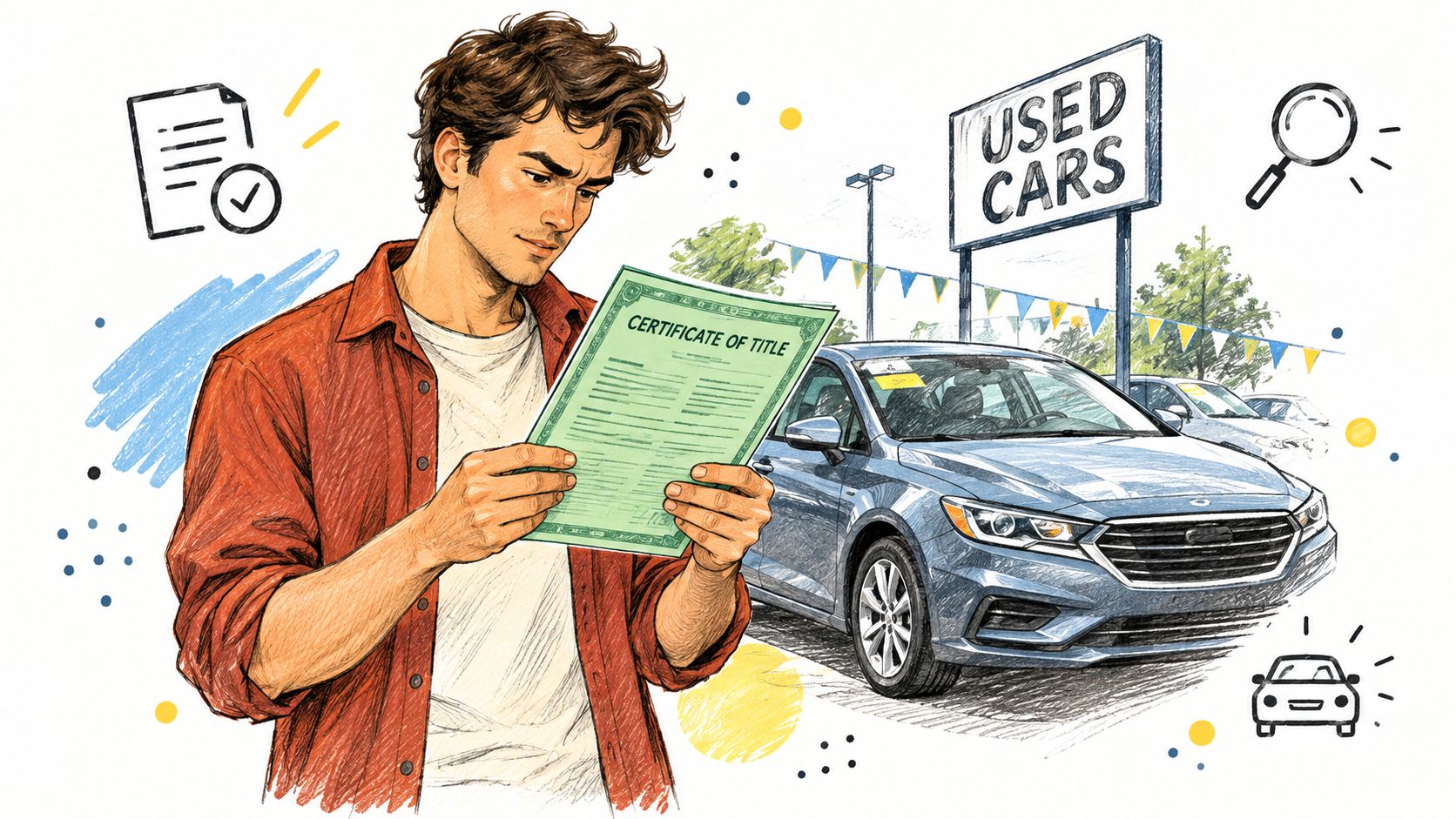
You are at a used-car lot, holding the title while the salesperson waits nearby. The paper is green, but the useful question is not whether green means clean. It is whether the title is clean in its recorded history and whether the document shows anything that needs verification.
In states that use color-coded certificates, green commonly identifies an ordinary title without a formal brand. The color is a quick label, much like a folder marked for routine files. It indicates how the issuing state classified the vehicle when that document was produced. It does not establish that the car has never had a collision, repair, mechanical failure, or ownership change in another state.
Read the title, not only the paper color
Start with the printed fields. On an Oklahoma title, look for the title type or brand information near the main vehicle details. A green document may identify the status as standard, while salvage, rebuilt, or junk classifications appear as separate categories in state records. The exact placement and wording can vary, so use the field labels rather than relying on the shade alone.
A green title generally supports three practical conclusions:
- Current title status: The issuing state treats the vehicle as unbranded under its own rules.
- No listed special designation: The face of the document does not show a formal salvage, rebuilt, flood, or junk notation.
- Ordinary transfer potential: The title can usually support a normal ownership transfer, subject to lien requirements and the next state's rules.
Those conclusions still leave important questions unanswered. Lenders, insurers, dealers, and future buyers may review the vehicle's condition and history in addition to its title category. A green title can therefore be a useful first clue without being a safety certificate or repair record.
Practical rule: Read the title language, brand fields, reverse side, VIN, mileage entry, owner information, and lien section before accepting the color as proof.
Then compare the VIN with an independent history search and arrange a mechanical inspection. The document shows the title's current classification. The vehicle history helps determine whether that clean-looking status tells the whole story.
How State Title Colors Actually Work
A title that looks green in one state may not carry the same meaning after the vehicle crosses a state line. The United States has no universal title-color dictionary. Each state sets its own certificate design, color system, and branding rules, so the issuing state and printed wording matter more than the shade alone.
Oklahoma illustrates the basic pattern. Its guidance identifies green as the standard title color and uses other colors for branded categories such as salvage, rebuilt, and junked vehicles (Oklahoma title guidance). That example does not create a national rule. An orange, blue, yellow, or white document may represent a different status elsewhere, and some states rely mainly on words rather than paper color.
Color is shorthand, not a mechanical diagnosis
A title brand records an official legal or insurance determination. It is not a mechanic's inspection report. For example, an insurer or agency may apply a brand after damage reaches that jurisdiction's total-loss threshold, but the document does not show that every component was inspected or that the vehicle has no remaining defect.
A clean vehicle may use colored paper in one state and a differently designed document in another. Read the issuing state, title type, brand field, and printed description together.
| Title Color | Status Meaning | Verifiable Example or Check | Buyer Implication |
|---|---|---|---|
| Green | Commonly standard or unbranded | Oklahoma uses green for its standard title | Usually no special brand appears on the current title |
| Red | May identify a branded category | Check the issuing state's DMV title guide for the current red-title assignment | Ask what event caused the listed brand |
| Orange | May identify another branded category | Check the issuing state's DMV title guide for the current orange-title assignment | Confirm whether the vehicle has a prior salvage or rebuilt history |
| Blue or another color | Meaning varies by jurisdiction | Check the issuing state's DMV title guide for the current color assignment | Read the printed brand instead of guessing |
| White or plain paper | May accompany text-based branding or another design | Check the issuing state's DMV title guide for the current assignment | Paper color alone provides little information |
The practical model is simple: title color is local shorthand. It helps an agency organize title categories, but it cannot establish the vehicle's full history. A green document may look clean while an earlier event appears in another state's records or in the vehicle's history. Use the actual title brand, then compare the VIN history before deciding what the paperwork really means.
Green Title vs Salvage and Rebuilt Titles
A title brand describes a legal status created by a specific event or determination. It isn't merely a warning about how attractive, damaged, or well-repaired the vehicle looks today.
A salvage title commonly follows an insurer's total-loss decision. Collision damage, weather damage, or a recovered theft can lead to that decision when the applicable state rules are met. The vehicle may still exist as a repairable car, but its title no longer presents it as an ordinary unbranded vehicle.
A rebuilt title usually applies after a salvage vehicle has been repaired and approved under the issuing state's process. The car may return to road use, but the prior brand remains part of its identity. Repair work can restore function without erasing the event that caused the original salvage designation.
The main categories in plain language
| Title Status | What It Usually Signals | What a Buyer Should Ask |
|---|---|---|
| Green or standard | No special brand appears on the current title | Does the VIN history also remain clean across states? |
| Salvage | The vehicle reached a state-defined loss or safety threshold | What damage caused the total-loss decision? |
| Rebuilt | A previously salvage vehicle was repaired and processed for road use | Who repaired it, and what inspection records exist? |
| Flood | Water damage was serious enough to create a formal brand | Were electrical, corrosion, restraint, and drivetrain systems affected? |
| Junk | The vehicle is generally intended for parts rather than normal road registration | Can it legally be registered, or is it parts-only? |
Flood damage deserves special caution because a vehicle can look clean after drying and cosmetic repair while hidden corrosion or electrical problems develop later. A junk designation is more restrictive still, since the vehicle is treated as a parts or scrap asset rather than a normal road vehicle.
A green title sits at the unbranded end of this comparison. That often makes financing, insurance, registration, and resale simpler than it would be with a branded equivalent, although individual companies and states apply their own rules. Before buying any used vehicle, compare the title against the VIN record. A VIN history check for a used Nissan Altima can help you look beyond the document in your hand.
When a Green Title Becomes a Branded One
A title doesn't normally change color because a mechanic finds an ordinary repair. The major transition usually begins when an insurer or state agency decides that the vehicle has reached a legally significant loss or safety condition.
Michigan-oriented guidance describes a total-loss benchmark at 75% of the vehicle's pre-damage actual cash value, including estimated parts and labor, while South Carolina uses the same 75% threshold for salvage branding in the circumstances described by its DMV (Michigan green-title explanation). The precise rule depends on the issuing jurisdiction and the type of damage.
The title-branding chain
- Damage is assessed. An insurer estimates the cost to repair the vehicle and compares that cost with its pre-damage value or applies another statutory test.
- A total-loss decision is made. If the applicable rule is met, the insurer handles the title under the state's salvage process.
- The state records the brand. The agency issues or updates the title with the relevant designation.
- The VIN record carries the history. Later title transactions can expose that branding through interstate title records.
| State | Threshold Rule | Example | Resulting Title Status |
|---|---|---|---|
| Michigan | Guidance describes repair costs at or above 75% of pre-damage actual cash value | Not provided | Salvage or rebuilt process may follow, depending on later repairs |
| South Carolina | Salvage branding applies when repair costs exceed 75% of pre-damage value or damage makes the vehicle unsafe | Not provided | Salvage brand |
| Other states | Rules vary by jurisdiction and damage category | Not provided | Check the issuing state's current requirements |
The key point is that a title brand is downstream of a financial or safety determination. A car can sustain substantial damage without receiving the same title result everywhere because states use different thresholds, definitions, and procedures.
Once a vehicle receives a salvage brand, repairs don't automatically restore a green title. A rebuilt designation may document that the vehicle returned to road use, but the prior loss event remains part of the vehicle's title history.
Why a Green Title Can Still Hide Past Damage
A buyer can inspect a green certificate, see no obvious brand, and assume the vehicle has always held clean status. That assumption fails when the car was titled in another state before the current document was issued.
Title systems are designed to preserve brand history across jurisdictions through NMVTIS-related records. A vehicle that once lost clean status may still have a historical record even if a later title looks ordinary. The current paper tells you what the issuing state is showing now. The VIN can reveal what happened before.
The difference between current status and lifetime history
Title washing exploits gaps between state rules and record practices. A vehicle with a serious prior brand may move through a jurisdiction that issues a different title after inspection or records the current paperwork without making the earlier damage obvious to a casual buyer.
That doesn't mean every out-of-state title is suspicious. Legitimate retitling happens every day when owners move, dealers transfer inventory, or rebuilt vehicles complete required procedures. The problem is that a green title alone can't distinguish legitimate movement from concealed history.
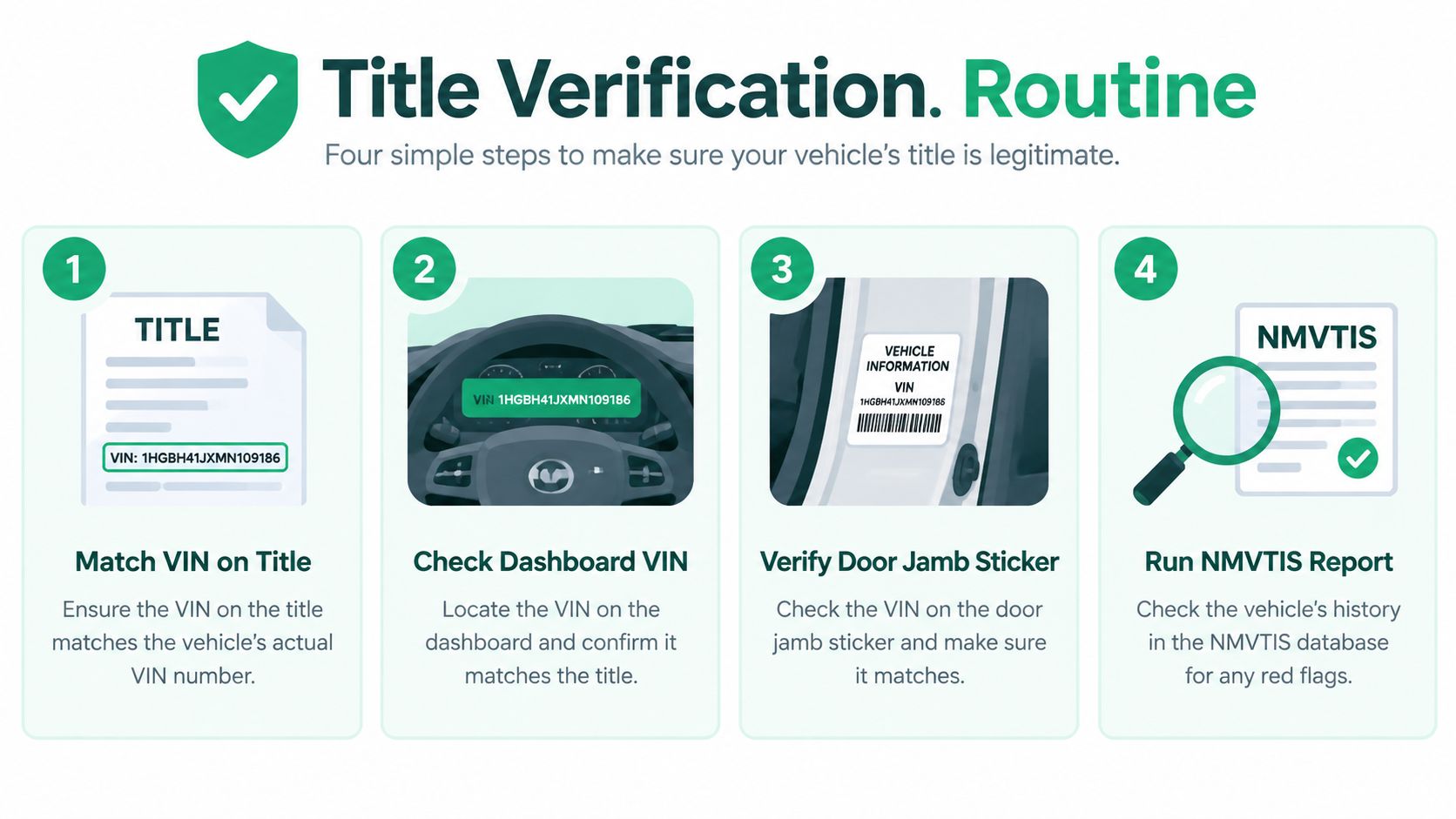
VIN cloning creates a separate risk. In a cloned-vehicle scheme, someone may use the identity of a legitimate vehicle on a different car. Matching the VIN across the title, dashboard, and door-jamb label helps detect inconsistencies, but a report and physical inspection are still necessary.
Oklahoma's consumer guidance illustrates why the absence of a brand matters, while legal commentary also advises buyers to look for entries such as insurance loss or recovered theft loss even when a title appears green (Oklahoma used-vehicle title advice). For a second layer of review, run a VIN history check for a used Honda Civic and compare its results with the seller's paperwork.
Checking Title Status Before You Buy or Register
Use a repeatable process instead of relying on a color impression. The goal is to make the title, the vehicle, the VIN report, and the registration record tell the same story.
Match the VIN everywhere. Compare the number on the physical title with the dashboard plate and door-jamb sticker. Look for mismatched characters, damaged fasteners, altered labels, or signs that a plate has been replaced.
Read a NMVTIS report line by line. Don't stop at a summary that says the vehicle has no current brand. Review title events, salvage entries, prior states, theft records, mileage issues, and dates. A report from VinCheck's Toyota Camry VIN check is one available way to investigate VIN-linked records.
Compare more than one record. A NMVTIS report can be paired with a commercial history report such as Carfax or AutoCheck, along with maintenance invoices, inspection paperwork, and auction photos when available. Differences between records deserve an explanation before money changes hands.
Ask for prior paperwork. Request previous titles and out-of-state documents when the seller says the vehicle moved between jurisdictions. If the seller can't explain a gap in ownership or title history, treat that gap as a reason to pause.
Confirm registration requirements. Before paying, contact the DMV in the state where you'll register the vehicle. Ask whether the current title is acceptable, whether any prior brand affects registration, and whether additional inspection documents are required.
A green title is a clue. The VIN history, physical inspection, and state registration review provide the decision.
Don't let a seller pressure you into skipping these checks because the title is green. A legitimate seller should allow reasonable verification, and a mismatch between the paper, the VIN, and the history is enough reason to delay the purchase.
Putting the Green Title Idea Together
Use three layers to interpret any green title.
First, identify the local meaning. Confirm how the issuing state uses color and whether green is its standard unbranded document. Don't apply another state's color chart automatically.
Second, inspect the title itself. Read every brand field, notation, lien entry, mileage entry, and ownership detail. The printed wording overrides your assumption about the paper color.
Third, check the VIN history. Look for prior title states, salvage or rebuilt events, flood and theft records, mileage inconsistencies, and other indicators that the current document doesn't show clearly.
When all three layers agree, the vehicle has a more credible clean-title profile. When they conflict, stop and investigate. A green title paired with a prior salvage record isn't automatically proof of fraud, but it is not the same risk profile as a vehicle with a consistent unbranded history.
The repeatable rule is straightforward: green means current unbranded status, not guaranteed lifetime cleanliness. Treat the color as the first question, not the final answer. If the seller's story, title wording, VIN numbers, or history records don't line up, postpone the transaction or walk away.
VinCheck can help you review VIN-linked title brands, salvage and flood records, theft status, mileage issues, recalls, liens, and prior sales or auction activity in one report. Visit VinCheck before you buy or register a vehicle, and compare the report with the physical title and the vehicle in front of you.
About the author
VinCheck Editorial Team — Editorial Standards & Review
The VinCheck Editorial Team reviews every published article against NMVTIS data accuracy and NHTSA recall validity. This byline appears on collaborative pieces and quick-update posts.