 Vin
VIN History Report Free: What You Get (and What You Miss)
By VinCheck Editorial Team, Editorial Standards & Review · Published 2026-09-25 · Updated 2026-09-25 · Reviewed by VinCheck Editorial Standards
A free VIN history report is a limited screening tool, not a complete vehicle history. It may show theft or salvage flags, but it typically omits accident, ownership, and detailed title history that paid reports provide.
The popular advice is usually wrong in one of two ways. Some guides dismiss every free check as useless, while others treat a clean result as proof that a car is safe to buy. Both positions can cost you money. A free VIN check has a practical job: quickly identify obvious risk before you spend more time or money. It doesn't replace a full report, an inspection, or a careful conversation with the seller.
A VIN connects records across databases and markets, giving buyers a way to compare the seller's description with documented events. The standard VIN is 17 characters long, and a history report can follow a vehicle from manufacture through ownership, sales, accidents, service events, and other recorded milestones (Car and Driver explains how to read a vehicle history report). The important question isn't whether the report is free. It's which records the free result exposes.
Table of Contents
- Why Free VIN Reports Are Not Full History Reports
- What Data Is Typically Included in a Free VIN Check
- Free Reports vs Paid NMVTIS-Grade Reports Explained
- Where to Get a Free VIN History Report
- Key Limitations Buyers Must Understand
- When to Upgrade From a Free Report
Why Free VIN Reports Are Not Full History Reports
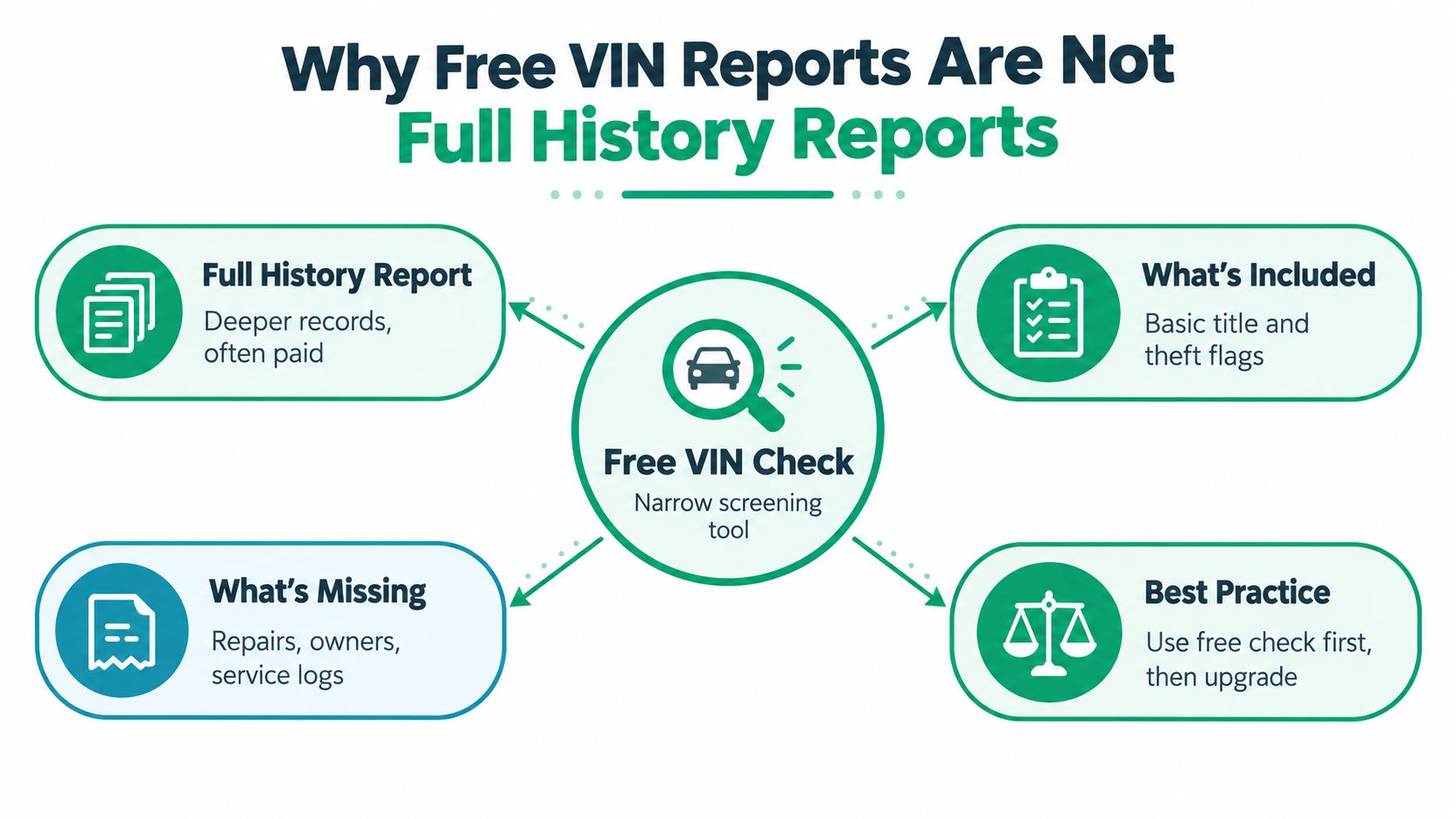
A free report doesn't mean a full report at no cost. In most cases, “free” describes a narrow access layer designed to return basic identification and selected risk signals. It can help you decide whether a vehicle deserves further investigation, but it usually can't establish that the vehicle has a clean ownership, accident, repair, or maintenance history.
That distinction matters because missing information is not the same as a clean record. A free result may fail to show an event because the source doesn't collect it, the event wasn't reported, or the vehicle moved through a jurisdiction with different record coverage. Treating silence as proof is how buyers end up defending a purchase they should have questioned.
The right mental model
Think of a free VIN history report as a filter, not a verdict. It can help answer, “Is there an obvious reason to stop?” It usually can't answer, “Has this car been properly repaired, consistently maintained, and accurately represented?”
A useful first pass should help you confirm:
- Vehicle identity: The VIN matches the advertised year, make, model, and configuration.
- Basic risk flags: The result doesn't immediately show a theft or salvage concern.
- Seller consistency: The information in the listing doesn't conflict with the available record.
Practical rule: A clean free result earns the vehicle a closer look. It doesn't earn the vehicle your deposit.
Paid access exists because deeper records require broader aggregation and interpretation. Accident entries, ownership history, mileage chronology, title events, service records, and auction activity often sit outside the narrow free preview. Buyers who understand that trade-off use free checks efficiently instead of expecting them to perform a job they weren't built to do.
What Data Is Typically Included in a Free VIN Check
Most free VIN checks begin with vehicle decoding. The VIN can identify the vehicle's year, make, model, trim, engine, and manufacturing details, depending on the service and the records available. That information is useful, but it isn't history. A decoded specification tells you what the vehicle was built as, not how it was used or what happened to it afterward.
A free check may also expose selected theft or salvage indicators. These are valuable because they can eliminate a vehicle before you arrange an inspection, travel to see it, or negotiate over a car with a serious title problem. The Toyota Camry VIN check example illustrates the kind of vehicle-identification workflow buyers commonly use before requesting deeper information.
Separate specifications from events
Use the result in layers rather than reading the headline as a final judgment.
- Decoded specifications confirm identity and equipment. They help catch a mismatched listing, but they don't prove condition.
- Theft signals may indicate that the vehicle appears in a participating theft database. A result without a flag still depends on the source's coverage.
- Salvage signals can point to a serious loss or branded status. That should trigger title verification and a physical inspection.
- Recall information can identify safety actions tied to the vehicle, but recall verification should come from the manufacturer or the official NHTSA VIN lookup.
The free layer is intentionally fast. It gives consumers an inexpensive way to screen several candidates and remove the obvious bad options. It isn't designed to reconstruct the vehicle's ownership trajectory, document every repair, or verify that the seller disclosed prior collision damage.
What usually stays outside the preview
Free tools commonly restrict accident detail, prior-owner context, mileage history, title chronology, service entries, and auction records. Some services offer only a decoded specification page or a limited signal from a particular database. Others bundle a preview with a paid report, which can make the word “free” sound broader than it is.
Read the result for what it says, not for what you hope it means. If it lists only vehicle specifications and a few flags, you have received an identification and screening result. You haven't received evidence that the car's complete past is uneventful.
Free Reports vs Paid NMVTIS-Grade Reports Explained
The meaningful difference is data depth. A free check may answer whether a narrow signal appears. A paid NMVTIS-grade report can consolidate title and brand information from state records, latest reported odometer readings, theft information when available, and brand events such as junk, salvage, flood, or total loss (the U.S. Department of Justice explains NMVTIS consumer data).
That broader view matters because title and odometer records affect more than resale conversations. A branded title can complicate insurance and reduce buyer demand. An odometer inconsistency can undermine the vehicle's stated mileage and raise questions about custody, wear, and valuation. The report doesn't replace a mechanic, but it gives the mechanic and buyer a better starting point.
Coverage at a glance
| Data Type | Free Report | Paid NMVTIS Report |
|---|---|---|
| VIN decoding | Commonly included | Included, with broader history context |
| Theft signals | May include selected flags | Theft history when available in the underlying records |
| Salvage indicators | May show a basic flag | Brand events and title context from participating state records |
| Title history | Often narrow or unavailable | Current and previous state title records, issue dates, and brands |
| Odometer history | Often absent or limited | Latest reported odometer readings and potential discrepancies |
| Accident history | Commonly limited or absent | May be available through additional datasets, but coverage varies |
| Repair and maintenance history | Usually absent | Not contained in core NMVTIS data |
| Recall verification | May provide a lookup link or limited result | Still requires manufacturer or NHTSA confirmation |
NMVTIS is strongest at title and brand validation, not complete mechanical diagnosis. Government guidance makes clear that NMVTIS doesn't contain repair history. That means even a paid report can show a clean title while the vehicle still has unresolved mechanical or post-collision problems.
Why the upgrade changes the decision
A free report can tell you to pause. A deeper report can reveal whether the pause concerns a branded title, a mileage conflict, a prior state record, or a total-loss event. That distinction gives you something concrete to verify with the seller, state agency, insurer, or independent inspector.
Don't buy a report because the label sounds all-inclusive. Buy it when the missing records could change your decision. For a vehicle with a complex history, a report that exposes title chronology and odometer context is far more useful than a simple "no flag found" result.
Where to Get a Free VIN History Report
Start with the VIN itself. Don't rely on a seller's screenshot, a copied listing, or a partial number. Match the VIN on the dashboard, door label, title, and listing before entering it into any service. A mismatch is a reason to stop and ask questions before you evaluate the car.
Use the free result as a screening sequence
- Decode the vehicle. Confirm the displayed year, make, model, trim, engine, and other identifying details against the car in front of you.
- Check obvious flags. Look for theft, salvage, flood, or total-loss signals where the service exposes them.
- Verify recalls separately. Use the manufacturer's system or NHTSA because a general history result isn't a substitute for recall verification.
- Ask for the missing record layer. If the seller claims one owner, regular service, or no damage, ask for documentation that supports the claim.
- Upgrade when the decision depends on hidden history. Don't let a free preview carry the burden of a complete purchase decision.
Standalone tools aren't the only source of free access. Dealerships and marketplaces increasingly attach history reports to listings, which makes screening easier but doesn't guarantee broad coverage. Read the report's data categories and provider notes. A report supplied with a listing may still expose only selected records.
For a second model-specific example, review the Honda Civic VIN check page to see how a free lookup can begin with identification before deeper review. If a service offers a trial or paid upgrade, inspect the cancellation terms and recurring billing language before entering payment details.
This short video shows how a VIN lookup can fit into an initial vehicle check:
The source matters as much as the result. NICB's free VINCheck, for example, is limited to theft and salvage signals from participating insurers and is explicitly not a full vehicle history report (NICB's consumer guidance). That makes it useful for fast elimination, not a reason to skip title research, an inspection, or a deeper report.
Key Limitations Buyers Must Understand
The most dangerous free-report mistake is confusing no visible record with no underlying problem. Free services may not collect repair history, complete ownership transfers, auction activity, lien information, or every state event. A vehicle can look clean in a narrow result and still have damage that never entered that particular database.
Repair history is a major blind spot. NMVTIS itself doesn't contain repair records, so a paid NMVTIS-backed report cannot prove that every repair was completed correctly. You still need service documentation, a physical inspection, and a scan for mechanical or electrical faults.
The blind spots that create false confidence
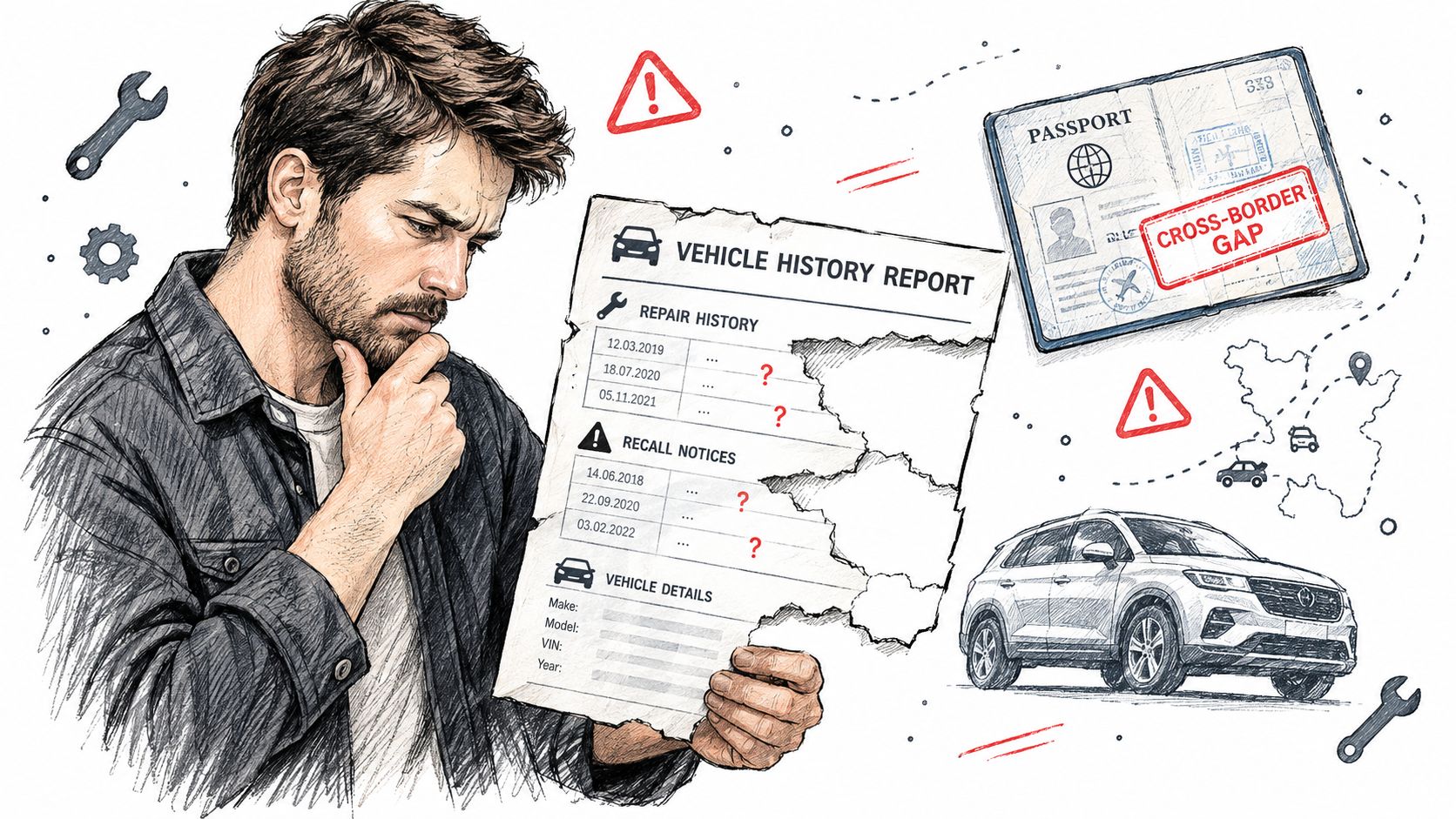
- Repair omissions: A report may not show bodywork, private repairs, or maintenance performed by a shop that didn't contribute data.
- Recall gaps: A history report isn't the final authority for open safety recalls. Check the manufacturer or NHTSA system directly.
- Cross-border fragmentation: A vehicle that moved between countries or jurisdictions may carry records that don't transfer cleanly into one database.
- Older-vehicle uncertainty: Older cars often have longer, less consistent ownership and service trails, making missing entries harder to interpret.
- Vehicle-type differences: Commercial, fleet, auction, rebuilt, and imported vehicles can have records distributed across different systems.
Why title cleanliness isn't enough
A title record is evidence about legal status and branding. It isn't a mechanical inspection. A clean title doesn't guarantee straight structure, functioning safety systems, correct mileage, or adequate maintenance. Conversely, a branded title doesn't tell you every detail of the damage or repair quality, so it requires careful follow-up rather than an automatic assumption about condition.
Cross-border searches deserve particular caution. Records may be fragmented when a vehicle changes jurisdictions, and an event absent from one source may appear in another. Ask where the vehicle was previously registered, request supporting documents, and compare the seller's timeline with every available record.
Missing data should lower your confidence, not raise it.
When to Upgrade From a Free Report
Upgrade when the vehicle's history could materially change your decision. That includes a car with a reported title issue, inconsistent mileage, a cross-border past, unclear ownership, auction exposure, or a seller who won't provide documentation. It also applies when you're buying for business use, planning to resell, or putting substantial savings into the purchase.
Consider two buyers. The first checks a free result on a used pickup, sees no theft or salvage flag, and assumes the truck is ready. The seller's description sounds plausible, but the buyer never verifies the title chronology or mileage. A deeper report later reveals a record conflict that changes the truck's value and raises questions about insurance. The free check didn't fail. The buyer asked it to answer a question it wasn't designed to answer.
The second buyer uses the free check to eliminate obvious risks, then upgrades before committing because the truck's ownership history is unclear. The paid report doesn't replace an inspection, but it gives the buyer a clearer record trail to discuss with the seller and mechanic. That is the correct sequence: screen first, investigate second, inspect before purchase.
Use these decision triggers
- Unclear provenance: The seller can't explain where the vehicle was registered or used.
- Brand-sensitive purchase: You need predictable insurance and resale treatment.
- Mileage-sensitive vehicle: The asking price depends heavily on low mileage.
- Potentially complex damage: The listing mentions repairs, rebuilding, flood exposure, or auction history.
- High-consequence use: A failure would affect work, family transport, or fleet operations.
For a truck-specific starting point, the Ford F-150 VIN check example can help you begin with identification before deciding whether deeper research is warranted. Don't negotiate around an unknown history. Verify the VIN, review the available records, obtain the deeper report when the risk justifies it, and pay for an independent inspection before signing.
VinCheck provides a free VIN check for initial vehicle identification and screening, while its broader reporting tools can help surface accident, title, salvage, theft, mileage, recall, lien, and auction information. Start with the free result, then visit VinCheck to review whether the vehicle needs a more complete history check before you buy.
About the author
VinCheck Editorial Team — Editorial Standards & Review
The VinCheck Editorial Team reviews every published article against NMVTIS data accuracy and NHTSA recall validity. This byline appears on collaborative pieces and quick-update posts.