 Vin
VIN Decoder VIN Number Year Chart Guide
By VinCheck Editorial Team, Editorial Standards & Review · Published 2026-10-04 · Updated 2026-10-04 · Reviewed by VinCheck Editorial Standards
Which character in a VIN tells you the model year, and can that one character really tell you whether a used vehicle is old or relatively recent? The answer is useful, but incomplete. The 10th character identifies the model year code, yet the same code can represent different years because the system repeats.
A VIN decoder VIN number year chart gives you the first answer quickly. A careful lookup goes further by checking the full VIN, resolving the 30-year overlap, handling invalid or incomplete entries, and separating the vehicle's factory identity from its later history. The guide below walks through that process in plain language.
Table of Contents
- Which VIN Character Tells You the Model Year
- How the 17-Character VIN Is Structured
- Why the Year Code Repeats Every 30 Years
- Reading the Year Chart From 1980 to 2039
- VIN Number Year Chart Quick Reference
- When the Year Code Alone Is Not Enough
- Decoding a VIN With VinCheck in Three Steps
- From Year Code to Full Vehicle History
- Common VIN Decoder Errors and How to Fix Them
- Special Cases for Classic Cars and Imports
- Your 30-Second VIN Year Lookup Checklist
Which VIN Character Tells You the Model Year
Which character in a 17-character VIN tells you the model year? The 10th character. Count from the left, including every letter and digit, and the character in position 10 is the model year code.
The model year isn't necessarily the calendar year when the vehicle was assembled. Automakers can build a vehicle before its designated model year begins, so a vehicle assembled near the end of one calendar year can carry the next model year. The VIN year code describes the vehicle's model year, not automatically its assembly date or the date when the first owner registered it. VIN year chart guidance centers the lookup on position 10 for that reason.
Finding the position without losing count
Start at the first character on the left and count one character at a time:
- Positions 1 through 9 come before the year code.
- Position 10 is the model year character.
- Positions 11 through 17 follow it.
The year code is a single letter or digit from a restricted set. No other VIN position replaces position 10 as the standard model year location in a modern VIN. That makes the first step simple, even before you use a decoder.
A VIN with the letter C in position 10 points to 1982 or 2012, not one uniquely identified year. That example shows why reading the character is only the beginning. You need the chart, and you may need supporting information from the rest of the VIN or a trusted decoder to determine which cycle applies.
Practical rule: Read position 10 first, but don't treat it as a complete vehicle history or an automatically unique year.
How the 17-Character VIN Is Structured
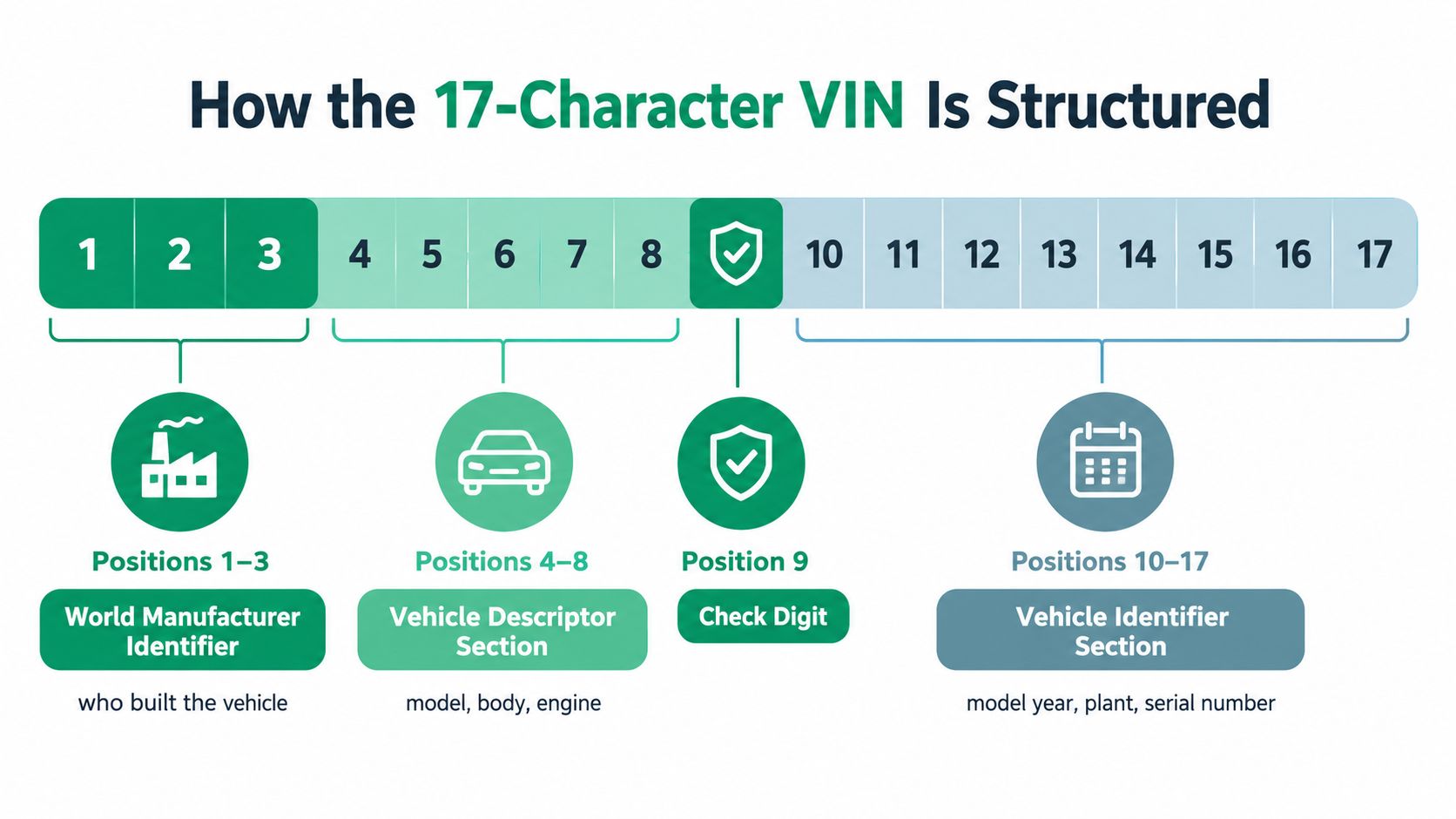
How can one string of letters and numbers describe a vehicle? Read the VIN in three zones, then inspect each position for its specific job.
The first zone is the World Manufacturer Identifier, or WMI, in positions 1 through 3. These characters identify the manufacturer and the geographic identity assigned to the VIN. They provide the starting point for identifying who built the vehicle.
Positions 4 through 9 form the Vehicle Descriptor Section, or VDS. The manufacturer uses this zone to encode details such as the vehicle line, body style, engine, and restraint system. Position 9 has a separate role in standard North American VIN processing. It serves as the check digit, helping validate the VIN rather than describing a vehicle feature.
The final zone is the Vehicle Identifier Section, or VIS, in positions 10 through 17. Position 10 carries the model year code, position 11 identifies the assembly plant under the manufacturer's coding system, and positions 12 through 17 give the vehicle's serial sequence.
Practicing with a labeled VIN
Use this example:
1HGCM82633A123456
Count from left to right:
| Position | Character | Function |
|---|---|---|
| 1–3 | 1HG | World Manufacturer Identifier |
| 4–8 | CM826 | Vehicle Descriptor Section |
| 9 | 3 | Check digit position |
| 10 | 3 | Model year code |
| 11 | A | Plant code position |
| 12–17 | 123456 | Serial sequence |
The key habit is counting accurately. In this example, the 3 in position 10 is the character you compare with a VIN year chart. The remaining characters help a decoder identify the vehicle and clarify uncertain results, but they do not shift the model year to another position.
Why the Year Code Repeats Every 30 Years
The modern VIN system became standardized for model year 1981 and newer vehicles, and the familiar 17-character format is used by NHTSA VIN tools and related standards. The year position doesn't have an unlimited alphabet. VIN rules exclude characters that could be confused with other characters or that aren't permitted in the year position.
The excluded characters are I, O, and Q, which can resemble digits or other letters. The year position also excludes U, Z, and 0. The remaining usable set contains 30 symbols, so the model year codes repeat on a 30-year cycle. The VIN year-code structure explains why chart references pair years across that cycle.
How the sequence moves
The pattern starts with letters, then changes to digits:
- Letters represent the earlier part of the cycle.
- Digits 1 through 9 represent model years from 2001 through 2009.
- Letters begin again for the next cycle.
- Digits return for model years from 2031 through 2039.
The clearest pairing is A = 1980 and 2010. The letter itself doesn't change between those model years. A VIN containing A in position 10 therefore needs context before you can say which year applies.
This design is compact, but it creates a predictable trap for buyers. A chart can translate the code correctly and still leave two possible years. The chart isn't defective. It was designed to repeat, which means the buyer must verify the cycle rather than assume that the first listed year is correct.
Reading the Year Chart From 1980 to 2039
What does the tenth character tell you? Read the chart as two parallel cycles. The first runs from 1980 through 2009, and the second repeats the same codes from 2010 through 2039. A published VIN year reference presents the codes as paired years, so the character provides a starting point rather than a complete answer.
The sequence begins with letters. A identifies 1980, B identifies 1981, and the permitted letters continue in order. The year position skips I, O, Q, U, and Z, which can be confused with other characters or are not used in this position. The letter Y means 2000 in the first cycle, not 1989 or 2039.
Digits follow the letter block. 1 through 9 identify model years 2001 through 2009, then return in the later cycle for 2031 through 2039. A VIN with 1 in position 10 can therefore indicate 2001 or 2031.
The repeated pattern at a glance
Use these pairs as memory anchors:
- A means 1980 or 2010.
- B means 1981 or 2011.
- C means 1982 or 2012.
- Y means 2000 or 2030.
- 1 means 2001 or 2031.
- 9 means 2009 or 2039.
The chart works like a lookup key. It matches position 10 to possible model years, but it does not inspect the vehicle, title, assembly date, or documents. For a VIN from before 1981, the standard 17-character chart may not apply. A misread character or decoder error message also requires checking the VIN and vehicle records, rather than forcing a chart result.
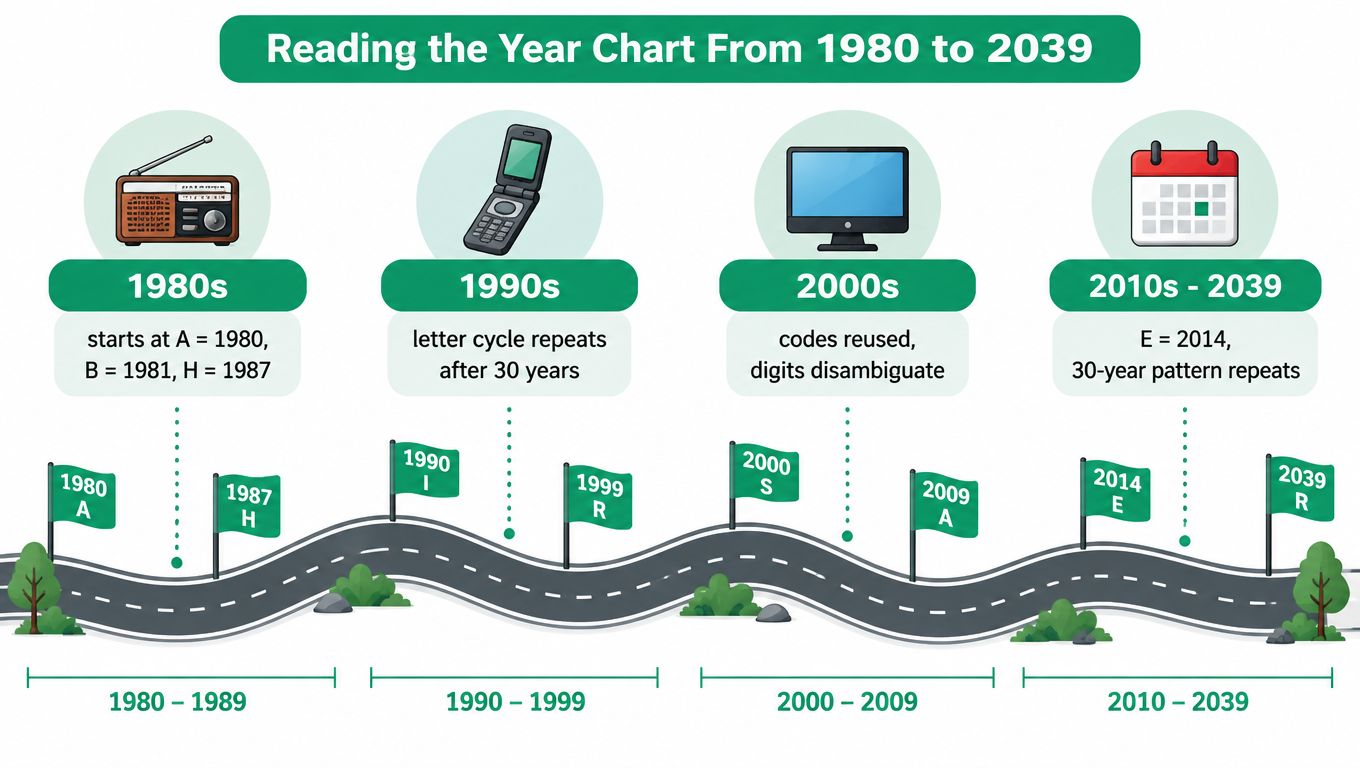
For example, 1 could describe a 2001 or 2031 model. Manufacturer information, plant coding, documents, and a VinCheck lookup can help resolve that ambiguity. VinCheck's free decoder and full history report provide a practical next check after you read the code yourself.
VIN Number Year Chart Quick Reference
The table below is designed for quick use. Find the character in position 10, then compare the two possible model years. The two columns make the 30-year repeat visible without requiring you to reconstruct the sequence.
| 10th Character | Model Year 1980–2009 | Model Year 2010–2039 |
|---|---|---|
| A | 1980 | 2010 |
| B | 1981 | 2011 |
| C | 1982 | 2012 |
| D | 1983 | 2013 |
| E | 1984 | 2014 |
| F | 1985 | 2015 |
| G | 1986 | 2016 |
| H | 1987 | 2017 |
| J | 1988 | 2018 |
| K | 1989 | 2019 |
| L | 1990 | 2020 |
| M | 1991 | 2021 |
| N | 1992 | 2022 |
| P | 1993 | 2023 |
| R | 1994 | 2024 |
| S | 1995 | 2025 |
| T | 1996 | 2026 |
| V | 1997 | 2027 |
| W | 1998 | 2028 |
| X | 1999 | 2029 |
| Y | 2000 | 2030 |
| 1 | 2001 | 2031 |
| 2 | 2002 | 2032 |
| 3 | 2003 | 2033 |
| 4 | 2004 | 2034 |
| 5 | 2005 | 2035 |
| 6 | 2006 | 2036 |
| 7 | 2007 | 2037 |
| 8 | 2008 | 2038 |
| 9 | 2009 | 2039 |
Excluded characters: I, O, Q, U, Z, and 0 don't appear as valid model year codes in the standard year position. A code that appears unclear or invalid deserves a second look at the VIN itself, especially if the character was read from a worn plate or a low-quality photograph.
When the Year Code Alone Is Not Enough
The most important limitation of a VIN year chart is ambiguity. A code such as A, B, or D can represent two model years separated by 30 years. The chart gives you candidates, not always a final answer.
The rest of the VIN supplies useful context. The WMI in positions 1 through 3 identifies the manufacturer and geographic assignment, which can make one candidate unlikely if the brand or vehicle line didn't exist in that form during that period. The VDS in positions 4 through 9 can identify body, engine, or restraint details that you can compare with manufacturer documentation.
Three clues that narrow the result
The plant code in position 11 offers another check. It doesn't independently display a complete build date, but it can help a decoder or experienced researcher connect the VIN to a manufacturer's production information. Positions 12 through 17 provide the serial sequence, which can also help place the vehicle within a production run.
Physical and documentary evidence matters too. Compare the candidate year with the vehicle's design, equipment, data plate, title, and registration. A compact modern vehicle with a code that could mean 1980 or 2010 needs more investigation before you record the year.
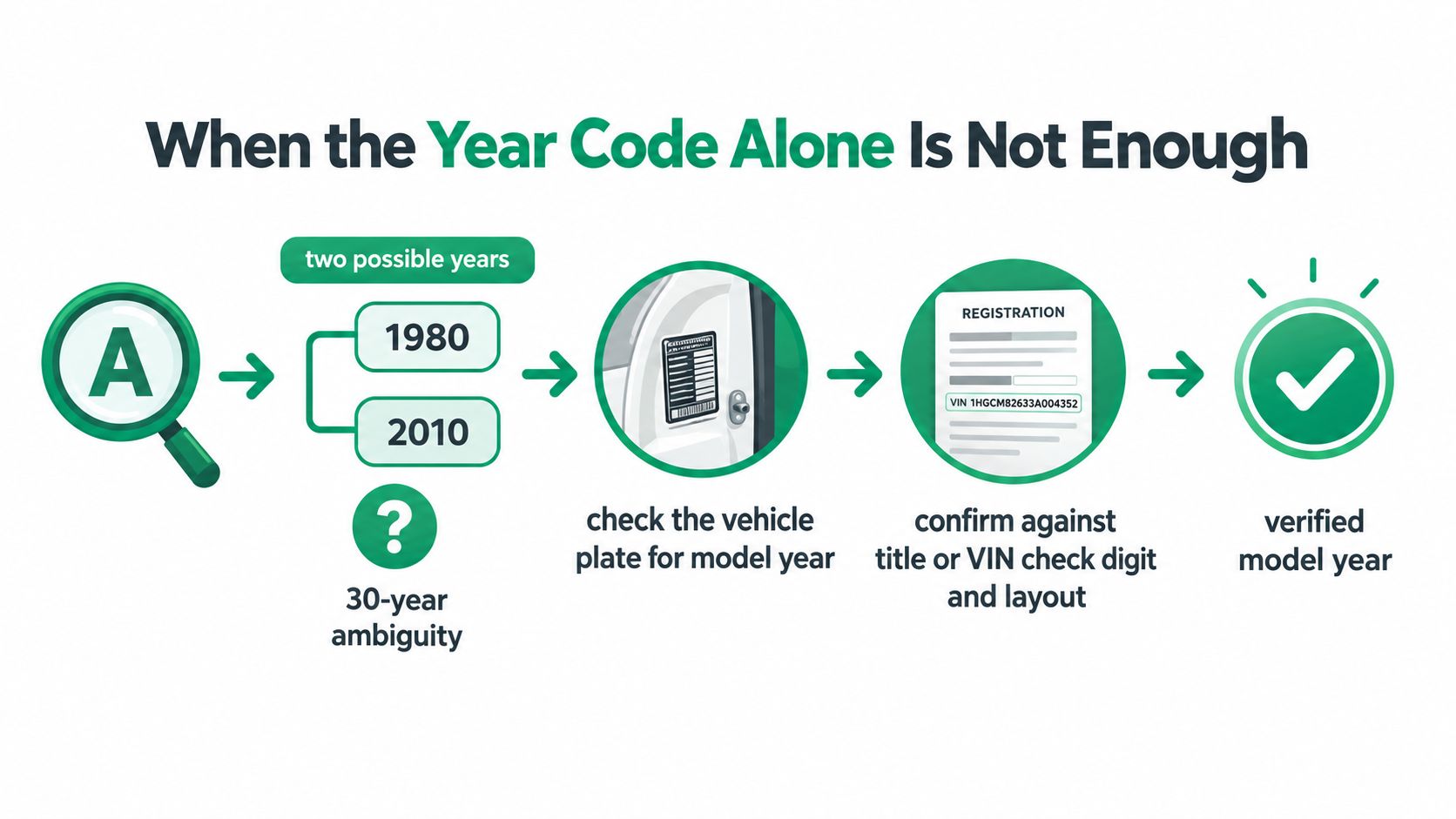
A decoder can combine these fields and return the model year alongside make, model, engine, and plant information. That doesn't make the chart unnecessary. It gives you a way to check whether the character you read was entered correctly and whether the chosen cycle fits the complete VIN.
The chart translates one character. The complete VIN supplies the context that makes the translation useful.
Decoding a VIN With VinCheck in Three Steps
Need to confirm a vehicle's model year before reviewing its history? VinCheck's free decoder can connect the position 10 year code with the rest of the VIN. Enter the complete VIN, because a single character cannot identify the vehicle by itself.
Step 1: Find the VIN field
Open the VinCheck VIN decoder and locate its search field. Copy the VIN from the dashboard, driver-side door area, registration document, or another trusted vehicle record. If the number comes from a photograph, compare it with the physical VIN when possible. A clear original source helps prevent one misread character from changing the result.
Step 2: Enter all characters carefully
Paste or type the full 17-character VIN, then check for transposed characters. Inspect markings that may resemble one another, including 3 and 8, 1 and 7, or a letter and digit in a worn stamping. Submit the search only after the complete sequence appears in the field.

Step 3: Compare the decoded result
Read the result panel and compare its model year with your position 10 chart reading. The output may also show the make, model, trim, engine type, transmission, drive type, and assembly plant. For a model-specific example, review a 2024 Toyota Camry VIN check.
A decoder can clarify a 30-year year-code repeat, flag an invalid entry, or show why a pre-1981 VIN does not fit the modern chart. If the displayed year conflicts with your manual reading, recheck every character and the vehicle documents.
The free decode provides specifications. A full vehicle history report examines separate records, including accidents, titles, mileage, liens, and theft.
From Year Code to Full Vehicle History
A year code tells you what model year the VIN is designed to represent. A specification decode tells you more about what the manufacturer built. Neither one, by itself, tells you what happened after the vehicle left the factory.
A full history report can add records such as:
- Accident and damage records: Review reported collisions, damage events, and salvage-related entries.
- Title brands: Look for salvage, rebuilt, flood, or lemon designations.
- Mileage anomalies: Compare recorded mileage and note inconsistencies identified through title or inspection records.
- Liens: Check for an active financial interest that could interfere with a clean transfer.
- Theft and recovery entries: Review theft or recovery information connected with available state and national records.
The model year still matters when you interpret the report. Older vehicles can have less complete digital reporting, while vehicles with more recent records may offer a broader sequence of title, mileage, auction, or damage entries. Sparse results don't automatically prove a clean history, just as a long record doesn't automatically prove that every event was severe.
Use the VinCheck vehicle history report for a 2023 Ford Mustang as the next type of lookup after confirming the VIN and model year. The sensible order is identification first, history second, and physical inspection before purchase.
Common VIN Decoder Errors and How to Fix Them
A decoder can reject a VIN for several different reasons. The message matters because each error points to a different correction. NHTSA's vPIC API documentation describes validation issues involving incorrect model years, invalid characters, incomplete VINs, and conflicts between the year position and valid year codes.
| Error Message | Likely Cause | How to Fix |
|---|---|---|
| Incorrect Model Year Displayed | The year code in position 10 was misread, or the selected 30-year cycle doesn't fit the VIN | Count to position 10 again, compare the character with the chart, and review the full decoder result |
| Invalid Character Detected | The entry contains a prohibited or misread character, such as I, O, or Q | Compare the VIN with the dashboard plate and door label, then request a corrected VIN from the seller or relevant authority |
| Incomplete VIN Error | Characters are missing from the submitted string | Obtain the complete VIN and enter it without spaces or omitted characters |
| Check Digit Mismatch | A character may have been mistyped, or the VIN may not follow the expected standard | Re-enter the VIN carefully and confirm it against the vehicle and manufacturer records |
Read the message literally
Don't fix an invalid-character message by guessing. A worn 0 can easily be mistaken for a letter, and a handwritten VIN may contain a transcription error. Ask the seller to provide a clear image of the stamped or mounted VIN and compare it with the paperwork.
If the decoder says the model year is inconsistent, check whether you accidentally counted from zero, skipped a character, or used the wrong year column. If the vehicle was not registered for U.S. sale or importation, decoded information may also be incomplete or inaccurate, so imported vehicles need additional verification.
Special Cases for Classic Cars and Imports
A standard VIN year chart isn't universal for every vehicle. NHTSA's modern VIN tools focus on model years 1981 and forward, and pre-1981 vehicles can fall outside the 17-character system. NHTSA's public decoder interface reflects that boundary, so an older VIN may be rejected rather than decoded incorrectly.
A classic vehicle with an older VIN
A classic vehicle from before the modern standard may have a shorter, manufacturer-specific identification format. It may not have a 10th-position year code at all. In that situation, compare the data plate, trim tag, title documents, and manufacturer's vintage VIN references. Don't insert characters or force the old identifier into a modern chart.
A gray-market import
A gray-market import can present a different problem. The VIN may have been issued under the destination country's system or assigned by an importer, and the available database may contain fewer records. The year shown in a document may refer to manufacture, model designation, importation, or legalization, so confirm what each date means.
A recognized import can still return useful records, but gaps deserve attention rather than automatic reassurance. For a vehicle such as a Chevrolet Corvette VIN lookup, use the recognized VIN result as one part of verification and compare it with the physical identification plate and ownership documents.
Your 30-Second VIN Year Lookup Checklist
Use this sequence when you're standing beside a vehicle or reviewing a private-sale listing:
- Locate the VIN: Check the dashboard, driver-side door area, or registration card. Confirm that the modern VIN contains 17 characters and doesn't include I, O, or Q.
- Count to position 10: Read the single letter or digit in that position aloud.
- Match the chart: Find the code in the reference table and identify both possible model years. Use the make, plant, serial sequence, vehicle condition, and documents to resolve a 30-year overlap.
- Run the decode: Enter the full VIN into VinCheck and compare the returned year with your chart result. If the results disagree, recheck the entry and the physical VIN.
- Check history before buying: Order a full report for accident, title, mileage, lien, theft, and recovery information. A year-code match can't reveal those records.
Never buy a used vehicle based on the chart match alone. The chart establishes a starting point, the decoder checks the complete identifier, and the history report helps you investigate what happened after manufacture.
VinCheck provides a free VIN decoder for confirming model year and vehicle specifications, plus full vehicle history reports for deeper checks. Visit VinCheck with the complete VIN, verify the 10th-position code, and review the available history before you commit to a used vehicle.
About the author
VinCheck Editorial Team — Editorial Standards & Review
The VinCheck Editorial Team reviews every published article against NMVTIS data accuracy and NHTSA recall validity. This byline appears on collaborative pieces and quick-update posts.