 Vin
Vehicle History Report for Classic Cars: Buyer Guide
By VinCheck Editorial Team, Editorial Standards & Review · Published 2026-09-09 · Updated 2026-09-09 · Reviewed by VinCheck Editorial Standards
A vehicle history report for classic cars is useful, but the most popular advice about it is wrong. A clean result doesn't prove that the car is authentic, original, accident-free, or even the same vehicle described by the seller. On an older car, “no records found” often means the digital trail is incomplete.
Treat the report as a screening tool, not a verdict. The job is a provenance investigation, combining title records, physical identifiers, factory documentation, restoration paperwork, and an inspection by someone who knows the marque. That approach takes more work, but it protects you from the classic-car risks that a modern VIN lookup can't see.
Table of Contents
- Why a Clean Report Does Not Mean a Clean Classic
- Structural Gaps in Classic Car History Data
- What a Classic Car History Report Actually Reveals
- Alternative Sources for Provenance and Authenticity
- Physical Identity Checks Every Buyer Must Perform
- Building a Layered Pre-Purchase Verification Workflow
- Non-Negotiable Checks Before You Sign the Title
Why a Clean Report Does Not Mean a Clean Classic
A modern history report is built around standardized identity data. Classic cars often predate that system, and their most important history may never have entered a digital database. A clean report can therefore mean only that no matching adverse record appeared in the reporting layer.
That distinction matters because classic buyers aren't purchasing transportation alone. They're paying for identity, originality, rarity, and documented continuity. An accident-free result doesn't establish that the engine is original, the body matches the chassis, the claimed options were factory-installed, or the car has remained the same vehicle throughout its life.
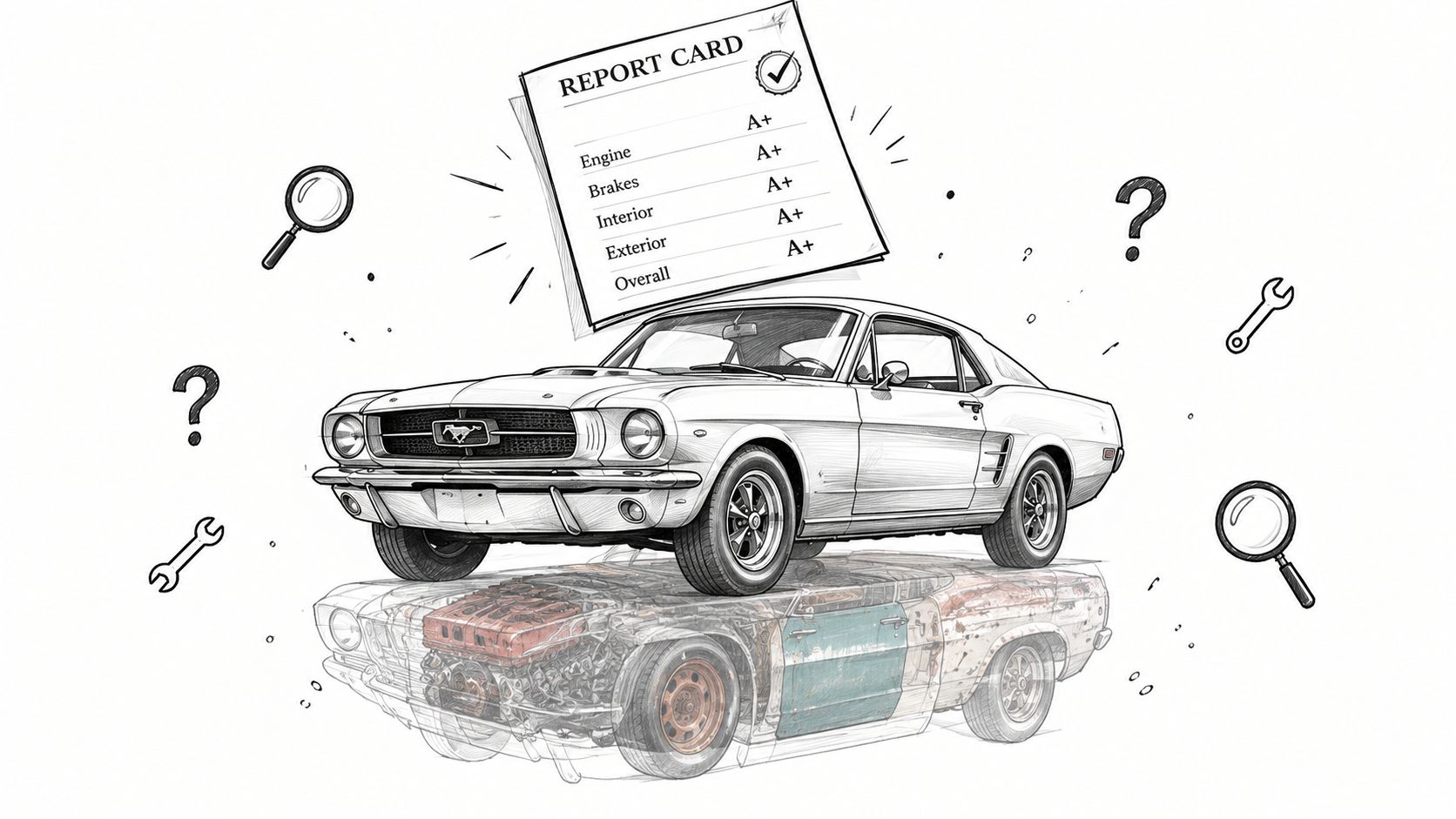
The database can be clean while the car remains unproven
Pre-1981 vehicles may use shorter or manufacturer-specific identifiers rather than the modern 17-character VIN. Records can also be fragmented between state title systems, paper files, private sales, restoration shops, and previous owners. If those events weren't digitized or linked to the identifier you searched, the report can't reveal them.
A seller who says, “The report is clean, so there's nothing to worry about,” is giving you a reason to slow down. Ask for photographs of every identification tag and stamping, copies of prior titles, restoration invoices, registration cards, and documents supporting the car's claimed specifications. If the seller refuses to provide basic evidence, the report shouldn't rescue the deal.
Practical rule: A clean report lowers concern about records it actually contains. It doesn't certify provenance that the database never received.
Reframe the purchase before you spend money
Start with the report to identify obvious problems, including branded titles, salvage records, theft indicators, and inconsistent title states. Then move to the car and its documents. A useful Corvette VIN research page can help you understand the kind of model-specific identification work required, but no lookup replaces inspection.
The right question isn't “Does this classic have a clean report?” Ask instead: “Do the digital records, paper trail, factory information, and physical car all tell the same story?” If they do, you have a defensible basis for buying. If they conflict, stop treating the report as reassurance and investigate the contradiction.
Structural Gaps in Classic Car History Data
Classic-car reports are thinner for structural reasons, not merely because a particular provider performed a weak search. The modern VIN system was standardized in 1981, and that standard created the familiar 17-character identifier used for consistent tracking in later vehicles. Cars built before that point may carry shorter or nonstandard numbers, which makes automated matching across state and insurance records much harder. SEMA's classic-car market report provides the broader market context for why these older records still matter.
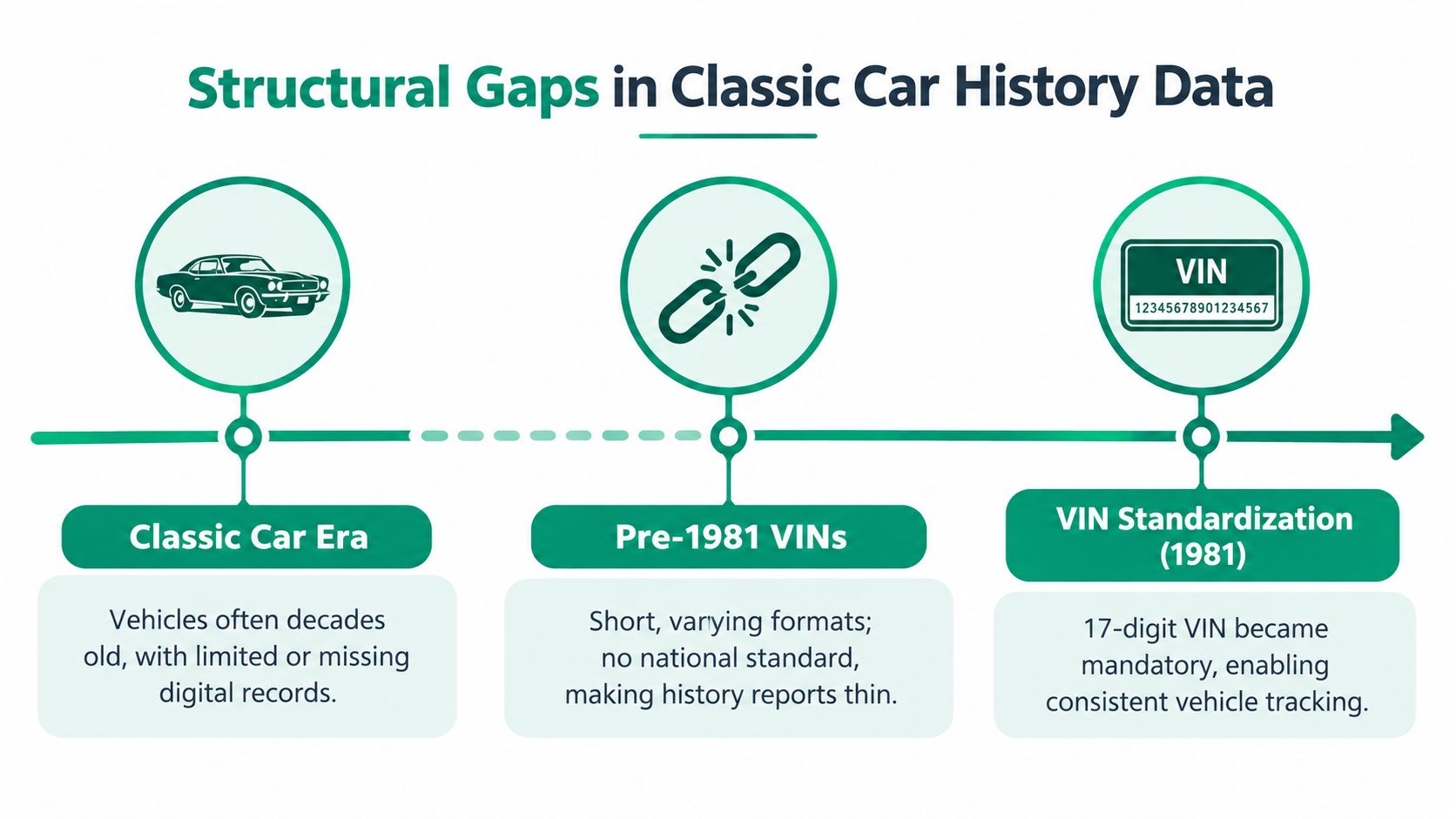
Why the identifier itself causes trouble
A modern VIN lookup expects a consistent format. A classic may instead require manual interpretation of a serial number, model-year convention, body designation, or manufacturer-specific sequence. One digit entered incorrectly can produce no result, while a component number may be mistaken for the legal identity number.
The problem gets worse when the car has changed states repeatedly. Older title records might not connect cleanly, and some available digital title data may reach back only to about 2000 or a few years earlier, depending on the state, as described in classic-car VIN data guidance. For a vehicle that spent decades changing hands before digitized records became common, that missing period should be treated as expected data loss, not proof of an uninterrupted history.
Mileage is especially unreliable
Mileage records deserve their own warning. Industry guidance notes that many states don't require odometer readings once a vehicle is 10 years old or older, so a classic-car report may show mileage as exempt or unknown instead of displaying a continuous numerical trail. A low number on the dashboard is therefore a claim that must be supported by invoices, registrations, inspection records, wear, and restoration documentation.
The market is large enough that these limitations have real consequences. SEMA estimated at least 9.4 million pre-1990 cars and trucks on U.S. roads, while UK historic and classic-vehicle research estimated a combined fleet of 3.01 million vehicles, comprising 1.54 million historic vehicles and 1.47 million classic vehicles, with sector turnover of £18.3 billion. These figures are documented in the Classic Cars report on historical vehicle information.
A thin report isn't automatically suspicious. A thin report combined with an unsupported seller story, mismatched identifiers, or missing paperwork is a serious problem.
What a Classic Car History Report Actually Reveals
A report still earns its place in the buying process. It can expose legal and insurance events that a polished restoration hides, and those findings can change whether you inspect the car at all. The key is to read each result as evidence with a defined scope, not as a complete biography.
In the United States, NMVTIS connects current and historical title information from participating state systems. Every state except Hawaii participates, and NMVTIS-linked reporting can often show title issuance, prior title states, title brands, salvage indicators, stolen or impounded status, and recorded odometer information. Progressive's classic-car VIN guidance also explains why older identifiers and physical locations require special attention.
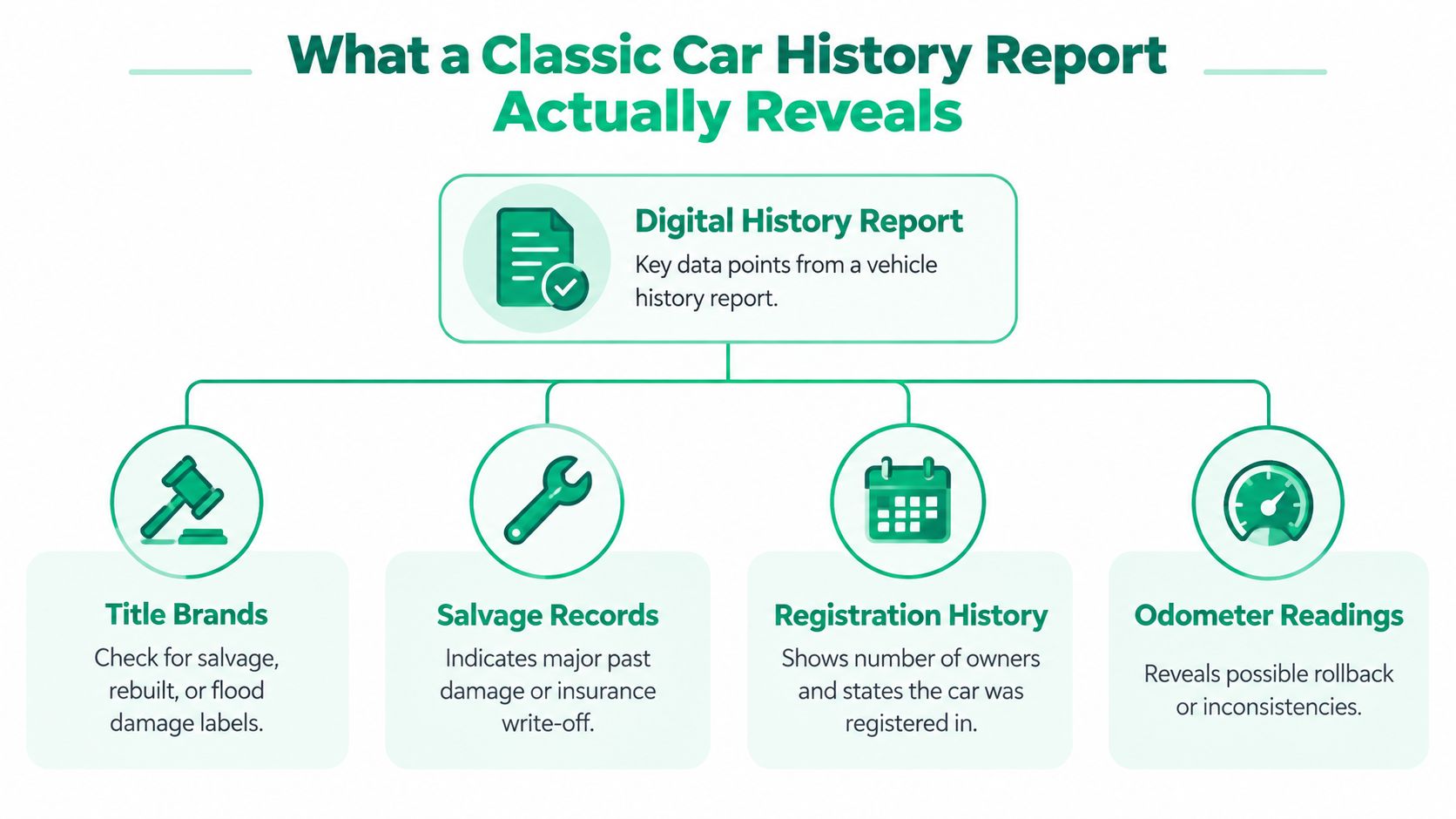
Read the adverse entries first
Don't begin with the ownership count or mileage display. Start with records that can make the car legally compromised, difficult to insure, or materially less collectible.
- Title brands: Salvage, junk, rebuilt, flood, or other brands require documentation and a realistic valuation. A later restoration doesn't erase the brand.
- Stolen or impounded status: These entries demand immediate clarification. Confirm the record relates to the vehicle you're examining and obtain evidence of lawful release or recovery.
- Prior title states: State movement can support the seller's story, but it can also reveal unexplained gaps or a path through jurisdictions known for fragmented records.
- Salvage-related records: Auction or salvage exposure may indicate major damage, even if the current title appears ordinary.
- Odometer entries: Treat recorded readings as checkpoints. They can expose an inconsistency, but a missing sequence doesn't prove a rollback.
A sample Ford Mustang VIN check can help you recognize the categories a digital report may present. It still won't establish factory originality or restoration quality.
Separate clean evidence from missing evidence
A clean title chain means the available records don't show a brand or adverse status. It doesn't mean every earlier title exists, every accident was reported, or every component is original. “No record” and “negative record” are not interchangeable.
Use the report to decide what deserves follow-up. If it shows a salvage, junk, stolen, or impound entry, pause the purchase until the identity and paperwork are independently verified. If it shows nothing, proceed to the evidence a database is least capable of supplying, factory records and the physical car.
Alternative Sources for Provenance and Authenticity
Digital history answers legal and administrative questions better than it answers collector questions. It may help identify title brands or stolen status, but it usually can't prove that a rare option was installed at the factory or that the engine still belongs to the chassis.
For that, build a source file around the marque. Factory and archive records may confirm build or dispatch details, original equipment, engine numbers, body numbers, and production specifications. Museum services, marque clubs, and specialist registries can help interpret those records, especially when the manufacturer's numbering system is unfamiliar.
| Source | What It Confirms | Best For |
|---|---|---|
| Marque-specific factory records | Build details, factory options, engine or body references, original equipment | Testing rarity and originality claims |
| Museum or manufacturer archive | Production or dispatch information, model-specific identifiers | Older cars with limited digital history |
| Owner club registry | Model conventions, known cars, expert interpretation | Resolving unusual tags, trims, and specifications |
| Restoration shop file | Work performed, replaced components, repair timeline, before-and-after evidence | Evaluating restoration scope and identity continuity |
| Prior-owner paperwork | Titles, bills of sale, registrations, service records | Bridging ownership and mileage gaps |
| Independent specialist inspection | Physical condition, stampings, structural repairs, restoration quality | Confirming that the current car matches the documents |
Ask the right question of each source
Don't request “everything.” Tell the archive exactly what you're trying to verify. Ask whether the supplied chassis number corresponds to the claimed model, whether the build date supports the seller's description, and whether the stated engine, body, trim, or options are consistent with factory information.
A club expert may know that a particular tag style changed during production. A restoration shop may have photographs showing when a body panel or frame was replaced. A prior owner may hold the missing registration card that connects two otherwise separate title records.
The documents don't need to be perfect to be useful. They need to corroborate one another. A factory record supports the specification, title copies support legal continuity, invoices support the restoration story, and physical inspection confirms that the evidence belongs to the car in front of you.
Provenance is a chain, not a single document
One factory certificate can't prove that every component remains original. One title can't prove that the car wasn't rebodied. One invoice can't prove the work was performed correctly. Confidence comes from agreement between independent sources.
When the seller claims an unusually rare specification, demand stronger documentation. The more the asking price depends on authenticity, the less acceptable a vague story becomes.
Physical Identity Checks Every Buyer Must Perform
A report searches records. It doesn't crawl under the car, inspect rivets, compare stamping depth, or notice that a body tag looks newer than the surrounding metal. Classic buyers must perform those checks in person or hire a specialist who understands the model.
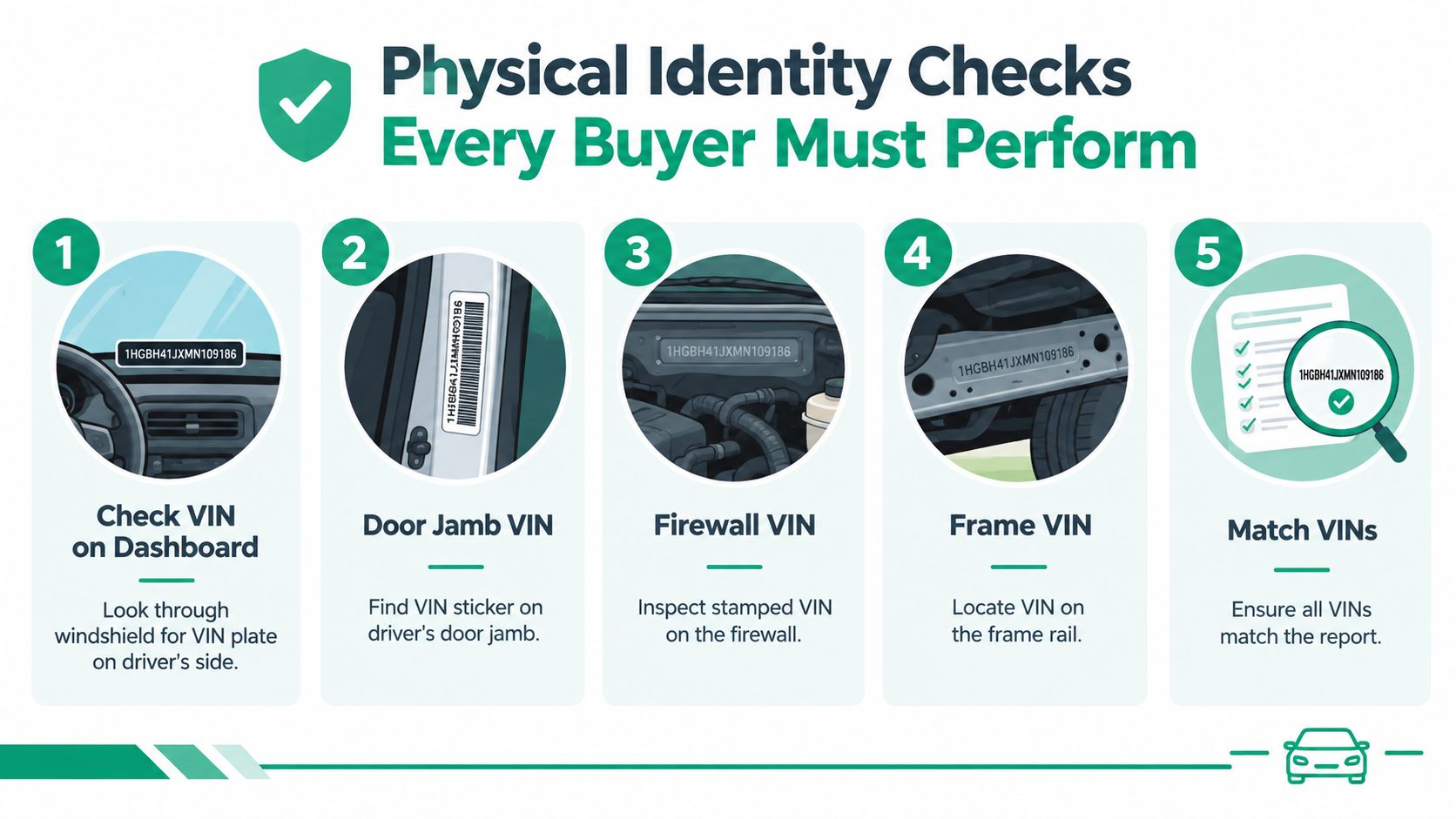
Locate every relevant identifier
Depending on the vehicle, identifiers may appear on the dashboard, door jamb, firewall, frame rails, wheel well, steering column, or major components. Don't assume the number on the engine is the legal VIN. Engines are replaceable, and an engine swap can leave the vehicle's legal identity unchanged.
Ask the inspector to photograph each identifier in place, not only as a close-up. Context helps prove that the tag or stamping belongs where it should and hasn't been transplanted from another vehicle.
Check the following before accepting the seller's description:
- Title and paperwork: Compare the legal identifier with the current title, prior documents, and report.
- Body tag: Confirm the tag's format, attachment, location, and information against model-specific references.
- Firewall or frame stamping: Look for consistent characters, spacing, depth, and surrounding metal.
- Major components: Record engine and body numbers separately. Treat them as supporting evidence, not automatic proof of identity.
- Repair areas: Inspect for replaced metal, unusual welds, altered surfaces, or signs that a stamping area was repaired.
Know what tampering can look like
Restamping and rebodied cars are central classic-market risks. A tag may be moved to a more desirable shell, a damaged section may be replaced, or an ordinary model may be presented as a rarer version. Title laundering can make the paperwork appear less alarming without proving that the physical car is authentic.
If a report shows salvage, junk, stolen, or impound history, treat identity manipulation as a heightened concern. Classic-car VIN inspection guidance recommends combining database results with stamped numbers, factory records, state title history, and hands-on inspection because a clean digital result can't establish originality.
Inspection standard: Never let fresh paint, a rebuilt engine, or a neat VIN plate end the investigation. Those are presentation features, not provenance.
Have the specialist compare the car's structure and markings with the model's known construction. A neutral inspection is particularly important when the car is remote, recently restored, or priced on a rare-option claim.
Building a Layered Pre-Purchase Verification Workflow
The safest workflow moves from inexpensive screening to deeper verification. Don't commission archive research or travel to inspect a car before checking whether the available title data contains a deal-breaking problem.
Start with identity and adverse history
Obtain the identifier directly from the car and title, not only from the listing. Run a history report and record every title state, brand, salvage entry, theft or impound indicator, and mileage checkpoint. If the number won't decode cleanly, don't force it into a modern format. Ask a marque specialist or the relevant state authority how that identifier should be interpreted.
Use a service such as VinCheck's vehicle value research tool as one screening option when you need to connect history findings with a valuation discussion. A report can help you decide whether the car deserves more research, but it shouldn't determine value by itself.
Build the paper and factory file
Request clear scans before you make travel arrangements or send a deposit. You want the current title, prior titles if available, bills of sale, restoration invoices, service records, old registrations, and photographs taken before major cosmetic work.
Then contact the marque archive, museum, factory record service, or knowledgeable club. Ask them to verify the claimed build details, factory options, engine and body references, and any unusual specification that affects price.
Make every source agree
Finish with an independent inspection. Give the inspector the report and documents, but ask for an independent assessment rather than a confirmation of the seller's story.
Walk away, or renegotiate sharply, when the evidence conflicts and the seller can't explain why. A missing record alone may be normal for an old car. A mismatched stamp, unsupported rarity claim, and evasive seller together form a pattern you shouldn't ignore.
Non-Negotiable Checks Before You Sign the Title
A classic purchase always includes unknowns. The objective isn't to pretend you can eliminate them. It's to identify which unknowns are ordinary age-related gaps and which ones threaten legal identity, originality, safety, insurability, or value.
Use this final checklist before signing:
- Run the report early: Check title brands, salvage events, theft or impound indicators, prior states, and recorded mileage before spending on travel or inspection.
- Verify the identifier on the car: Match the title and report to the dashboard, door jamb, firewall, frame, body tag, and other applicable stampings.
- Treat older gaps pragmatically: Pre-2000 ownership, accident, and mileage gaps can reflect limited digitization. They aren't proof of a clean past or a fraudulent car by themselves.
- Request factory evidence: Confirm build details, original equipment, engine or body references, and claimed special options through marque-specific records where available.
- Demand paper continuity: Titles, bills of sale, registrations, invoices, and restoration photographs should support the seller's timeline.
- Hire the right inspector: Use a specialist familiar with the make and model, not only a general mechanic.
- Price the uncertainty: If originality or identity remains unproven, don't pay as if the claim were established.
- Check insurability before closing: Discuss the car's title history, agreed value, restoration status, and documentation with an insurer. A resource on classic auto insurance for enthusiasts can help you understand the coverage questions to raise.
The clean report is one piece of evidence. The purchase becomes defensible only when digital records, documents, factory information, and physical inspection agree.
VinCheck offers VIN decoding and history reporting that can surface title brands, salvage records, theft status, mileage issues, recalls, liens, and related vehicle data for an initial screening. Run a report through VinCheck before you invest in archive research, travel, or a specialist inspection, then use the result as the first layer of a proper classic-car provenance check.
About the author
VinCheck Editorial Team — Editorial Standards & Review
The VinCheck Editorial Team reviews every published article against NMVTIS data accuracy and NHTSA recall validity. This byline appears on collaborative pieces and quick-update posts.