 Vin
Used Car Value History: A Buyer's Guide
By VinCheck Editorial Team, Editorial Standards & Review · Published 2026-09-18 · Updated 2026-09-18 · Reviewed by VinCheck Editorial Standards
Most buyers think a used car's value is whatever the listing says today. A current price is only a snapshot, while used car value history shows whether the vehicle is following a normal depreciation path, riding an abnormal market wave, or carrying damage and documentation problems that will follow it to the next sale.
The market has already demonstrated how misleading a single price can be. Cox Automotive reported that the average used-vehicle listing price reached about $28,000 for the first time in 2021, while the Manheim Used Vehicle Value Index recorded annualized gains as high as 54% after the pandemic began and averaged nearly 26% from June 2020 through December 2021. By December 2022, the index had fallen 15% year over year, the largest one-year decline in its history, according to Cox Automotive's used-vehicle pricing analysis.
That cycle matters because the same logic applies to the car in front of you. A low asking price can reflect an ordinary age-related decline, a weak segment, a branded title, inconsistent mileage, or a seller trying to move a vehicle whose history makes future resale difficult. Your job isn't just to find the lowest number. It's to understand the path that produced it.
Table of Contents
- Why Current Price Tags Tell Only Half the Story
- How Past Events Alter the Depreciation Curve
- Tracing Sale History and Auction Records by VIN
- Choosing the Right Valuation Tools and Data Sources
- Leveraging Historical Data in Price Negotiations
- Final Verification Checklist Before You Buy
Why Current Price Tags Tell Only Half the Story
A listing price answers one question, what the seller wants now. It doesn't answer whether the vehicle was priced fairly before an accident, whether it has already passed through an auction, or whether comparable cars are becoming cheaper faster than this one. Those details determine whether today's discount is genuine value or compensation for a problem you'll inherit.
The broader market has also become structurally more expensive, not merely temporarily distorted. A Cox Automotive presentation cited by the Federal Reserve Bank of Chicago reported that vehicles priced below $30,000 represented 54% of the used market in 2012, but only 19% in 2021. The same presentation reported overall price growth of 39% since 2012, alongside a larger share of vehicles priced above $50,000.
The cheap-car trap
A car can look inexpensive beside today's listings and still be a poor purchase. If its segment is losing demand, if incentives have weakened the new-car price structure, or if a prior loss event limits financing and trade-in options, the advertised discount may be the market's warning.
- Its age-adjusted trajectory: Compare the car with vehicles of similar age, mileage, powertrain, and trim. A generic model average can hide major differences between an entry trim and a highly equipped version.
- Its market position: Separate retail asking prices from wholesale and auction evidence. A dealer's price includes preparation, overhead, warranty exposure, and profit. An auction result reflects a different transaction environment.
- Its personal history: Accident records, title branding, service gaps, theft records, liens, and odometer concerns can shift value more than a small difference in mileage.
Practical rule: Never negotiate from the listing alone. Negotiate from the listing, the vehicle's documented history, and the direction of comparable values.
Historical context also prevents a common mistake, treating an unusual market peak as a permanent benchmark. The post-pandemic run-up was driven by low supply and strong demand, then followed by a steep correction. A seller who references what similar cars commanded during that surge may be anchoring you to a market that no longer exists.
Your aim is not to reconstruct every past transaction. It's to identify the vehicle's normal value path, then isolate the events that pushed it above or below that path.
How Past Events Alter the Depreciation Curve
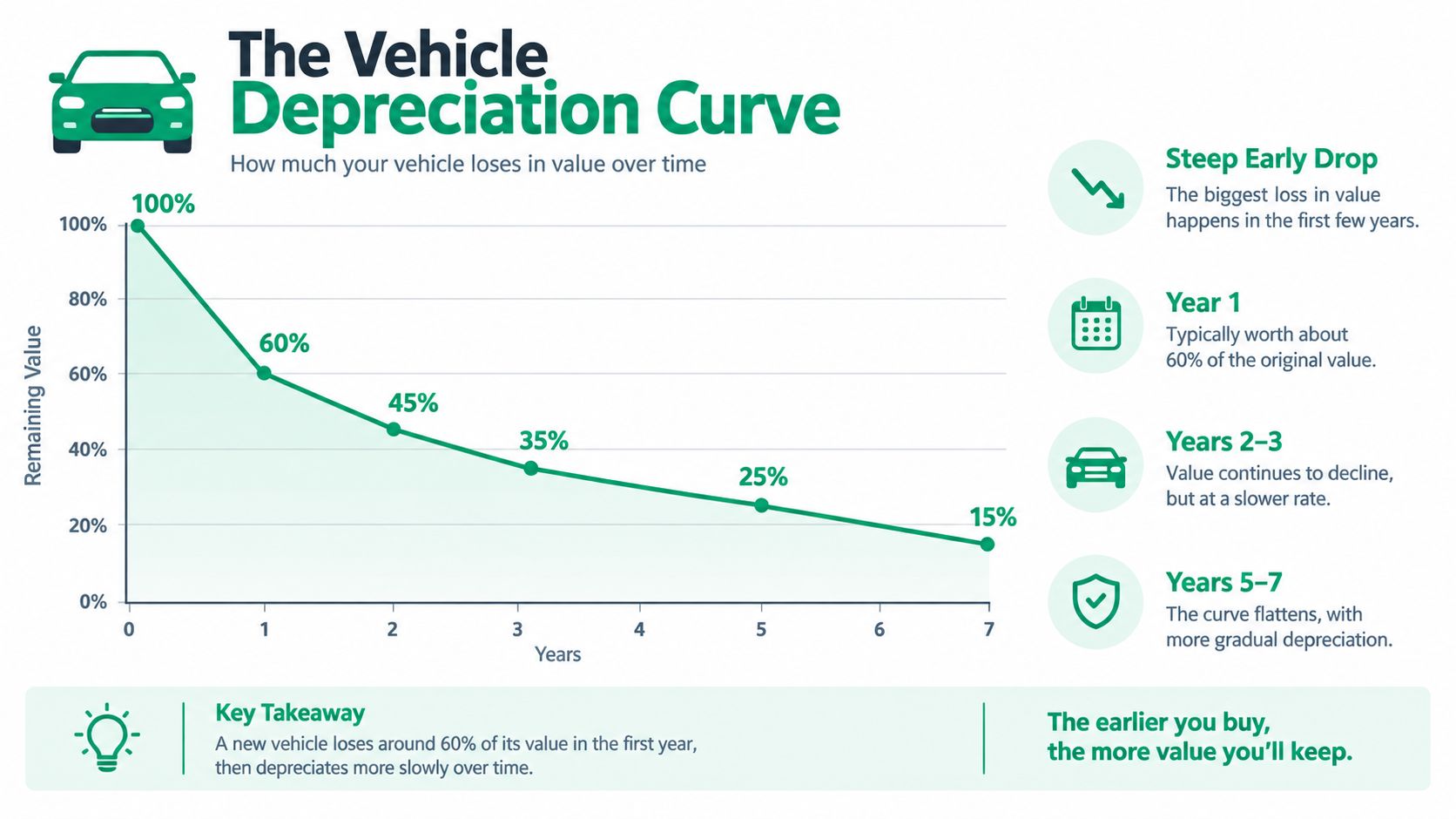
Depreciation doesn't behave like a straight line. Newer vehicles generally lose value fastest in their early ownership years, then the rate slows as the vehicle ages. Cox Automotive Europe describes the same nonlinear pattern in its 2026 used-market report, which states that vehicles under 12 months old were selling at about 65% of original cost new. The report also identifies the sharpest year-on-year residual-value decline for 1- to 2-year-old vehicles between 2023 and 2024, followed by stabilization into 2025.
That shape changes how you should read a price history. A large decline on a nearly new vehicle may fit the ordinary curve. The same decline on an older vehicle could signal a title event, accident, mechanical concern, or a segment-wide change in demand.
History flags change the curve itself
Age and mileage establish the baseline, but they don't explain the whole resale outcome. An empirical analysis summarized by Cox Automotive Europe found that selling prices decline nonlinearly with age and accumulated mileage, while good condition, documented service history, and clean accident records raise achievable prices. The same analysis found persistent premiums for premium and reliable brands after accounting for age and mileage.
Treat the following flags as curve-changing inputs, not simple deductions:
- Accident damage: The repair quality, location of damage, structural involvement, and airbag deployment matter more than the word “accident” alone. A superficial repair and a frame repair shouldn't receive the same valuation treatment.
- Branded or salvage title: A title brand can restrict the buyer pool and complicate financing, insurance, and future trade-in discussions. The lower price may be justified, but it rarely removes the resale penalty.
- Odometer inconsistency: A mileage conflict undermines every age-and-mileage comparison. Until resolved, value the vehicle conservatively.
- Incomplete service records: Missing documentation doesn't prove neglect, but it removes evidence that supports a stronger residual value.
- Repeated auction appearances: Multiple listings can indicate rapid flipping, failed retail placement, or unresolved defects. The pattern deserves an explanation before you raise your offer.
A clean history doesn't guarantee a good car, and a damaged-history car isn't automatically worthless. It does mean the evidence must support the price. A pre-purchase inspection should test the physical claims, while the history report tests the seller's narrative.
Tracing Sale History and Auction Records by VIN
The VIN is the organizing key for a vehicle's past, but a single decoder won't provide the full transaction story. Start by confirming the VIN on the dashboard, door label, registration, title, and seller's paperwork. If those identifiers don't match, stop the valuation exercise until the discrepancy is explained.
Build the timeline in four passes
Identify the exact vehicle. Decode the VIN to verify model year, engine, body style, drivetrain, and factory configuration. This prevents you from comparing a base car with a higher-trim example that carries different equipment and demand.
Check official title and status records. Look for salvage, rebuilt, flood, junk, theft, and other title indicators. NMVTIS-grade records can help surface title brands and insurance-related events, but no database can guarantee that every incident was reported.
Search auction and listing evidence. Salvage auction photographs may show damage that the current seller's images omit. Note the date, mileage, visible damage, declared condition, sale status, and whether the vehicle later appears with a clean-looking retail presentation.
Reconcile the sequence. Put title changes, mileage entries, service visits, auction events, and advertised sales in chronological order. A sharp mileage jump, a title change followed by a quick resale, or repeated appearances with different descriptions deserves direct questioning.
Use a vehicle-specific Toyota Camry VIN check example to see the type of identification and history workflow a buyer can apply before contacting a seller. The point isn't to accept a report as an absolute verdict. It's to create a factual timeline that you can test against the physical car.
A report may show an auction event without showing the final transaction price. In that case, use the event as context rather than pretending you know the exact wholesale value. Auction condition, location, fees, transport, and buyer access can materially change what the result means.
The sequence matters more than any isolated entry. A car that changed hands normally, accumulated consistent mileage, and has supporting service records tells a different value story from one that moved rapidly through salvage and retail channels.
Choosing the Right Valuation Tools and Data Sources
No valuation tool is sufficient by itself. A free VIN decoder is useful for confirming identity and factory specifications, but it usually won't tell you whether an insurer declared the vehicle a total loss, whether the odometer is consistent, or how the car compares with actual auction activity.
A full history report adds event context. It may reveal title brands, accident entries, theft records, liens, mileage anomalies, recalls, and prior sales or auction activity. That information doesn't replace a mechanic, but it can stop you from paying inspection and transport costs for a car that should have been rejected earlier.
Match the tool to the decision
| Tool or source | What it helps establish | What it cannot prove alone |
|---|---|---|
| Free VIN decoder | Identity, specifications, and configuration | Condition, repair quality, or fair market price |
| Comprehensive history report | Title events, reported damage, mileage issues, liens, recalls, and theft indicators | Complete coverage of every unreported incident |
| Retail valuation estimator | A market reference for a comparable vehicle | The effect of hidden damage or poor documentation |
| Auction records and photographs | Prior condition and wholesale context | A universal retail value |
| Manufacturer and safety databases | Recall and safety information | Mechanical condition or resale demand |
Look for a provider that combines history data and valuation context, rather than forcing you to interpret unrelated fragments. VinCheck provides VIN decoding, vehicle history reports, value estimates, safety ratings, recall searches, mileage checks, lien and title indicators, and salvage auction research in one interface. Those tools are useful when you need to connect a vehicle's recorded past with its likely resale position.
A Toyota Camry vehicle value reference can help illustrate how model-specific pricing context differs from a generic estimator. Use any estimate as a starting point, then adjust for trim, condition, location, service documentation, and history flags.
Cross-check before trusting the output
A history report with no entries doesn't prove a spotless past. Events may never have reached an insurer, public agency, auction, or participating repair facility. That limitation applies across the category, so a clean result should increase confidence, not end the investigation.
Compare at least one retail reference with one auction or wholesale reference, then inspect the car. If those sources disagree sharply, don't average them blindly. Find the reason for the spread.
Leveraging Historical Data in Price Negotiations
The strongest negotiation isn't “I found a cheaper car online.” Sellers can dismiss that comparison because location, trim, condition, and preparation differ. A stronger argument connects a documented event to a realistic future cost or resale limitation.
Start with the vehicle's clean baseline. Find comparable examples with similar age, mileage, body style, powertrain, and equipment. Then identify the specific factor that separates the candidate from those examples, such as accident damage, a branded title, missing service evidence, or an auction record showing prior severe damage.
Turn evidence into an offer
Use this sequence:
- State the reference: “Comparable clean-history vehicles are being advertised in this range.” Keep the comparison similar.
- Name the documented issue: Point to the VIN report, title record, auction photograph, or mileage entry. Don't rely on an accusation or a vague impression.
- Explain the future impact: A future buyer may ask the same questions, and a dealer may offer less for a vehicle with a difficult history.
- Make a defensible offer: Base it on the adjusted risk and your inspection findings, not on an arbitrary discount.
- Be ready to leave: If the seller refuses to acknowledge a material history issue, the negotiation has already given you useful information.
A damaged vehicle can still be worth buying if the repair is documented, the inspection is clean, and the price reflects the narrower resale market. A clean-title car with inconsistent mileage or missing records may deserve more caution than a cosmetically repaired bumper with strong documentation.
The report isn't your negotiating weapon. The connection between the report and the vehicle's future value is.
Three situations that justify pressure
A salvage auction record with visible structural damage should lead you to demand repair documentation, alignment measurements, and a professional inspection. If the seller can't provide them, don't treat the advertised discount as sufficient compensation.
A mileage conflict requires resolution before price discussion. Ask for service invoices, inspection records, registration history, and an explanation of each gap. If the evidence remains inconsistent, value the car based on the least favorable credible mileage interpretation.
A recent rapid resale can indicate that the vehicle was acquired cheaply and moved quickly after basic cosmetic work. Ask why it changed hands, what repairs were completed, and whether the seller will put those claims in writing.
The objective is not to win a confrontation. It's to make the seller price the car according to the same history a future buyer will see.
Final Verification Checklist Before You Buy
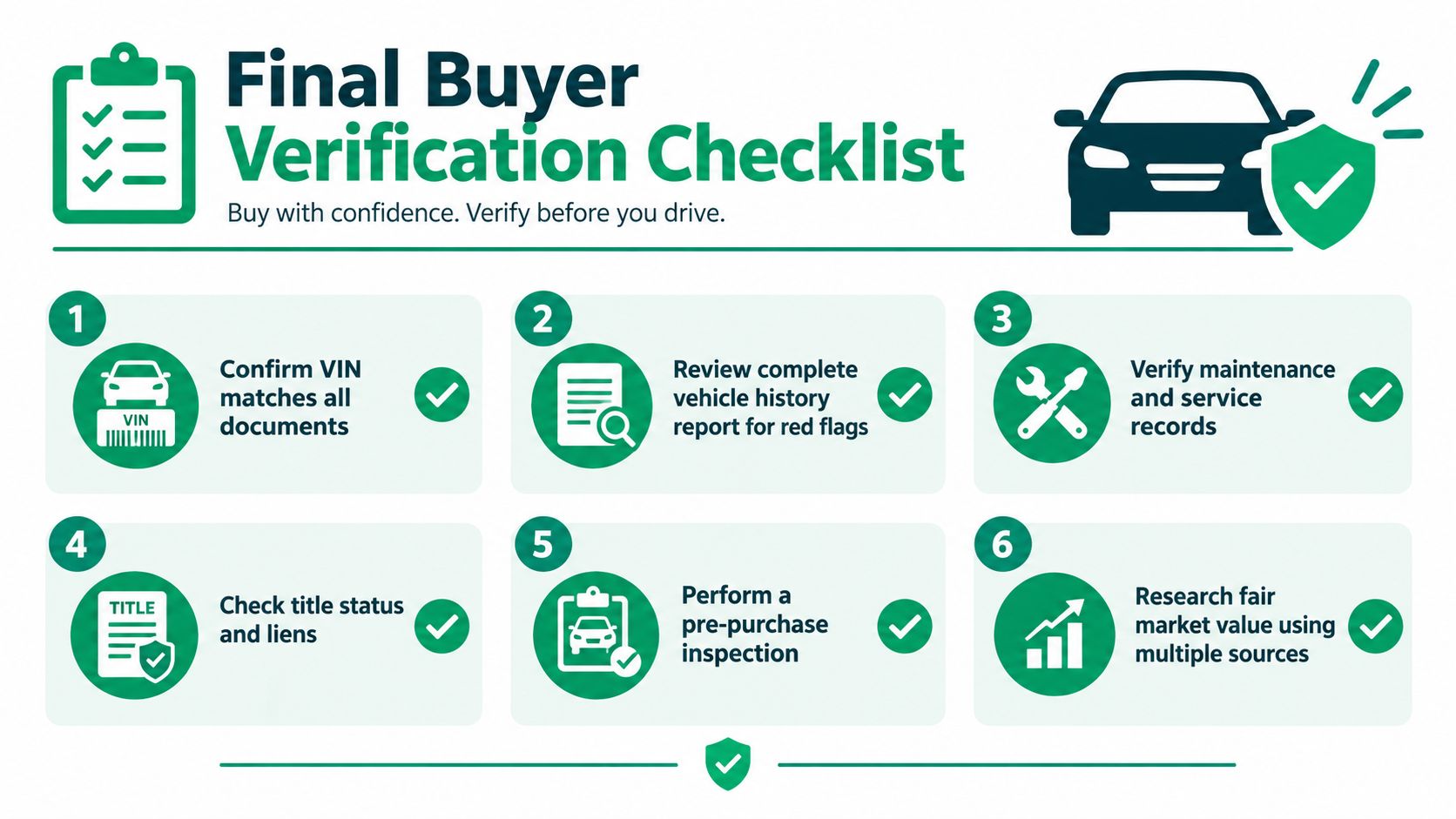
A valuation is finished only when the documents, vehicle, and seller's explanation agree. Run the checklist in order. If a critical item fails, pause the purchase rather than allowing a low price or emotional attachment to rush the decision.
Confirm the identity and legal status
- Match every VIN: Check the dashboard, door jamb, title, registration, insurance paperwork, and history report. Any mismatch needs a documented explanation.
- Review title status: Confirm whether the title is clean, branded, rebuilt, salvage, flood-related, or subject to another status. Check for liens before money changes hands.
- Resolve theft and ownership concerns: Make sure the vehicle isn't reported stolen and that the seller has the legal right to transfer it.
Test the historical narrative
- Read every event: Don't stop at the report summary. Review accident descriptions, mileage entries, auction records, service visits, imports, and title changes.
- Ask targeted questions: If the record shows damage, ask what was repaired, who performed the work, and whether invoices or photographs exist. If the seller's answer conflicts with the report, treat the conflict as a valuation issue.
- Inspect the mileage evidence: Compare the odometer with service invoices, inspection records, tire wear, interior wear, and electronic diagnostics where available.
Verify the physical car
- Get an independent inspection: Choose a mechanic who isn't financially connected to the seller. Ask for checks of structure, paint thickness, alignment, suspension, airbags, leaks, electrical systems, and underbody damage.
- Drive beyond the block: Test cold starting, braking, steering, highway tracking, transmission behavior, climate controls, and warning lights. A polished test drive won't compensate for a missing inspection.
- Check recalls and safety information: Use the Toyota Camry safety and recall reference or the relevant manufacturer and government resources for the exact vehicle. An open recall doesn't automatically end the deal, but you need to know who will complete the repair.
Finally, compare the seller's all-in price with multiple market references after adjusting for condition and history. Include taxes, registration, dealer fees, transport, immediate maintenance, and any required repairs in your calculation. If the car is only “cheap” before those costs, it isn't cheap.
Used car value history is most useful when it changes your behavior. Walk away from unexplained title events, unresolved mileage conflicts, and sellers who resist independent inspection. Buy the vehicle whose price makes sense after its entire story is accounted for, not the one with the most attractive headline number.
VinCheck combines VIN decoding, vehicle history records, mileage and title checks, auction research, value references, recalls, and safety information to help you evaluate the car's past before negotiating its future price. Run the vehicle through VinCheck before you pay a deposit, schedule an inspection, or sign the purchase paperwork.
About the author
VinCheck Editorial Team — Editorial Standards & Review
The VinCheck Editorial Team reviews every published article against NMVTIS data accuracy and NHTSA recall validity. This byline appears on collaborative pieces and quick-update posts.