 Vin
Suzuki Motorcycle VIN Number Decoder Guide
By VinCheck Editorial Team, Editorial Standards & Review · Published 2026-09-04 · Updated 2026-09-04 · Reviewed by VinCheck Editorial Standards
You're standing beside a used Suzuki, paperwork in hand, trying to decide whether the bike in front of you is really the bike described by the seller. The title shows a dense string of letters and numbers, the frame stamping is dirty, and a quick online decoder may return only part of the answer. That's where a Suzuki motorcycle VIN number decoder becomes useful, but only if you know what the result can prove and what it can't.
A VIN check has two jobs. First, it identifies the motorcycle's coded details, such as its manufacturer, model year, plant, and production sequence. Second, a separate history search can connect that VIN to title, theft, salvage, lien, and mileage records. Treating those as separate steps keeps a promising purchase from becoming an expensive paperwork problem.
Table of Contents
- What a Suzuki Motorcycle VIN Tells You
- Reading the 17-Character Suzuki VIN Layout
- Decoding the Model Year and Production Sequence
- Locating and Verifying the VIN on the Bike
- Common Suzuki VIN Decoding Pitfalls to Avoid
- What to Do When the VIN Is Not 17 Characters
- Running a VIN-Based History Check on a Suzuki
What a Suzuki Motorcycle VIN Tells You
A used Suzuki can look right while its paperwork, frame, and online record point in different directions. The VIN helps sort those clues. On a modern motorcycle, it is a 17-character structured code built under the federal VIN standard described by NHTSA's VIN interpretation. Read character by character, it can connect the bike to its manufacturer, model details, model year, assembly plant, and production sequence.
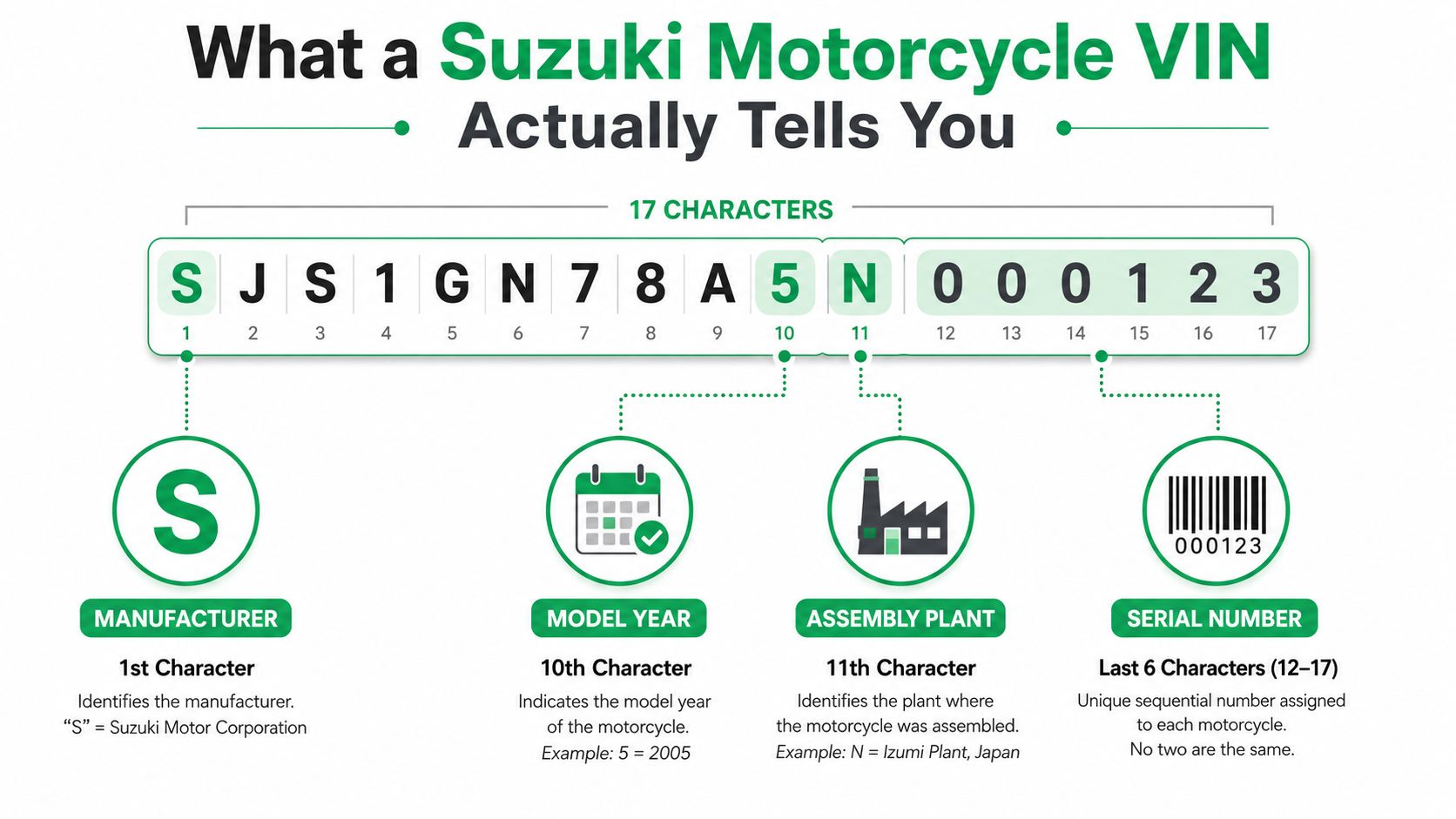
For a U.S.-market Suzuki motorcycle, the opening commonly appears as JS1. This is the World Manufacturer Identifier, or WMI, which identifies Suzuki and the assigned market or country. The middle characters describe the motorcycle, while the later positions carry the model-year, plant, and individual sequence information. In practice, the VIN works like a parts label for the motorcycle's identity. One wrong character can send a decoder to the wrong result.
The information hidden in the code
A complete decode can help establish:
- Manufacturer and market assignment: The WMI points to Suzuki and the relevant country or market coding.
- Vehicle description: The middle block may identify vehicle type, model line, engine family, displacement, or emissions region, depending on Suzuki's submission.
- Model year: The 10th character marks the model year. For recent Suzuki examples, L corresponds to 2020, M to 2021, N to 2022, P to 2023, R to 2024, S to 2025, and T to 2026, as shown in Suzuki's NHTSA decoder data.
- Assembly plant: The 11th position identifies the plant code recorded in the VIN.
- Production sequence: Characters 12 through 17 make up the six-character sequential production number.
The stamped frame VIN remains the primary identity to verify. The engine case can carry a separate engine number or code, but that number does not replace the frame VIN. If the title, frame stamping, and engine details do not agree, pause before buying and run a history check. A model-specific resource, such as a Toyota VIN decode example, demonstrates the general format of an online vehicle lookup, while Suzuki's character assignments still require Suzuki-specific interpretation. Older Suzuki motorcycles with 11-digit VINs sit outside this modern workflow, so many decoders reject them without explaining the gap.
Reading the 17-Character Suzuki VIN Layout
Start by copying the VIN exactly as stamped. Don't remove a character because it looks unusual, and don't replace a letter with a number based on appearance. A modern Suzuki VIN uses three working blocks: the World Manufacturer Identifier, the Vehicle Description Section, and the Vehicle Indicator Section.
Positions 1 through 3 identify the manufacturer
The first three characters are the WMI. JS1 is the common example for Suzuki motorcycles sold in the United States. A different prefix can indicate another vehicle category or market assignment, so a decoder that accepts Suzuki vehicles should still confirm that the prefix belongs to a motorcycle rather than assuming every Suzuki VIN describes the same type of vehicle.
Positions 4 through 9 describe the motorcycle
Characters 4 through 9 form the Vehicle Description Section. Suzuki uses these positions to encode details such as vehicle type or weight class, model line, engine family, displacement, and emissions or regional information. The exact interpretation can vary by submission, which is why a partial result shouldn't be treated as a complete factory specification.
The 9th character is the check digit. It is calculated from the other VIN characters and is used to validate whether the number has been copied correctly. It may look like an out-of-place letter or number, but it isn't decorative and shouldn't be edited out.
Positions 10 through 17 identify year, plant, and sequence
The final block begins with position 10. That character represents the model year, not necessarily the calendar year when the motorcycle was sold. Position 11 identifies the assembly plant, and positions 12 through 17 create the sequential production number.
Practical rule: Copy the VIN twice, once from the title and once from the frame. Decode the frame version first, then compare every position with the paperwork.
NHTSA's VIN interpretation and standardization guidance explains why the fixed-length format matters. A standardized VIN lets registration systems, parts departments, insurers, and history databases refer to the same vehicle identity instead of relying on a seller's description or a shortened serial number.
Decoding the Model Year and Production Sequence
A buyer may see a clean-looking Suzuki, then pause at the VIN and ask two practical questions: what model year is this Suzuki, and where does it sit in the production run? Positions 10 through 17 provide the starting point, but the year character needs context.
Position 10 follows a repeating year-code system. The same letter can return in a later cycle, so do not read it as a sale-date stamp. For recent Suzuki examples, L identifies 2020, M identifies 2021, N identifies 2022, P identifies 2023, R identifies 2024, S identifies 2025, and T identifies 2026. A public Suzuki decoder lists those assignments, but the result still needs to match the motorcycle and its paperwork.
Why one letter can create two answers
A D in position 10 could point to a later cycle associated with 2013 or an earlier cycle associated with 1983. Frame design, engine configuration, registration documents, and period-correct parts help separate those possibilities. The VIN gives you a working answer, not permission to ignore the physical evidence.
That distinction matters when ordering model-specific parts for your bike. Parts catalogs may separate closely related model years even when the motorcycles look nearly identical. Treat the VIN year as the first filter, then confirm the model code and fitment before buying a component.
Position 11 identifies the assembly plant code assigned to the VIN record. Positions 12 through 17 create the six-digit production sequence. A low sequence may interest collectors, yet it does not by itself prove rarity, originality, or higher value. Condition and documentation remain stronger evidence.
A public decoder may leave some Suzuki characters unresolved. That result is a prompt to compare the complete VIN with the frame, title, registration, and manufacturer records. Older Suzuki motorcycles with 11-digit VINs are a separate gap: many modern decoders reject them, so a failed lookup does not automatically mean the motorcycle is fraudulent.
Locating and Verifying the VIN on the Bike
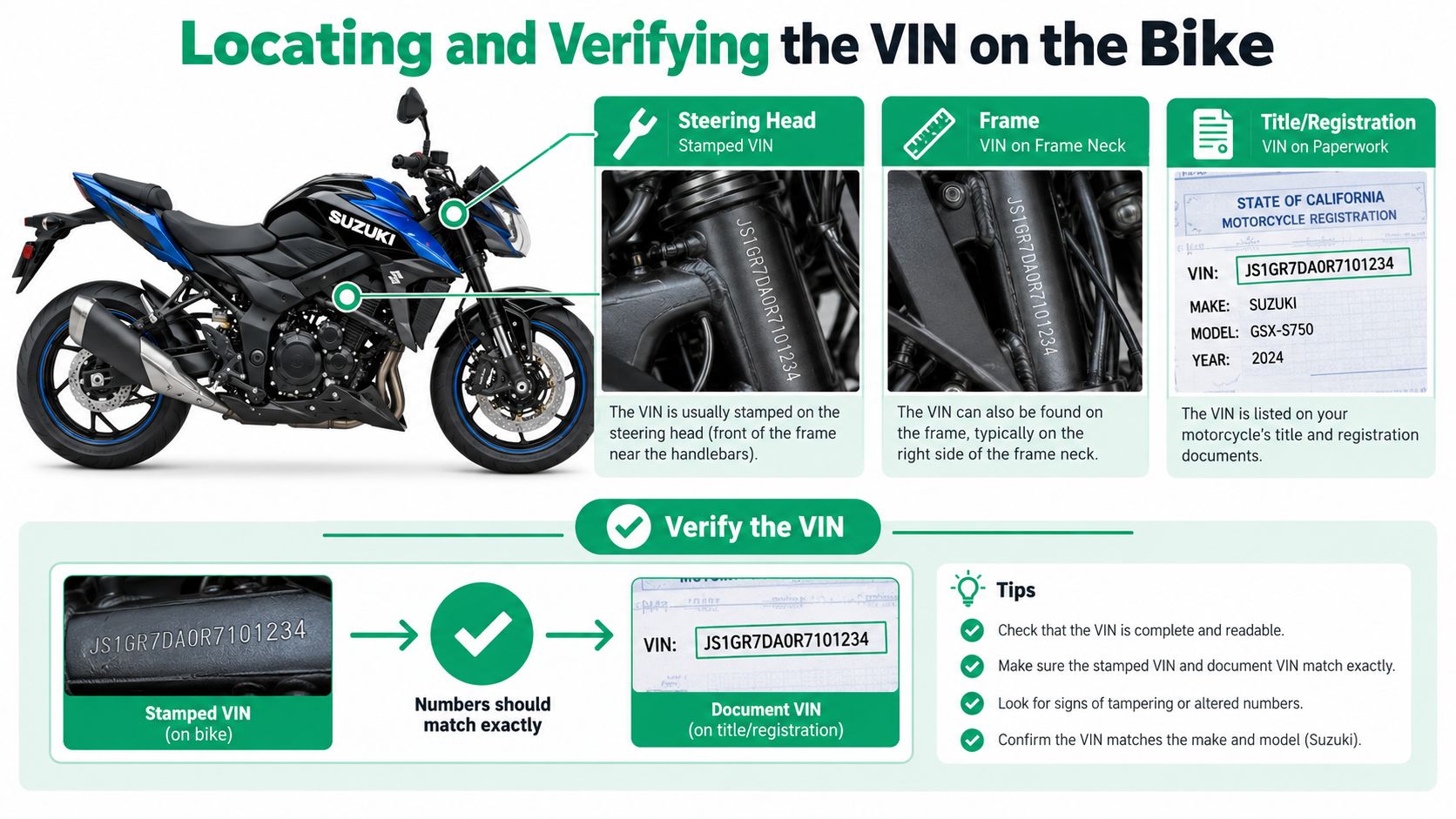
The seller hands you paperwork showing JS1GN7DA762105678. Before you enter it into a Suzuki motorcycle VIN number decoder, you need to find the same number on the motorcycle. The title is not enough, because a clerical error can travel from one document to another while the frame carries the vehicle's actual identity.
On many street Suzukis, look first at the steering-head neck, behind the front forks. Turn the handlebars if necessary and use a flashlight at a low angle. Some sport and adventure models place the stamping on a frame-side rail or another frame area near the swingarm or engine, while a certification label may sit on the left side of the headstock.
Read the stamping, not just the label
A sticker can fade, peel, or be replaced. The frame stamping is harder to dismiss, although dirt, corrosion, thick paint, and repairs can make individual characters difficult to read. Clean the area gently with a mild degreaser and a cloth. Avoid aggressive grinding or sanding, because altering the stamped area can create a legal and inspection problem.
Look for consistent depth, spacing, alignment, and character shape. Fresh-looking numbers surrounded by disturbed metal, weld marks, grinding, or unusual paint deserve careful scrutiny. The Suzuki identification reference also highlights the need to separate model-year interpretation from other Suzuki designation systems.
The engine case may carry a separate engine stamp near the countershaft or another model-specific location. An engine replacement isn't automatically proof of wrongdoing, but an unexplained engine and frame mismatch can affect registration, insurance, parts selection, and resale. If the seller says the engine was changed, ask for the repair record and confirm what your local authority requires.
Enter the frame VIN into a decoder only after you've transcribed it. Then compare the output with the bike's physical features and documents. A general vehicle lookup example illustrates why a database result should support, not replace, a hands-on inspection.
The video below can help you visualize the inspection process:
Common Suzuki VIN Decoding Pitfalls to Avoid
Two mistakes cause most confusion. The first is treating the 10th character as a unique calendar-year label. The second is ignoring a failed check digit because the rest of the VIN appears to decode successfully.
Year codes repeat. If you read the character without considering the motorcycle's design, engine family, documentation, and production context, you can assign the wrong decade. A seller may describe the bike by registration year, model year, or the year it was imported, and those labels aren't always interchangeable.
The check digit creates a different kind of warning. Because position 9 is mathematically derived from the rest of the VIN, a failed validation can indicate a transcription mistake, a damaged stamping, or possible tampering. Don't “fix” the number by changing position 9 until the original frame stamping has been read again.
Suzuki VIN pitfalls at a glance
| Pitfall | What It Looks Like | How to Respond |
|---|---|---|
| Reused year code | The 10th character appears to identify an older or newer bike than the seller described | Compare the code with the motorcycle's physical generation, documents, and model-year references |
| Misread character | A letter resembles a number, or a dirty stamp produces an uncertain transcription | Clean the area gently, use angled light, and compare the frame with the title |
| Failed check digit | The VIN begins with a plausible Suzuki prefix but validation doesn't agree | Stop the transaction until the full VIN is re-read and checked |
| Partial decoder result | The tool identifies Suzuki but leaves model or specification fields unresolved | Cross-check the frame, registration, and manufacturer records |
| Engine and frame mismatch | The engine stamp doesn't correspond to the frame identity | Ask whether the engine was replaced and verify the paperwork and local requirements |
A decoder result is evidence, not permission to overlook a mismatch.
A failed check digit alone might be a typo. A failed check digit combined with disturbed metal, inconsistent paperwork, or an incorrect model description is a much stronger stop signal. Walk away until the identity is resolved, especially if the seller pressures you to pay before you can inspect the stamping.
What to Do When the VIN Is Not 17 Characters
You find an older Suzuki in a shed, read the frame stamp, and count only 11 characters. A modern decoder rejects it immediately. That response does not prove the motorcycle lacks a valid identity. It may fall outside the format the tool accepts.
The modern 17-character VIN system became standard in 1981, and motorcycles follow that system too. Earlier Suzuki motorcycles may carry an 11-character VIN, while off-road and specialty models can add further format variation. The year of manufacture, model family, and market can all affect how the shorter number should be interpreted.
Online decoders often assume a 17-character entry. They may refuse a shorter code without explaining why, leaving the owner to confuse a software limitation with a suspicious motorcycle. Treat the decoder like a socket that fits only one bolt size. A different tool is needed for an older stamping.
A practical route for an older Suzuki
Photograph the frame stamp before transcribing it. Copy every character exactly, including unclear marks, and record the model name, engine markings, approximate production period, country of sale, and numbers shown on the title or registration. Do not insert invented characters or force an 11-character code into a 17-character field.
Take the number to a Suzuki dealer parts department and ask whether it can be matched with factory parts or build records. A vintage Suzuki specialist may have model-specific tables showing how the shorter sequence relates to the model, engine type, and production run. Model-specific forums can help identify the right reference, but an anonymous interpretation remains a lead until documents or manufacturer records support it.
Contact the relevant motor-vehicle authority before purchasing the bike. Older motorcycles may require a separate verification process, including documents, inspection, or ownership records that a modern decoder cannot assess.
A rejected 11-character VIN is neither a clean bill of health nor proof of fraud. It signals that the character-by-character decoding step must be paired with a historical-format lookup and a paperwork check.
Running a VIN-Based History Check on a Suzuki
A free decoder can tell you what the VIN is supposed to identify. It can't, by itself, tell you whether the motorcycle was stolen, written off, rebuilt, exposed to flood damage, or transferred with an unresolved lien. For that second question, run the verified 17-character VIN through a history provider that uses title and vehicle-record data, then compare the report with the bike in front of you.
The report should help you examine the categories that create the greatest purchase risk:
| Risk Category | What It Reveals | Why It Matters for a Suzuki Buyer |
|---|---|---|
| Salvage or rebuilt title | Whether an authority branded the motorcycle after major damage or repair | A sportbike may look presentable after repair while retaining structural or registration concerns |
| Odometer history | Recorded mileage entries and possible inconsistencies | A mileage conflict changes how you assess wear, service needs, and the seller's description |
| Flood damage | A recorded water-loss or flood-related event | Corrosion and electrical faults can appear later, even after cosmetic cleanup |
| Lien status | A recorded financial interest in the motorcycle | An unresolved lien can complicate a clean transfer of ownership |
| Theft records | Reports connected to the VIN in available vehicle databases | A bike with a theft issue can create serious ownership and recovery risks |
Use the report as a cross-check, not as a substitute for inspecting the frame. The model year and engine family should make sense beside the decoder output, stamped VIN, title, and registration. A mismatch in any one of those records deserves a pause. Several mismatches together are a reason to end the deal.
For a second vehicle-history workflow example, see this VIN check example for a 2024 Toyota Camry. The same principle applies to a Suzuki: decode the identity first, then investigate the events attached to that identity. VinCheck provides motorcycle VIN decoding and history reporting that can surface title brands, salvage and flood records, theft status, liens, mileage issues, recalls, and related vehicle-history indicators.
Use the frame-stamped number as your starting point, compare it character by character with the title and registration, and resolve every year-code or check-digit mismatch before paying. Visit VinCheck to run a Suzuki motorcycle VIN lookup that combines initial identification with a vehicle-history check, so you can investigate the bike's records before committing to the purchase.
About the author
VinCheck Editorial Team — Editorial Standards & Review
The VinCheck Editorial Team reviews every published article against NMVTIS data accuracy and NHTSA recall validity. This byline appears on collaborative pieces and quick-update posts.