 Vin
Speedometer and Mileage Not Working: Causes & Fixes
By VinCheck Editorial Team, Editorial Standards & Review · Published 2026-09-05 · Updated 2026-09-05 · Reviewed by VinCheck Editorial Standards
You're driving normally when the needle drops to zero. You glance down again, hoping it's a temporary glitch, then notice the odometer has stopped adding miles too. The car still moves, but the dashboard no longer tells you how fast you're going or how far you've traveled.
That combination deserves more attention than a quick sensor swap. The key question is simple: is the odometer still counting while the speedometer is dead? That answer separates a likely cluster fault from a lost speed signal, and it can also reveal a mileage record problem before you buy, sell, or trade the vehicle.
Table of Contents
- What It Means When Your Speedometer and Mileage Stop Working
- The Likely Causes Ranked From Cheapest to Most Serious
- How to Diagnose the Problem Before You Buy Parts
- Repair Costs and Safe Ways to Keep Driving
- Could This Actually Be Odometer Fraud
- Documenting the Issue and Verifying the Real Mileage
- Your Next Step Based on Whether You Own, Buy, or Sell
What It Means When Your Speedometer and Mileage Stop Working
The instrument cluster has three important jobs. It displays your road speed, records trip and total mileage, and, on many vehicles, receives or displays speed information shared with the engine, transmission, cruise control, ABS, and traction-control systems. A failure can therefore affect more than the needle in front of you.
Start with a controlled check. Drive only where it's safe, have a passenger watch the display, and note whether the total odometer or trip counter changes. If the needle stays at zero but the mileage continues to increase, the vehicle is probably receiving a speed signal while the cluster's gauge section has failed. That points attention toward the gauge motor, circuit board, display, or cluster connector.
If both the speedometer and mileage stop together, suspect the signal path first. The vehicle may have lost input from a vehicle speed sensor, wheel-speed sensor, tone ring, wiring harness, fuse, or network module. On older cars, a broken speedometer cable can create the same result.
Practical rule: Don't order a sensor until you know whether the odometer is still incrementing.
An erratic needle changes the picture again. Jumping, dropping, or intermittent readings often indicate an unstable connection, damaged wiring, a failing sensor, or internal cluster electronics. Warning lights for ABS, traction control, or the transmission make the fault more urgent because the speed signal may be shared across several systems.
This guide covers the checks to run before buying parts, realistic repair expectations, safe temporary driving options, and the possibility that a dead mileage display hides an odometer discrepancy. If you're dealing with a used vehicle, document the fault immediately. A clear record protects you during a warranty claim, sale, purchase dispute, or title review.
The Likely Causes Ranked From Cheapest to Most Serious
Begin with the inexpensive checks. A blown fuse can disable the whole cluster or a separate speed-sensor circuit, and heat discoloration around the fuse matters even when the filament doesn't look obviously broken. Next, inspect the cluster connectors and the transmission-side wiring for looseness, corrosion, oil saturation, or chafing.
A failed vehicle speed sensor, usually mounted at the transmission or differential, is a common cause when both displays stop. Some vehicles instead calculate speed through the CAN network using wheel-speed sensors, so the fault may originate at an ABS sensor or damaged tone ring. On older vehicles, the equivalent failure is a broken, binding, or disconnected mechanical speedometer cable.
The symptom pattern gives you useful direction:
- Needle dead, odometer still counting: Suspect the instrument cluster, gauge motor, display, or cluster circuit board.
- Needle and odometer both frozen: Suspect the fuse, sensor, tone ring, harness, connector, or network signal.
- Reading jumps or drops: Suspect an intermittent connector, chafed wire, unstable sensor output, or cable problem.
- ABS and traction warnings appear too: Investigate wheel-speed inputs and the ABS module, not just the dashboard.
- Speedometer fails after bumps or when hot: Look closely at harness movement, connector tension, and internal cluster solder joints.
The most serious diagnosis is a signal failure that affects the transmission or engine computer. A vehicle may shift poorly, lose cruise control, or store fault codes when the computer no longer receives a valid speed input. Don't replace the cluster first just because it's the part you can see.
| Likely Cause | Typical Repair Cost (USD) | Symptom Pattern |
|---|---|---|
| Fuse or loose connector | Varies by vehicle and access | Cluster or speed signal suddenly goes dead |
| Vehicle speed sensor | Often lower-cost than cluster work | Speedometer and odometer stop together |
| Wiring or connector damage | Varies with access and harness damage | Intermittent or erratic readings |
| Wheel-speed sensor or tone ring | Varies by hub and ABS design | Speed fault with ABS or traction warnings |
| Speedometer cable | Varies by older vehicle design | Mechanical noise, jumping needle, dead display |
| Instrument cluster motor or circuit board | Can require specialist repair | Needle dead while odometer may still work |
The order matters. Fuse first, signal path second, cluster last is the approach that prevents unnecessary parts replacement.
How to Diagnose the Problem Before You Buy Parts
A proper diagnosis starts with evidence, not a shopping list. Check every fuse associated with the instrument cluster, vehicle speed sensor, ABS, and transmission control. Use a test light with the circuit energized, or inspect for a broken filament and heat damage. If the cluster is intermittent, remove it only as far as the service procedure allows and reseat its connectors.
Confirm the signal with live data
A scan tool that displays the vehicle-speed PID can tell you whether the powertrain computer sees speed while the dashboard does not. On a VSS-based system, a steady road test around 30 to 40 mph is a useful check, as described in this vehicle speed sensor diagnostic guide. A zero or erratic reading in the PCM points toward a missing signal rather than an isolated gauge failure.
If the computer sees a stable speed but the needle stays at zero, move downstream to the cluster, communication wiring, or gauge motor. If the computer sees no speed, inspect the sensor, harness, connector, fuse, and related modules before touching the cluster.
Test the sensor and wiring
Unplug a two-wire magnetic sensor and measure resistance across its pins. A typical expected range is about 190 to 250 ohms, but the vehicle's service specification controls. Spinning the shaft should produce a clean AC waveform. Hall-effect sensors usually receive 5 or 12 volts and should switch their signal between near-zero and near-supply voltage.
Inspect the transmission port for oil-contaminated connectors, then perform a wiggle test while watching live data. A reading that cuts out when the harness moves is strong evidence of wiring or terminal trouble. For a Hall-effect circuit, a good energized ground should measure under 0.1 volt, according to the independent repair guidance summarized in this speedometer diagnosis resource.
Check the ABS side
Modern vehicles may calculate road speed from wheel-speed sensors. Look through the wheel well for a damaged tone ring, broken sensor body, packed debris, or a harness pulled tight near the hub. Scan the ABS and transmission modules, not just the engine computer.
If you want a shop to test the network, sensor output, and harness instead of guessing at parts, you can browse our diagnostic services for a structured inspection option. The cluster becomes the leading suspect only after the computer receives a valid speed signal and the odometer or needle still fails to respond.
Repair Costs and Safe Ways to Keep Driving
Repair pricing depends heavily on access, vehicle design, and whether the fault affects a simple sensor or a programmed cluster. A vehicle speed sensor replacement is commonly cited at roughly $150 to $250 total by repair guidance, while the broader repair range can reach approximately $150 to $350 when labor, access, and vehicle variation are included. Cluster repairs often cost more because the unit may need rebuilding, replacement, or programming.
Luxury and European vehicles usually require more diagnostic and programming time. Domestic trucks often land toward the lower end, but a damaged harness can reverse that pattern if the technician must unwrap or replace a difficult section.
| Likely Cause | Typical Cost Range | Repair Time |
|---|---|---|
| Fuse or connector correction | Low if no harness damage exists | Short inspection or repair |
| Vehicle speed sensor | $150 to $350 | Often a straightforward service visit |
| Wiring harness repair | $200 to $600 | Depends on access and damage location |
| Instrument cluster repair or replacement | $400 to $900 | May require programming or specialist work |
Use temporary measures only until the repair is scheduled. A GPS-based speedometer app can provide a speed reference, but keep the phone mounted legally and don't handle it while driving. For distance, highway mile markers can help you estimate travel, but don't use that estimate for maintenance intervals. Record your actual trip details separately.
Don't guess your speed by traffic flow or engine sound. That isn't a safe substitute for a working, accurate speed display.
Avoid driving when ABS or traction-control warnings accompany the failure, especially in poor weather, towing conditions, school zones, or unfamiliar areas. If you're evaluating a particular vehicle's value while the dashboard fault is unresolved, compare its condition and history with a 2024 Toyota Camry value reference, rather than treating the displayed mileage as automatically reliable.
Could This Actually Be Odometer Fraud
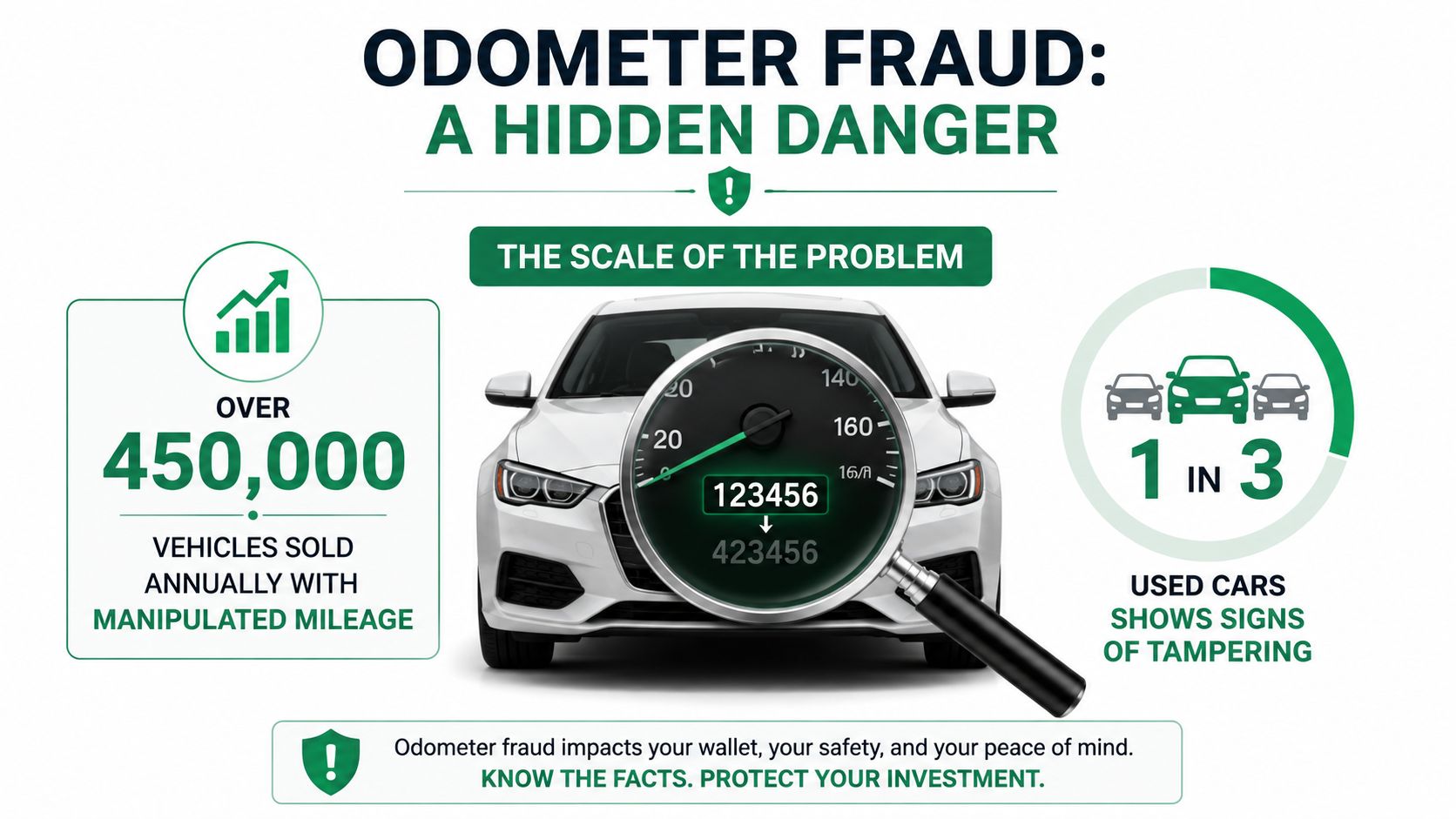
A dead odometer is a repair issue, but on a used vehicle it's also a documentation warning. The National Highway Traffic Safety Administration's odometer fraud information estimates that more than 450,000 vehicles are sold each year in the United States with false odometer readings. Its cited research estimates a 3.47% lifetime incidence rate during the first 11 years of a vehicle's life, consumer losses of about $1,056 million per year, and an average loss of $2,336 per rolled-back vehicle.
Europe has faced the same problem. A 2017 European Parliament research report described odometer fraud affecting roughly 5% to 12% of used-car sales in some national markets, with indicative estimates of 30% to 50% tampered vehicles in some cross-border transactions. The report also cited cumulative damage of EUR 1.4 to 2.8 billion across Belgium, France, Germany, Luxembourg, and the Netherlands. Those figures justify treating mileage inconsistencies as a market-integrity problem, not a minor dashboard annoyance.
How the discrepancy can happen
Older mechanical odometers can be physically rolled back. Newer vehicles can have mileage altered through module reprogramming, while a replacement cluster can display a reading that doesn't match the vehicle's history. A non-functioning odometer doesn't prove fraud, but a seller who can't explain when it failed, who diagnosed it, or what the mileage was at discovery has created a serious verification problem.
Look beyond the dashboard:
- Wear mismatch: Compare the pedals, steering wheel, driver seat, and switches with the claimed mileage.
- Record gaps: Check whether service entries, inspection records, and emissions documentation progress logically.
- Title language: Review any “Not Actual Mileage” branding or related disclosure.
- Seller behavior: Treat refusal of an independent inspection or written mileage statement as a reason to pause.
Mileage also affects claims and vehicle valuation, so buyers and owners should understand how odometer readings affect total loss claims. If the odometer stops while a vehicle is being advertised, don't accept a verbal promise that the number is correct. Require records and an independent scan before money changes hands.
Here's the practical position: a genuine cluster failure can be repaired and documented; an unexplained mileage gap should stop a purchase until it's reconciled.
For additional context on the fraud risk, review this video before relying on a questionable dashboard reading:
Documenting the Issue and Verifying the Real Mileage
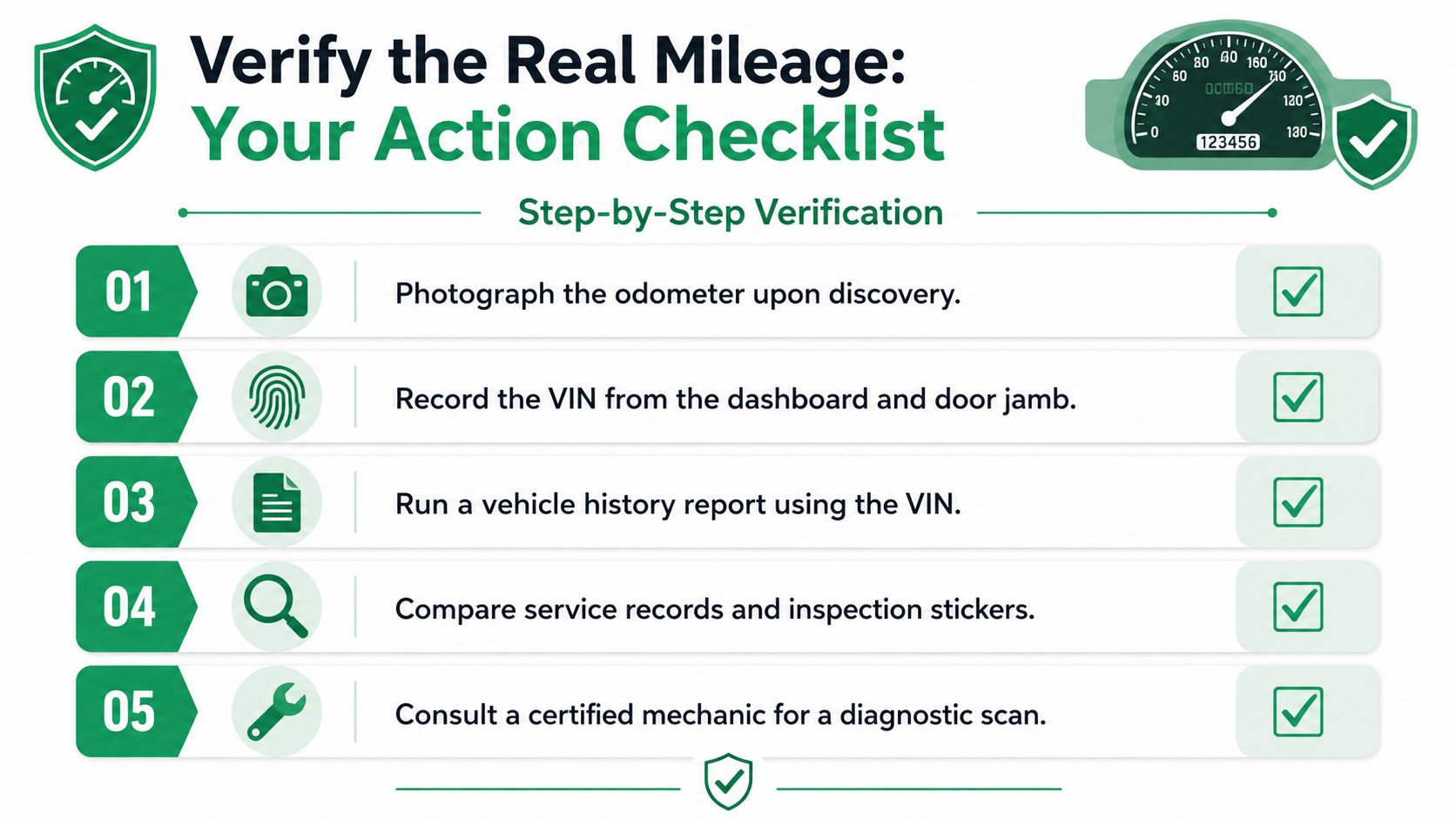
Treat the first failure like evidence. Photograph the odometer, speedometer position, warning lights, and the full dashboard as soon as you notice the problem. Use a timestamped image if possible, and write down the date, VIN, approximate mileage, driving conditions, and whether the trip counter changed.
Build a mileage record
Collect independent records in a logical order:
- Save the current dashboard evidence. Photograph both the total mileage and trip display, even if one is frozen.
- Record the VIN twice. Confirm it on the dashboard and the driver-side door jamb, then note any mismatch.
- Order a history report. Compare entries from CARFAX, AutoCheck, or the NMVTIS database with the current reading.
- Gather service paperwork. Oil changes, tire work, inspections, emissions tests, and dealership invoices may show mileage at different points.
- Ask for the title and disclosure statement. Read the odometer disclosure carefully before signing.
- Get an independent scan. Have a qualified technician check the cluster, PCM, ABS, and transmission modules for stored mileage or fault information.
Use a VIN-based report as one piece of evidence, not the entire conclusion. A mileage history check can identify an impossible sequence, a sudden drop, or a long unexplained gap. You can also use a VIN check for a 2024 Toyota Camry to see how vehicle identification and history verification fit into a pre-purchase review.
Compare physical condition with the paperwork
Tire DOT date codes can show whether the tires are consistent with the vehicle's maintenance history, although they don't establish mileage by themselves. Brake rotor wear, pedal surface wear, steering-wheel texture, seat bolsters, and driver-control markings should make sense alongside the claimed use.
If the records can't be reconciled, ask the seller for a written statement identifying the displayed mileage, the date the odometer stopped, and the repair plan. Check your state's title-brand rules and reporting requirements before signing. If fraud remains suspected, contact the state attorney general, your motor-vehicle agency, or NHTSA, and keep copies of every report, message, photograph, invoice, and signed disclosure.
Don't rely on a promise that the issue will be fixed after the sale. Put any remedy, disclosure, inspection right, or cancellation term in writing before you pay.
Your Next Step Based on Whether You Own, Buy, or Sell
The right action depends on your position, but the first question stays the same: does the odometer still count?
If you own the vehicle
Check the mileage behavior, scan the relevant modules, and get a written estimate that identifies the failed component. Keep the repair order, diagnostic results, photographs, and mileage recorded at each visit. That file protects you if a future buyer questions the vehicle's history.
If you're buying
Pause the transaction if the cluster is dead and the seller can't produce consistent service records. Also walk away when the seller refuses an independent inspection, avoids a written mileage disclosure, or presents a history with unexplained gaps. Those are not negotiation quirks. They're verification failures.
A documented sensor or cluster repair can be acceptable when the mileage history remains consistent and the seller provides invoices. A repair estimate, an honest disclosure, and permission for an independent scan are reasonable conditions. A missing history, a refusal to inspect, and a title or mileage discrepancy are reasons to return the car before purchase.
If you're selling
Fix the fault when practical, or disclose it clearly before advertising. Obtain a mechanic's statement showing the diagnosis, the mileage recorded at inspection, and whether the odometer is believed to be accurate. Follow your state's title and odometer disclosure rules, and never hide a known dashboard defect to make the vehicle appear more attractive.
For broader make and model research before listing or buying, you can browse Toyota vehicles, then verify the specific vehicle by VIN rather than relying on a generic model estimate.
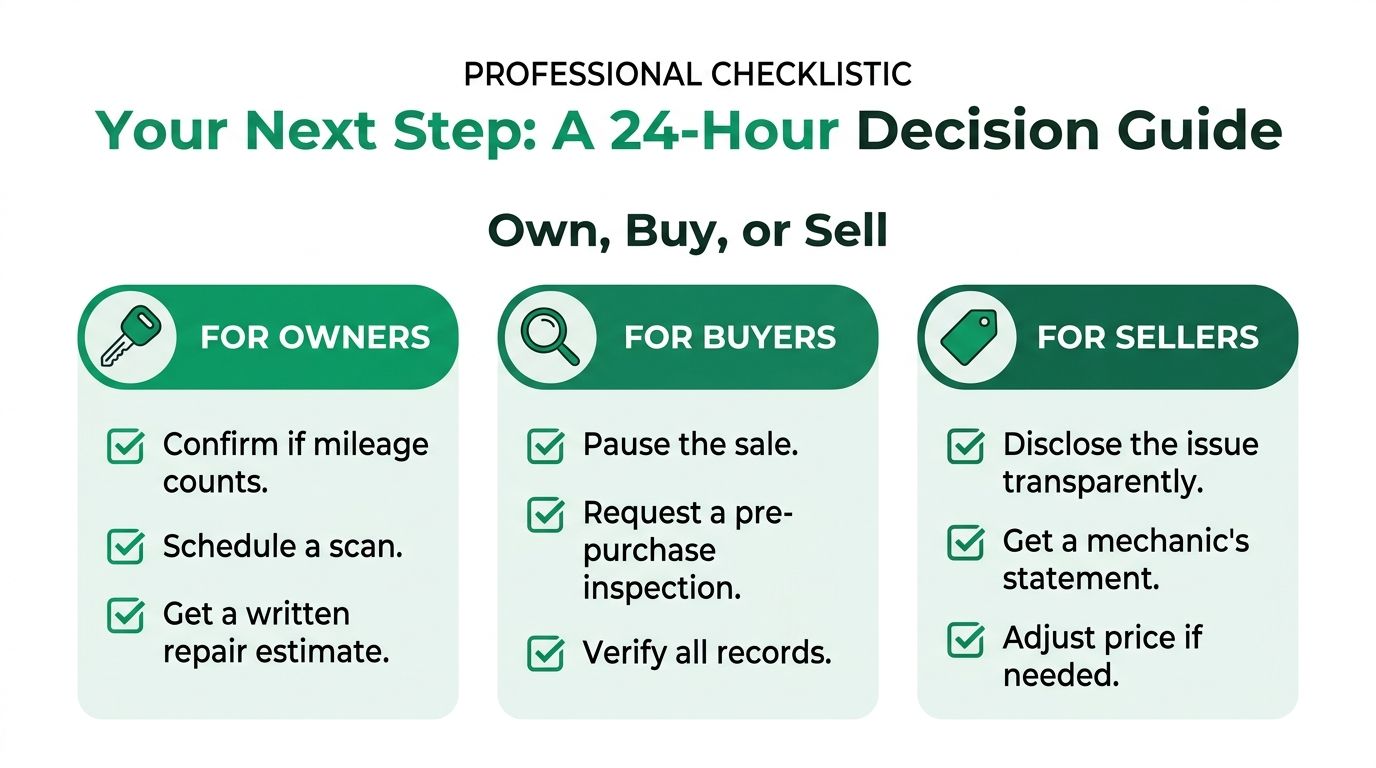
Owners should schedule a diagnostic scan. Buyers should pause and inspect. Sellers should disclose and document. Those three actions are simple, defensible, and far cheaper than guessing.
VinCheck provides VIN decoding and vehicle history reports that can surface mileage inconsistencies, title brands, accidents, salvage events, recalls, theft records, liens, and prior sale or auction activity. Before buying or selling a vehicle with speedometer and mileage problems, visit VinCheck to review the VIN-linked history and check whether the recorded mileage makes sense.
About the author
VinCheck Editorial Team — Editorial Standards & Review
The VinCheck Editorial Team reviews every published article against NMVTIS data accuracy and NHTSA recall validity. This byline appears on collaborative pieces and quick-update posts.