 Vin
Safety Ratings Explained and How to Compare Them
By VinCheck Editorial Team, Editorial Standards & Review · Published 2026-09-06 · Updated 2026-09-06 · Reviewed by VinCheck Editorial Standards
You're comparing two used-car listings. Both advertise five-star safety, both look clean in the photos, and both seem suitable for your family. One is a newer model with updated crash-avoidance equipment. The other earned its stars under an older testing protocol, has a different body style, and may have been repaired after a serious collision. On the surface, the ratings look identical. They may not mean the same thing.
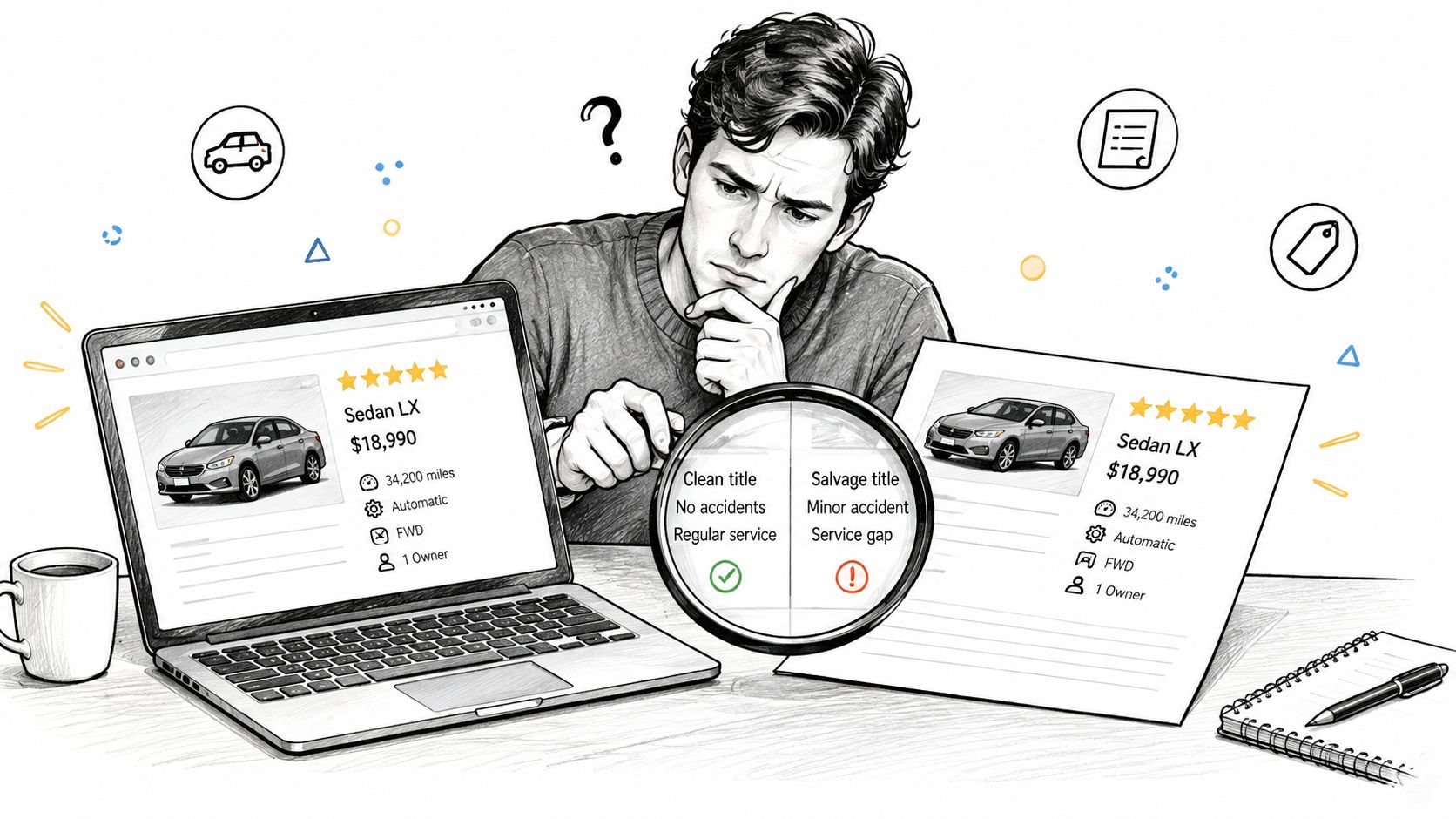
Safety ratings give buyers a useful starting point, but the star count alone leaves out important context. You need to know which organization performed the tests, which year's protocol applied, which body style and equipment were tested, and whether the individual vehicle still has its original safety structure and systems.
This guide is for first-time used-car buyers, parents comparing family vehicles, and anyone who wants to separate a meaningful safety result from a vague sales claim. You'll learn how NHTSA's stars differ from IIHS grades, why test years matter, and how to connect a model-level result to the specific vehicle identified by its VIN.
If you're narrowing your search to practical family transportation, broader buying advice such as these family hybrid car recommendations can help with the first stage of choosing a vehicle type. Safety ratings then help you compare the candidates more carefully.
A high rating doesn't guarantee that a particular used car is safe today. It doesn't reveal hidden flood damage, poor repairs, missing airbags, worn tires, or an unresolved recall. Treat the rating as one essential filter, then verify the actual vehicle before you make an offer.
Table of Contents
- Introduction to Safety Ratings for Car Buyers
- What Safety Ratings Actually Measure
- How NHTSA 5 Star Ratings Work
- How IIHS Ratings and Top Safety Awards Work
- How to Compare Safety Ratings Across Models and Years
- Using Safety Ratings to Evaluate a Specific Used Vehicle
- Making a Confident Decision With Safety Ratings
Introduction to Safety Ratings for Car Buyers
Safety ratings are standardized assessments designed to make vehicle comparisons easier. They compress results from controlled tests into a format that shoppers can understand quickly. That convenience is valuable, but compression also removes detail, much like a school report card summarizes several subjects without showing every assignment.
A five-star result doesn't mean a vehicle is immune to injury in every collision. It means the vehicle performed favorably under the relevant test conditions and criteria. The meaning depends on the rating program, the testing year, and the exact version of the vehicle that was evaluated.
The useful question isn't “Does this car have five stars?” It's “Five stars from which program, in which year, for which configuration, and what does the individual vehicle's history show?”
That distinction matters most in the used market. A nameplate can remain the same while the manufacturer changes the platform, airbags, driver-assistance equipment, headlights, or body design. A sedan and a hatchback carrying the same model name may not have identical crash behavior. A rating page can also describe a new vehicle, while the car in front of you may have been repaired after a collision.
The shopping process becomes clearer when you separate three tasks:
- Understand the rating system: Learn what the stars or grades measure.
- Compare equivalent results: Match test years, protocols, body styles, and equipment.
- Inspect the specific vehicle: Check its VIN-linked history, recalls, mileage, title status, and physical condition.
That sequence prevents a common mistake. Buyers often use a model rating as if it were a condition report. It isn't. A strong original result can't confirm that a used car still has its factory airbags, undamaged structural members, or correctly calibrated driver-assistance sensors.
The best use of safety ratings is therefore comparative. They help you remove weaker candidates and identify vehicles that deserve closer inspection. They don't replace a professional inspection, a careful test drive, or a history review.
What Safety Ratings Actually Measure
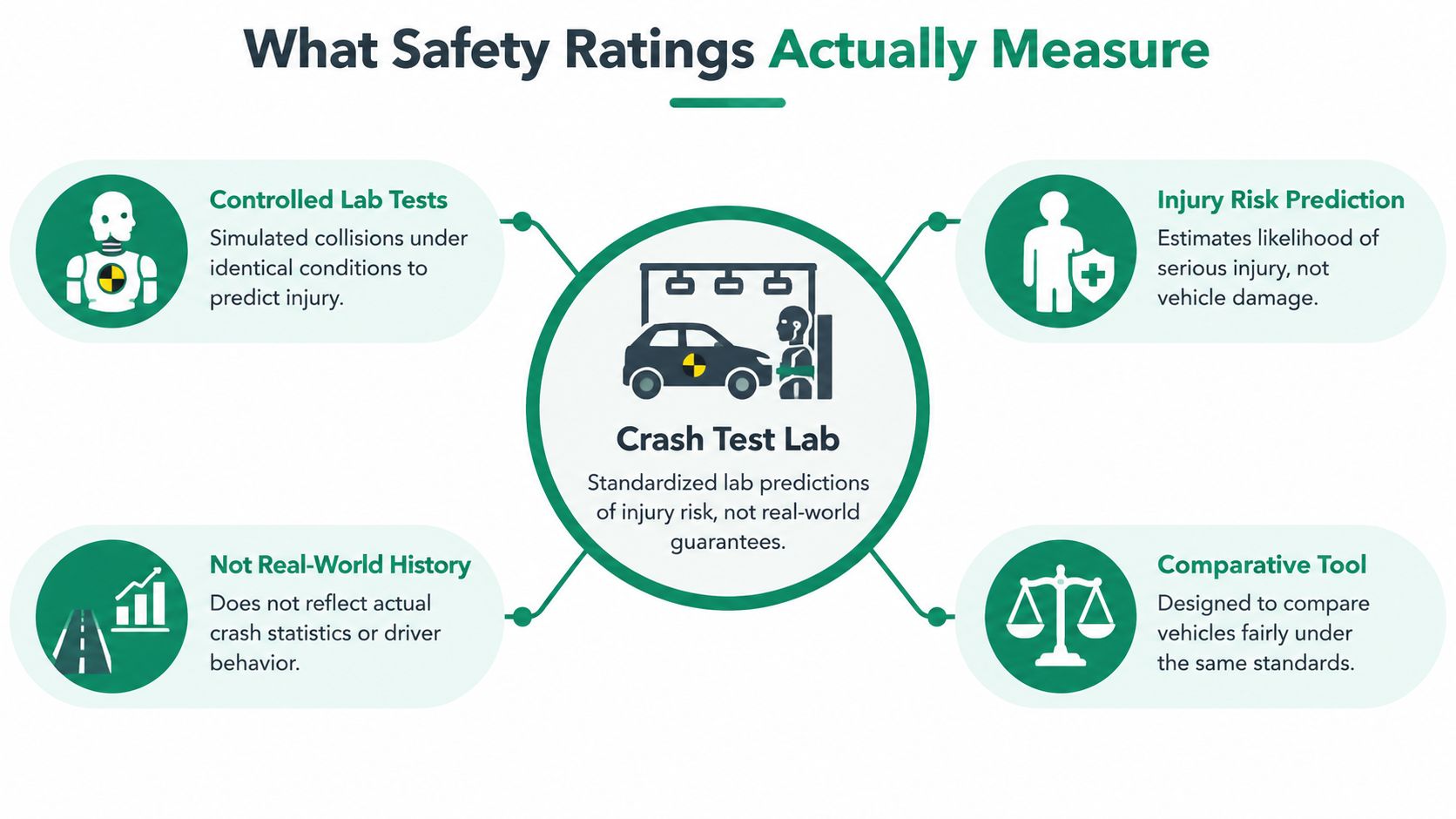
Think of a safety rating as a controlled report card, not a promise. The vehicle is placed through standardized evaluations, and the results estimate how well it may protect occupants or prevent certain crashes under those conditions. The system gives shoppers a common language for comparing vehicles that manufacturers might otherwise describe with broad marketing terms.
What the tests can tell you
Crash tests use controlled setups, instrumented dummies, and repeatable conditions. Those conditions allow evaluators to examine how a vehicle's structure, restraints, airbags, and safety technologies respond in particular scenarios. The result is an estimate of injury risk, not a prediction of exactly what will happen to every occupant in every real crash.
A rating can help answer questions such as:
- Does the passenger compartment remain protective in the tested impact?
- Do restraints and airbags manage occupant movement effectively?
- Does the vehicle offer technologies that can help avoid or reduce certain collisions?
- How does one tested vehicle compare with another under the same framework?
The focus is usually occupant protection and crash prevention, not repair cost or cosmetic damage. A vehicle can receive a favorable result while still suffering extensive damage in a severe collision. Conversely, a car with visible damage might have preserved its occupant compartment, but you can't determine that from appearance alone.
What the rating cannot tell you
Safety ratings don't record the complete real-world history of a used vehicle. They don't show whether a particular car has been in a crash, whether a replacement airbag was installed properly, or whether a repaired frame has returned to its original specifications. They also don't account for every driver decision, road condition, weather event, or impact angle.
For a practical example of a model-specific rating page, you can review Toyota Camry safety ratings for the 2024 model year. Use a page like this to understand the tested model, then keep the distinction clear: the page describes a vehicle configuration and rating result, not the condition of every used Camry sold today.
Regulatory compliance is another separate idea. A vehicle must meet applicable minimum legal requirements, while consumer safety programs provide additional comparative information. Passing a legal standard and earning a favorable consumer rating aren't interchangeable statements.
The simplest mental model is this: the rating describes how a vehicle performed in a defined evaluation, while the inspection and history report describe what happened to the individual car. You need both perspectives before buying.
How NHTSA 5 Star Ratings Work
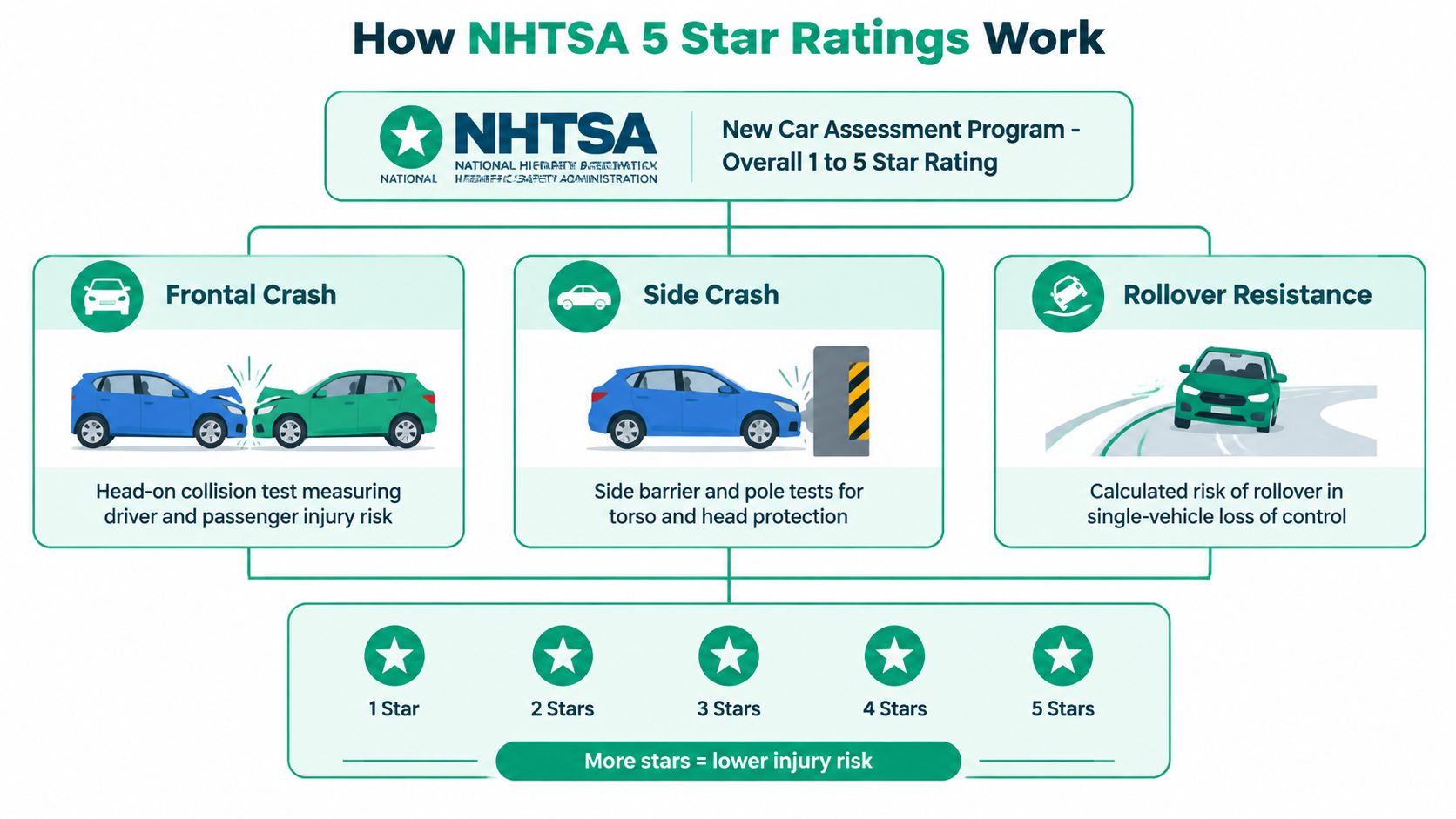
NHTSA's New Car Assessment Program, or NCAP, uses a 5-Star Safety Ratings system to communicate crash protection and rollover safety beyond minimum federal requirements. The rating comes from three broad evaluation areas: frontal crashes, side crashes, and rollover resistance, as described by NHTSA's official ratings information.
The three parts behind the stars
Frontal evaluation examines injury risk for occupants in a simulated head-on collision. The test considers how the vehicle's structure and restraint systems manage forces affecting the driver and passenger positions.
Side evaluation addresses impacts from the side, including barrier and pole scenarios. Side structures, seat belts, airbags, and the vehicle's ability to manage head and torso movement all contribute to the result.
Rollover resistance estimates the likelihood of rollover in a single-vehicle loss-of-control situation. It's a calculated assessment rather than a simple statement that a vehicle will or won't roll over in every emergency maneuver.
The overall star result combines these areas into a consumer-facing benchmark. A higher star count generally indicates a lower modeled risk of serious injury in the tested scenarios. That doesn't make the scale absolute. A three-star vehicle isn't automatically dangerous in every situation, and a five-star vehicle can't eliminate crash risk.
NHTSA stars are best read as a relative risk indicator, not a generic “safe” or “unsafe” label.
Why configuration matching matters
Used-car shoppers should avoid searching by model name alone. First verify the model year, body style, and, where relevant, the trim or equipment package. A manufacturer can make structural or safety-equipment changes during a production run, and those changes may affect how the tested vehicle represents the one you're considering.
A rating for a sedan may not apply without qualification to a wagon, coupe, or SUV variant. Optional equipment can also matter, particularly when it affects crash avoidance, lighting, restraints, or sensor operation. If the listing omits the exact configuration, treat the rating as incomplete evidence rather than a final answer.
This short video provides a visual introduction to the NHTSA-style evaluation areas:
The individual car still needs inspection after you understand its model rating. If a vehicle has deployed airbags, damaged belt pretensioners, or questionable restraint repairs, consult a qualified repair professional. Buyers who want background on restraint-related work can review information about our seat belt repair service, while remembering that online information doesn't replace an inspection of the car you're buying.
How IIHS Ratings and Top Safety Awards Work
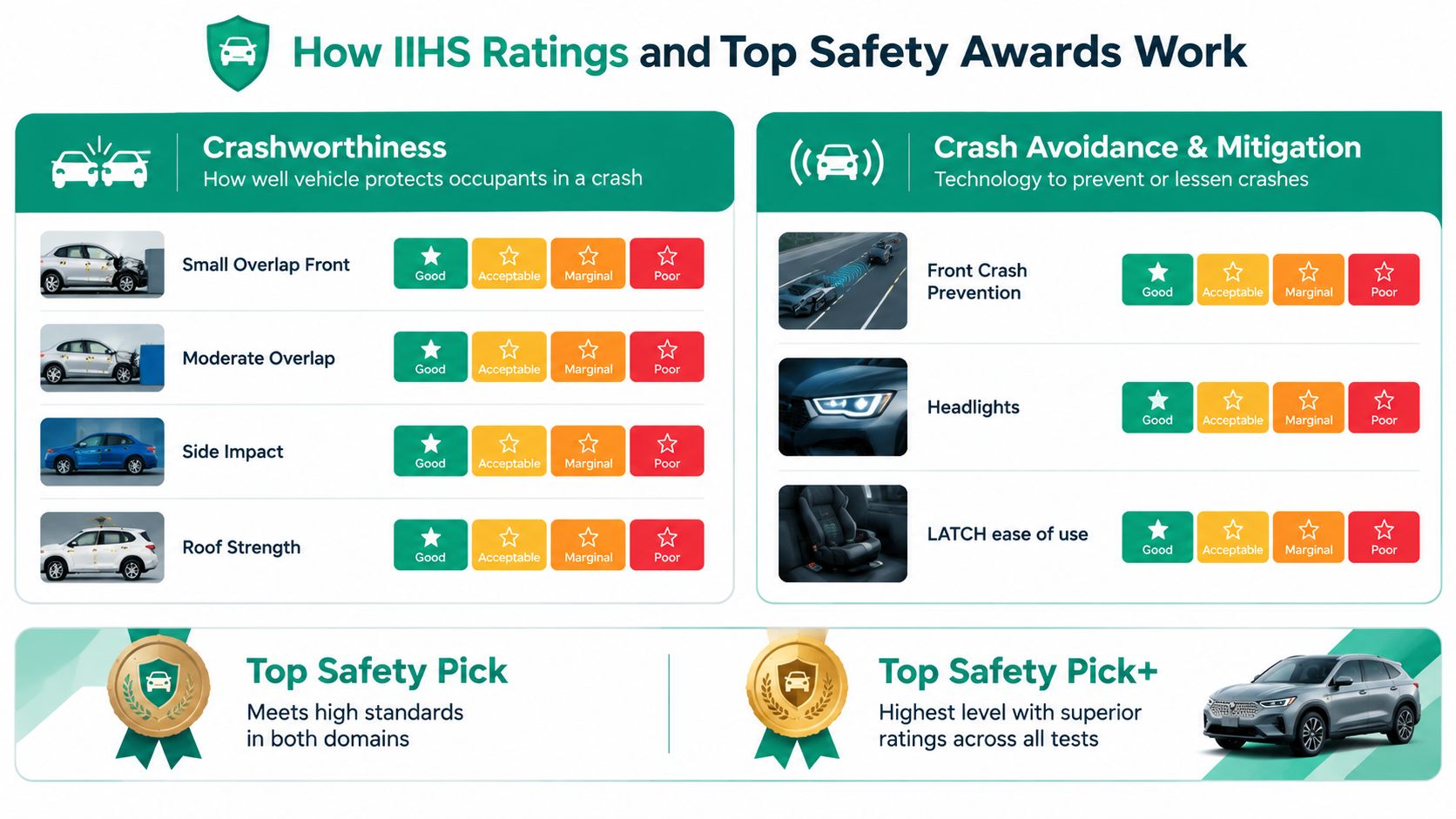
IIHS uses a more granular system than a simple star scale. Its evaluations cover two domains: crashworthiness and crash avoidance and mitigation. IIHS currently maintains ratings across eight tests, and it grades individual results as Good, Acceptable, Marginal, or Poor, according to IIHS ratings criteria.
Crashworthiness looks at protection during impact
Crashworthiness asks how well the vehicle protects its occupants once a collision occurs. The tests examine the vehicle's structure, restraint performance, and injury measures in different impact patterns. A vehicle may perform well in one type of crash and less well in another, which is why the individual grades matter.
The Good to Poor scale gives you more detail than a single overall star count. A buyer can see whether a model's result is consistently strong or whether one test pulls down its safety profile. Don't stop at an award badge if the underlying grades reveal a weakness relevant to your driving needs.
Crash avoidance evaluates what happens before impact
Crash avoidance and mitigation evaluates technologies that may help prevent a crash or reduce its severity. This domain can include front-crash-prevention performance and headlight performance, among other evaluated features. The technology only helps when it's present, functioning, and correctly maintained on the vehicle you're buying.
That creates an important cause-and-effect distinction. A strong occupant compartment may protect people well after a collision begins, while automatic emergency braking or effective headlights may help prevent the collision from occurring in the first place. These are related goals, but they aren't the same test.
IIHS's Top Safety Pick+ award requires strong results across updated crash tests along with acceptable or good headlight and front-crash-prevention performance. As a result, a vehicle can show solid crash protection yet miss the highest award because its lighting or crash-avoidance performance doesn't meet the required level.
A safety award is a summary of several requirements. Read the individual grades to find the reason behind it.
The award also may depend on equipment. If a used vehicle lacks the safety package evaluated by IIHS, you shouldn't assume it carries the same performance as a better-equipped version. Check the window sticker, original equipment information, and the vehicle's current condition before treating an active-safety result as applicable.
How to Compare Safety Ratings Across Models and Years
A fair comparison starts by matching the context behind each result. Star counts from different programs aren't automatically equivalent, and the same star count from different test years may reflect different requirements. The Euro NCAP announcement about its 2026 protocol changes describes the 2026 protocol as its biggest overhaul since 2009 and explains that ratings from different years aren't directly comparable because the criteria change over time.
That warning applies to a common used-car mistake: comparing an older five-star result with a newer five-star result as if both vehicles passed the same exam. A newer protocol may examine modern concerns such as driver monitoring, open-road assistance behavior, crash avoidance, and post-crash support in ways an older protocol didn't.
Build an equal comparison
Use this order when reviewing two vehicles:
- Identify the organization. Separate NHTSA, IIHS, Euro NCAP, and other programs instead of placing all stars and grades on one scale.
- Record the test year. The year tells you which criteria and protocol applied.
- Match the body style. Confirm whether the result covers the same sedan, SUV, hatchback, or other configuration.
- Check the tested equipment. Look for airbags, automatic emergency braking, headlights, and other features included in the evaluation.
- Read individual results. Don't rely on the overall badge when a detailed breakdown is available.
- Verify the specific car. Use the VIN, history report, recall information, and inspection to confirm that the vehicle matches the tested version and remains properly repaired.
The table below gives you a simple working document for two listings.
| Comparison Factor | Vehicle A | Vehicle B | What to Verify |
|---|---|---|---|
| Testing organization | Record the program | Record the program | Are the results from the same organization? |
| Test year | Write the year | Write the year | Did the protocol change between the results? |
| Body style | Note the configuration | Note the configuration | Does the tested body style match the listing? |
| Safety equipment | List relevant features | List relevant features | Was the tested equipment standard or optional? |
| Detailed results | Record grades or test areas | Record grades or test areas | Does one vehicle have a specific weak area? |
| Vehicle history | Note title, crash, and repair findings | Note title, crash, and repair findings | Does the individual car still match the tested condition? |
For a model-specific reference point, you can review Toyota Camry model information, then confirm the exact year and configuration before drawing a conclusion. The goal isn't to find the biggest number. It's to compare like with like.
Using Safety Ratings to Evaluate a Specific Used Vehicle
A model rating describes a tested vehicle. Your purchase decision concerns one physical car with one VIN, one repair history, and one set of installed equipment. That difference is where many buyers get caught.
Consider a family SUV that earned a favorable rating. The listing looks attractive, but the history report shows a previous collision with a branded title, and the seller can't provide clear documentation for airbag replacement. The original rating remains useful for understanding the SUV's design, but it doesn't prove that this repaired example retains the same protection.
Now consider a budget sedan with an ordinary-looking listing. Its model rating may be solid, the title may be clear, and the vehicle may have complete maintenance records. A careful buyer still checks for open recalls, verifies the installed safety package, and asks a technician to inspect structural areas and restraint components.
A practical vehicle-level workflow
- Start with the VIN: Decode the vehicle to confirm its year, make, model, body style, and equipment.
- Review the history: Look for accidents, salvage or rebuilt branding, flood events, theft records, mileage inconsistencies, liens, and auction activity.
- Check recalls: A favorable crash result doesn't mean the vehicle has no unresolved safety campaign.
- Confirm equipment: Compare the actual car with the tested version using its window sticker, build information, and visible safety hardware.
- Inspect the repairs: Ask for invoices and have an independent technician examine the structure, airbags, belts, sensors, and alignment.
A VIN lookup can consolidate vehicle identification, history indicators, recalls, and safety-rating information in one workflow. Toyota Camry VIN check information for the 2023 model year illustrates the kind of model and vehicle research buyers can perform before arranging an inspection.
Parents buying for inexperienced drivers may also want broader guidance, such as these expert picks for new drivers. Use those recommendations to create a shortlist, then apply the same VIN-specific checks to every candidate.
The key question is not whether the model once performed well. It's whether this exact vehicle has the right configuration, an acceptable history, working safety equipment, and documented repairs.
Making a Confident Decision With Safety Ratings
Safety ratings work best as a three-stage filter.
First, identify what the result means. NHTSA stars summarize frontal, side, and rollover evaluations, while IIHS grades separate crashworthiness from crash avoidance and mitigation. Don't compare a star count with a grade as if they were interchangeable.
Second, compare results fairly. Check the testing organization, test year, protocol, body style, and equipment. An older top rating and a newer top rating may not represent the same examination.
Third, validate the individual vehicle. Confirm the VIN, review title and accident history, search recalls, verify equipment, and arrange an independent inspection. A model-level rating can't reveal poor repairs or missing restraint components.
Keep this short checklist beside you while shopping:
- Program: Which organization produced the rating?
- Year: Which test year and protocol apply?
- Configuration: Does the tested body style and equipment match?
- Detail: What do the individual test results show?
- History: Has this specific vehicle had structural or airbag-related damage?
- Condition: Has an independent technician inspected it?
You don't need to fear safety ratings or treat them as a guarantee. Read them as evidence, compare them in context, and connect them to the vehicle's real history before you decide.
Use VinCheck to review a vehicle's VIN details, history indicators, recalls, and available safety-rating information before you commit to a purchase. Visit VinCheck to begin a vehicle-specific lookup and take the rating from a general model claim to a more informed buying decision.
About the author
VinCheck Editorial Team — Editorial Standards & Review
The VinCheck Editorial Team reviews every published article against NMVTIS data accuracy and NHTSA recall validity. This byline appears on collaborative pieces and quick-update posts.