 Vin
How to Lookup BMW Options by VIN
By VinCheck Editorial Team, Editorial Standards & Review · Published 2026-09-30 · Updated 2026-09-30 · Reviewed by VinCheck Editorial Standards
You're looking at a used BMW that appears to have the right trim, the right wheels, and the right options. The seller says it has the M Sport package, upgraded brakes, adaptive headlights, and premium equipment. But the window sticker is missing, the description may be copied from a listing, and the car could have been imported or modified. You need to know what BMW installed at the factory, not what the current owner believes is fitted.
A BMW option lookup by VIN can answer that question, but only if you understand what the lookup is doing. The VIN identifies the vehicle, while a separate BMW build-data record contains the factory option codes. The difficult part is translating those codes accurately, accounting for market differences, production-date changes, incomplete databases, and parts that were added after the car left the factory.
Table of Contents
- Understanding the BMW VIN and Build Sheet Connection
- Executing a Reliable BMW Option Lookup
- Decoding BMW SA Option Codes and Packages
- Why Your BMW VIN Lookup Might Show Missing Options
- Handling Older Classics and Gray Market Imports
- Final Verification Checklist for BMW Buyers
Understanding the BMW VIN and Build Sheet Connection
A seller may describe a BMW as an M Sport car with adaptive lighting and upgraded brakes, while the vehicle in front of you has different wheels, calipers, or headlights. The 17-character BMW VIN acts as a key for resolving that conflict. It identifies the vehicle and points a decoder toward associated production records, but it does not contain a plain-language equipment list by itself.
A reliable lookup therefore has two separate jobs. Vehicle decoding confirms the model, engine family, production plant, drivetrain, type key, and other identity details. Build-data decoding translates BMW's factory codes into equipment descriptions. The first job establishes which car the VIN represents. The second explains how that car was configured when it was ordered and produced.
The translation step causes many lookup errors. BMW records use market-specific equipment codes, package combinations, and production-date conventions. Older vehicles may have incomplete online records, while some databases expose only part of the original build data. A result can therefore identify the car correctly while still omitting options or displaying a description that needs manual checking. BMW's VIN and SA-code decoding guidance explains the separation between VIN identification and the vehicle's full option list.
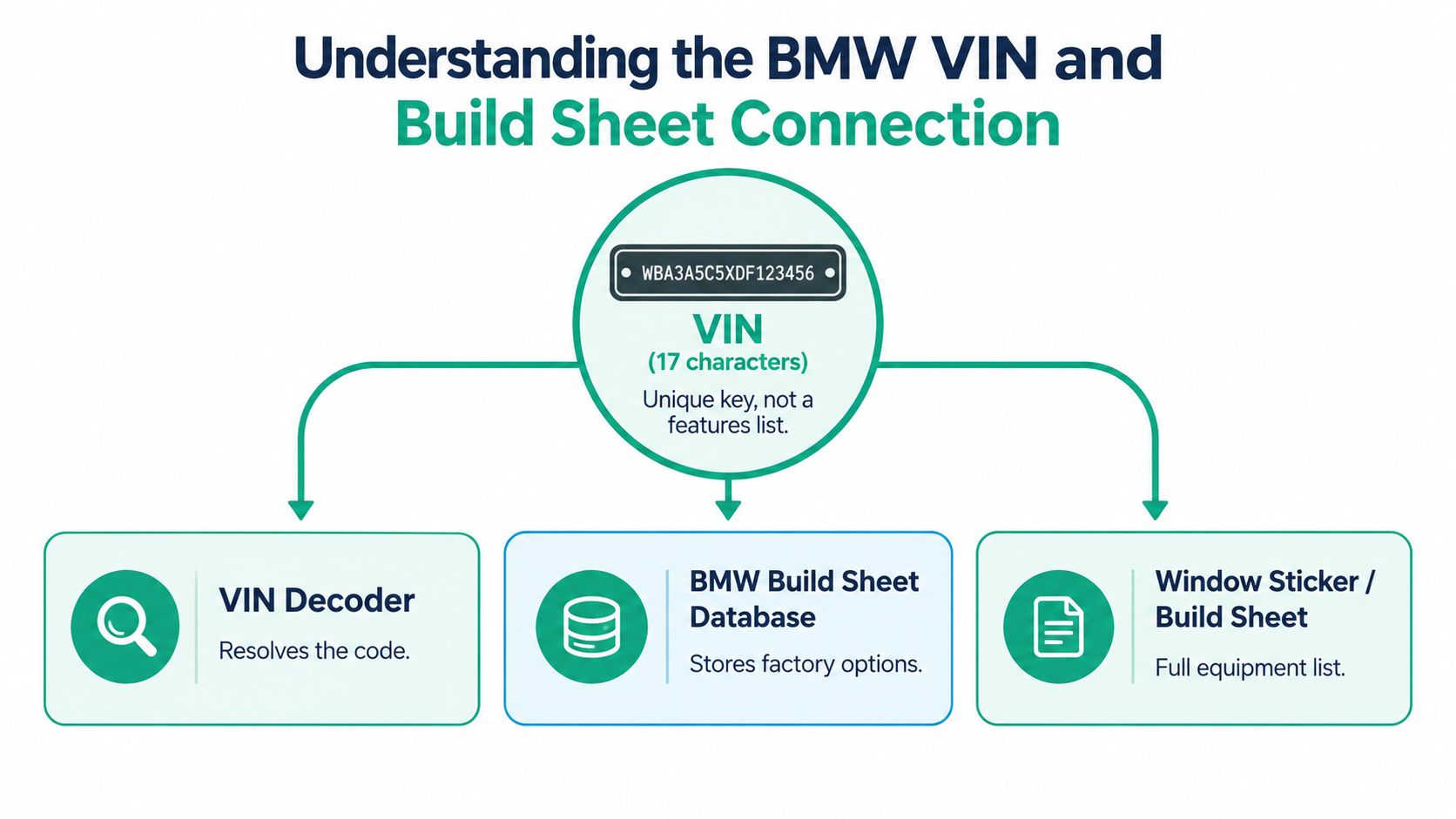
The VIN identifies the car
A vehicle-history report can provide registration, title, mileage, accident, or auction information. Use those records to examine the car's history, then use a BMW-specific decoder to examine its original configuration. The two sources answer different questions and should not be treated as interchangeable.
The VIN decoder should return the model and production identity, followed by the factory SA code translation. SA means Sonderausstattung, BMW's term for optional factory equipment. The codes are stored in build records associated with the VIN, and the decoder must translate them accurately for the result to be useful to a buyer.
Examples include 337 for the M Sport package, 704 for M Sport suspension, 2NH for M Sport brakes, and 552 for adaptive LED headlights. These codes offer stronger evidence of original specification than a trim label copied into an advertisement. BMW option-code references explain these code meanings and their connection to the vehicle configuration in this BMW option-code reference.
The build sheet supplies the detail
Look for a readable build sheet or SA-code list, then compare it with the physical car. Treat the record as evidence of factory equipment, not confirmation that every listed component remains installed. It may not show a later retrofit, dealer accessory, replacement interior, or repair-related parts change.
If the record lists M Sport brakes but the car has different calipers, inspect the parts and request supporting invoices. If adaptive lighting appears in the advertisement but not in the decoded record, ask the seller for documentation before placing a value on that claim. The VIN starts the verification process. It does not replace a physical inspection.
Executing a Reliable BMW Option Lookup
Run the lookup as a controlled verification process rather than entering a VIN and accepting the first screen of results. The objective is to establish three things: the VIN belongs to the vehicle, the decoded identity matches the car, and the translated option list is consistent with supporting documents and physical equipment.
Start with the complete VIN
Copy all 17 characters. Use the VIN from the dashboard, door-jamb plate, registration, title, and seller documentation where available. Don't rely on a shortened sequence if the service requests the full VIN. BMW lookup workflows have increasingly moved toward the complete 17-character identifier because it provides more precise vehicle matching.
Check the decoded identity. Confirm the model, engine family, production information, drivetrain, plant, and trim-level data against the vehicle in front of you. A mismatch can indicate a transcription error, incorrect paperwork, a database problem, or a more serious identity issue.
Retrieve the SA-code list. A BMW-specific service should expose factory options rather than only returning generic specifications. The result may present readable descriptions immediately, or it may show raw codes that require a separate translation layer.
Save the result. Download or print the build sheet if the service allows it. Record the date of the lookup and retain the original output with the purchase documents. Databases change, and a saved result gives you a fixed reference for later discussions with a seller, dealer, or repair shop.
Compare the output with documentation. The strongest confirmation comes from comparing the decoded build sheet with the original window sticker, order confirmation, dealer record, or other BMW documentation. A VIN-linked vehicle details report can be useful for the broader vehicle-identification stage, but a BMW buyer should still confirm that the selected service exposes factory option data for the relevant market and vehicle.
A window sticker helps because it expresses the original configuration in buyer-facing language. The build sheet is closer to the underlying production data, while the sticker can make package names, equipment groups, and factory pricing easier to compare with the seller's description. Neither document replaces a physical inspection, especially if the BMW has had multiple owners or significant modifications.
Use this practical comparison when reviewing the result:
- Identity match: The decoded model and drivetrain should correspond to the vehicle and its paperwork.
- Package match: Claimed packages should appear as relevant SA codes or documented package descriptions.
- Hardware match: The car should physically contain the equipment associated with valuable options.
- Document match: The build sheet, sticker, and order paperwork shouldn't materially contradict one another.
- Modification check: Differences should be classified as retrofits, replacements, dealer additions, or unresolved discrepancies.
The following video can help buyers understand the general lookup experience before they run their own vehicle:
Don't treat a clean-looking result as complete just because the page labels it “full.” The underlying data source may have stronger coverage for one market or model family than another. If an expensive option is central to the purchase decision, verify it through more than one form of evidence.
Decoding BMW SA Option Codes and Packages
A BMW build sheet rarely reads like a plain-language equipment list. It presents factory data as compact codes that must be translated into equipment, packages, and production context. Those entries can cover suspension, brakes, lighting, seats, upholstery, wheels, audio, communication systems, and driver-assistance features. The lookup is therefore a code-translation task, not a simple search for a package name.
BMW codes commonly appear as three- or four-character identifiers, often with an S-prefix and an A-suffix in BMW-style formatting. For example, one record may show S552A, while another displays 552. Both can refer to the same option. Normalize the format before comparing results. A decoder that treats S552A and 552 as unrelated entries may report missing equipment even when the factory code is present.
Read codes before trusting package names
BMW package names can change by market, model, and production period. The same label may include different hardware, while a feature sold separately in one region may be bundled into a package elsewhere. Review the individual SA codes instead of relying only on labels such as “M Sport” or “Luxury.”
| SA Code | Equipment Description | Category |
|---|---|---|
| 337 | M Sport package | Package and trim |
| 704 | M Sport suspension | Suspension |
| 2NH | M Sport brakes | Brakes |
| 552 | Adaptive LED headlights | Lighting |
These examples come from published BMW option-code references. Use the code as the starting point, then confirm that its description matches the vehicle's market and production context. A database can retrieve a valid code and still attach a vague, outdated, or incorrect translation. That limitation matters when a package affects the asking price. After confirming the equipment, compare it with a used car value estimate to see whether the claimed specification is reflected in market pricing.
Separate factory equipment from appearance
M Sport bumpers, aftermarket wheels, or an M badge do not prove that the car left the factory as an M Sport build. Owners can replace exterior parts without changing the original build record. The same issue applies to suspension, steering wheels, seats, headlights, audio equipment, and brakes.
Use the SA code to identify the claimed equipment, then inspect the corresponding hardware. For M Sport suspension, check the springs, dampers, and related components. For M Sport brakes, compare the calipers and rotors with the expected specification. Adaptive headlights require the correct lamp assemblies and operating functions. Similar-looking parts are not sufficient evidence.
Understand the breadth of the option space
BMW's code system extends well beyond headline packages. Aggregated references describe inventories containing roughly 1,671 distinct option, color, upholstery, and wheel codes, showing why unnormalized text searches can return incomplete or misleading matches. The BMW option-code database documents that breadth.
Do not infer every package component from one code. Confirm what the code means for that model, market, and production period, then check the related equipment on the car. A translated result gives you a workable lead. Physical inspection and supporting records determine whether that translation describes the BMW you are buying.
Why Your BMW VIN Lookup Might Show Missing Options
A sparse build sheet doesn't automatically mean the BMW lacks equipment. It may mean the decoder found the vehicle identity but couldn't retrieve or translate every factory code. This is one of the most important limitations to understand before rejecting a car or accepting a seller's explanation.
BMW factory data can be fragmented by region, packaging rules, production-date changes, and database coverage. Two cars with the same model and model year can have different equipment because they were built for different markets or ordered under different option structures. A North American specification may not map cleanly to a European or other-market build, even when the cars appear identical from the outside.
Production date can matter more than model year
The model year is a broad label. BMW can change equipment, package content, supplier components, or option availability during a production cycle. A decoder that translates an option using a generic model-year description may therefore provide a result that is technically plausible but not sufficiently precise for the individual vehicle.
Market packaging creates another complication. BMW may list an item as a standalone option in one region and include it inside a package in another. A translation table built from one market's ordering guides can omit, rename, or misinterpret codes from another market. The BMW build-data discussion describes the international nature of BMW, MINI, Rolls-Royce, and BMW motorcycle decoding, while also illustrating why the source and scope of the underlying data matter.
Practical rule: A missing code is a prompt to investigate, not proof that the equipment was never fitted.
Distinguish incomplete data from a modified car
Start by comparing the sparse result with the physical vehicle. If the car has a feature that the database doesn't display, look for a window sticker, original order sheet, dealer printout, service invoice, or market-specific documentation. An original sticker can establish what was ordered, while an inspection can show whether that equipment remains installed.
Dealer-installed accessories and later retrofits normally won't appear as factory SA codes. The same is true of replacement parts from another trim level. A Harman Kardon grille, an M Sport steering wheel, or a set of larger wheels can be installed after delivery. The factory record and the current hardware may both be genuine, but they describe different points in the car's history.
Use the lookup output with the right level of confidence:
- High confidence: The code, supporting document, and physical equipment agree.
- Moderate confidence: The code is present, but the translation needs market or production-date confirmation.
- Low confidence: The result is partial, the VIN identity is uncertain, or a valuable feature exists only in the seller's description.
- Unresolved: The database and vehicle contradict each other without documentation explaining why.
This approach prevents a common error, which is treating “not shown” as “not fitted.” It also prevents the opposite error, accepting every visible feature as original factory equipment.
Handling Older Classics and Gray Market Imports
Modern VIN tools work best when the vehicle has a standardized 17-character VIN and a corresponding digital build record. Older BMWs can fall outside that workflow entirely. Pre-1981 vehicles may not use the modern 17-character format, so a contemporary decoder may reject the identifier or return information that says little about the car's original specification. The limitations of classic BMW identification are outlined in this classic BMW VIN and records guide.
A failed lookup is useful if you treat it as a diagnostic result. It tells you to stop forcing the vehicle through a modern decoder and move to records that match its age and history.
Triage the identifier first
Check the VIN at every available location, including the chassis plate, stamped body area, registration documents, service records, and import paperwork. Older cars may have shorter identification formats, while gray-market imports can carry documentation that doesn't align neatly with the conventions used by the country where you're searching.
Look for consistency rather than assuming the first legible number is correct. A mismatch can result from a replacement body panel, corrosion, restoration work, a transcription error, or a more serious identity problem. Document each version before contacting an archive, specialist, or seller.
Use period documentation when digital data stops
For a classic BMW, useful evidence may include the original sales invoice, dealer order sheet, delivery record, factory color and trim record, period parts documentation, service booklet, import file, or restoration photographs. BMW Classic or archive records may provide a more suitable route than a general-purpose VIN website, particularly when the vehicle predates standardized digital records.
Don't expect a modern tool to recreate a complete build sheet for every historic car. A partial result can still help identify the chassis or production context, but it shouldn't be used to certify originality on its own. For a collector vehicle, the provenance file often matters as much as the decoded identity.
Treat modified imports as layered evidence
A gray-market BMW may have received lighting, emissions, safety, suspension, or interior changes to meet local requirements. Those alterations may be necessary and legitimate, but they won't necessarily appear in the original factory record. A swapped engine, transmission, dashboard, control module, or body panel creates another separation between the VIN-linked build and the current car.
Build a record with separate labels:
- Factory evidence: Original BMW records and period documents.
- Import evidence: Customs, registration, compliance, and conversion records.
- Current condition: Parts and systems installed today.
- Unverified claims: Equipment mentioned by the seller without supporting evidence.
That structure keeps a partial decode from becoming a false guarantee. If the car has missing stickers, swapped modules, or extensive restoration work, pay for a specialist inspection and ask for documentation before treating an option claim as part of the vehicle's value.
Final Verification Checklist for BMW Buyers
A decoded build sheet answers one question, which is what BMW recorded at production. The car inspection answers another, which is what you will receive. Buyers get into trouble when they use one as a substitute for the other.
Start with the identity. Match the VIN on the dashboard, chassis plate, paperwork, and lookup result. Confirm that the model, engine family, drivetrain, body style, and production information make sense for the vehicle. If those basics don't align, stop the option analysis until the identity issue is resolved.
Then audit the high-value claims first. Don't spend equal time on every code when the purchase decision depends on a few specific features.
- M Sport package: Compare the SA-code result with the bumpers, steering wheel, seats, trim, wheels, and other equipment claimed in the listing.
- M Sport suspension: Check whether the installed suspension hardware corresponds with the factory configuration. Don't infer it from badges or appearance.
- M Sport brakes: Inspect the calipers, rotors, and related hardware. A painted caliper isn't evidence of the original brake package.
- Adaptive lighting: Confirm the lamp assemblies and functions rather than relying on the presence of LED headlights.
- Interior and audio: Compare seat materials, trim, speaker grilles, controls, and amplifiers with the translated build information.
- Dealer additions: Mark accessories, protection products, tow equipment, wheels, and other additions separately because they may not be part of the factory record.
Reconcile every contradiction
If the seller claims an option that doesn't appear, request the original window sticker or order documentation. If the code appears but the equipment is absent, ask whether the component was removed, replaced, or damaged. If the physical item is present but the database is silent, classify the result as incomplete until another reliable record supports it.
A useful inspection file includes the decoded build sheet, photographs of the VIN locations, photographs of claimed option hardware, service invoices, and written answers to unresolved questions. This makes it easier to negotiate without relying on memory or sales language.
The strongest specification is the one supported by a code, a document, and a physical part.
The option lookup should also sit beside a broader vehicle review. History, mileage consistency, title status, recalls, accident records, and safety information can change the purchase decision even when the factory equipment is exactly as advertised. A VIN-based safety and recall lookup is one example of the separate checks that belong in the buyer's due-diligence file.
Before signing, assign each major option a confidence level. Confirmed means the records and car agree. Probable means the evidence is strong but one source is missing. Unverified means the claim comes only from the listing or visual appearance. That simple classification stops attractive equipment descriptions from becoming part of the price you pay.
VinCheck offers VIN decoding, vehicle history reporting, window sticker lookup where supported, mileage checks, title and salvage information, recalls, and safety data in one online service. Use the VinCheck tools to establish the BMW's identity and available original-equipment records, then compare the result with the physical car and any BMW documentation before you buy.
About the author
VinCheck Editorial Team — Editorial Standards & Review
The VinCheck Editorial Team reviews every published article against NMVTIS data accuracy and NHTSA recall validity. This byline appears on collaborative pieces and quick-update posts.