 Vin
Lien Status Check How to Verify a Clean Title Fast
By VinCheck Editorial Team, Editorial Standards & Review · Published 2026-09-17 · Updated 2026-09-17 · Reviewed by VinCheck Editorial Standards
You're standing beside a used car that looks perfect. The seller has the keys, the paper title appears genuine, and you're ready to send the payment. Then the DMV refuses the transfer because a lender's security interest is still attached to the vehicle. The seller may insist that the loan was paid off, but your problem remains until the lien is officially released in the title record.
A lien status check helps you identify that risk before money changes hands. It can show whether a lender or another claimant still has an interest connected to the vehicle identification number, or VIN. It can also reveal why a simple “no lien” statement from a seller isn't always enough. The record may be incomplete, the vehicle may have moved between states, or a payoff may not yet have been recorded through the correct paper or electronic process.
If you're evaluating an electric vehicle, combine the title review with a broader buying a used EV checklist so you're not checking ownership risk while overlooking condition, battery, or safety questions.
This guide starts with the basic idea of a lien, then follows the record from federal title infrastructure to state DMV systems. You'll learn how to search with a VIN or plate, how to compare paper and electronic release evidence, and how to investigate vehicles that have crossed state or national borders. By the end, you'll have a repeatable way to decide whether a vehicle can transfer cleanly before you commit to the purchase.
Table of Contents
- What a Lien Means and Why It Stays With the Vehicle
- Where Lien Records Live From NMVTIS to State DMV Systems
- How to Check Lien Status Step by Step With VIN and Plate
- How to Confirm a Lien Is Truly Released and Title Will Transfer
- Handling Multi State and Cross Border Lien Risks With Real Examples
- Next Steps If a Lien Is Found and How to Protect Your Purchase
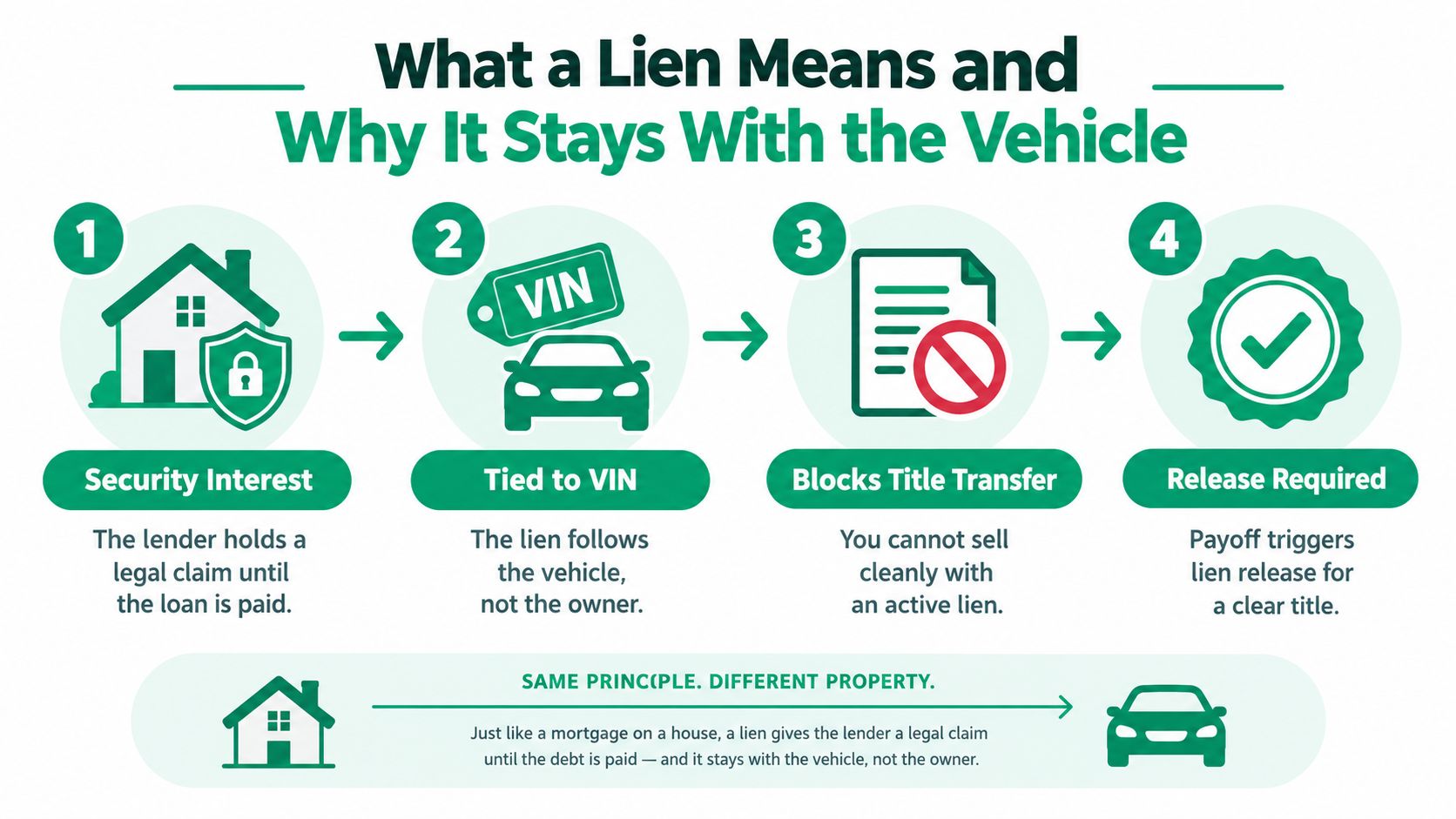
What a Lien Means and Why It Stays With the Vehicle
A vehicle lien works much like a mortgage on a house. A bank may lend money to buy a home, but the borrower doesn't hold completely unrestricted ownership until the debt is satisfied and the mortgage is released. With a car, the lender's security interest is recorded against the vehicle title and connected to the VIN.
That connection matters because the lien follows the vehicle, not the seller. If the owner sells the car while the lien remains active, the buyer may receive possession without receiving clear title. The seller's promise that the debt has been paid doesn't replace the official release record.
Read the title record as a chain
A useful lien review asks four connected questions:
- How many liens appear? One vehicle can have more than one recorded interest, so don't stop after finding the first lender.
- Who is the lienholder? The lender's name should match the financing or release documents supplied by the seller.
- When was the interest recorded? Lien dates can help explain whether the claim relates to the current loan or an earlier transaction.
- Is the status active or released? “Paid” and “released” aren't interchangeable. The record should show that the security interest was formally cleared.
An unreleased lien can block title transfer and may expose a buyer to repossession risk if the underlying obligation wasn't properly satisfied. The same issue affects dealers accepting trade-ins and lenders deciding whether a vehicle provides reliable collateral.
Practical rule: Treat a lien as cleared only when the issuing authority or its electronic title system records the release, or when the relevant DMV confirms that the supplied paper release is sufficient for transfer.
The paper title alone can mislead you. A seller may hold a document that looks clean while the state's electronic record still names a lender, or the paper may be missing a required release notation. The VIN printed on the car, title, report, and release documents must match before you rely on any of them.
Where Lien Records Live From NMVTIS to State DMV Systems
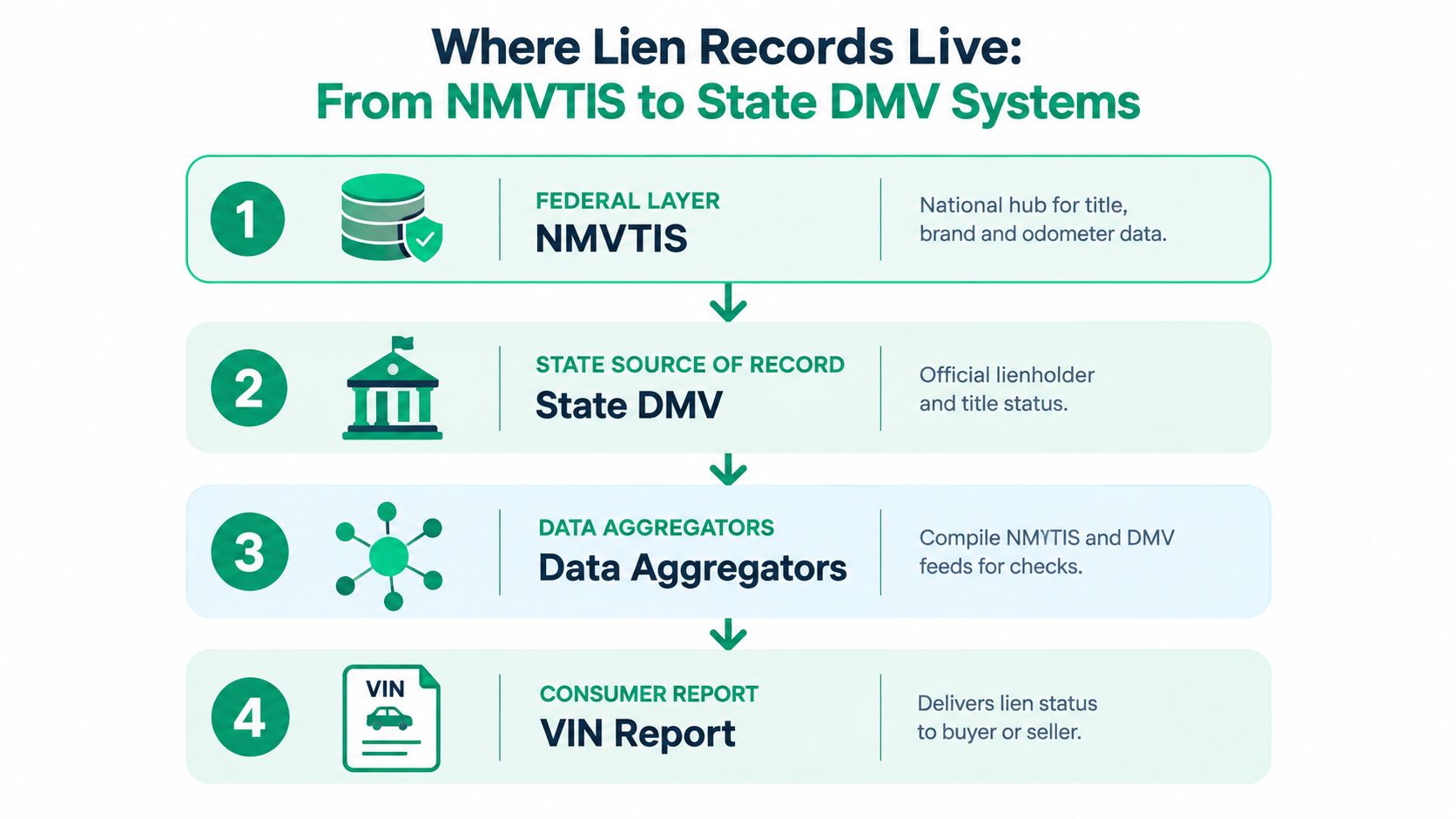
A vehicle lien status check depends on several connected records, not one universal public file. The National Motor Vehicle Title Information System, or NMVTIS, is the main public framework supporting national title-history checks. Federal guidance says buyers can use NMVTIS-related information to review a vehicle's current title, brand history, latest reported odometer reading, and, when available, historical theft data before purchase. Federal NMVTIS program guidance also explains that NMVTIS is designed to help protect consumers from fraud and unsafe vehicles and to help prevent stolen vehicles from being resold.
NMVTIS also supports cross-state title verification. A state motor vehicle agency describes the system as allowing titling agencies to compare paper-title information with electronic data from the state that issued the title. That cross-state function matters because a vehicle may have a title history in one jurisdiction and a current registration in another.
The state DMV remains central
NMVTIS itself doesn't contain lienholder address information or detailed repair history. Federal program guidance also states that lien and theft data remain maintained by the state DMV that issued the title. That makes the issuing DMV the source of record for lien changes, including releases and corrections.
A consumer report can aggregate available information from NMVTIS and state feeds, but it can't manufacture a missing filing. Provider language commonly identifies lienholder names only when available, and industry title-check guidance warns that lien data doesn't cover every motor vehicle because not all lienholders provide data to the source. A report that shows no lien is useful screening evidence, but it isn't an absolute guarantee that no claim exists anywhere.
This is why a thorough check often combines:
- An NMVTIS-based history search, to identify title movement and brands across states.
- The current state DMV record, to confirm the official lien status.
- Prior-jurisdiction research, when title history shows the vehicle previously belonged to another state.
- Release-document validation, if the seller says a recorded lien has been paid.
Arizona's motor vehicle agency illustrates the practical change created by online access. Buyers can check title status using a VIN and look for current financial or operation-of-law liens instead of depending solely on an in-person DMV visit. That convenience makes preliminary screening faster, but it doesn't remove the need to confirm an unclear or conflicting result with the responsible DMV.
The right mental model is a layered one. NMVTIS helps connect title history across jurisdictions, aggregators make that information easier to review, and the state DMV controls the official lien record. If any layer is incomplete or outdated, the buyer should pause rather than treat a clean-looking report as conclusive.
How to Check Lien Status Step by Step With VIN and Plate
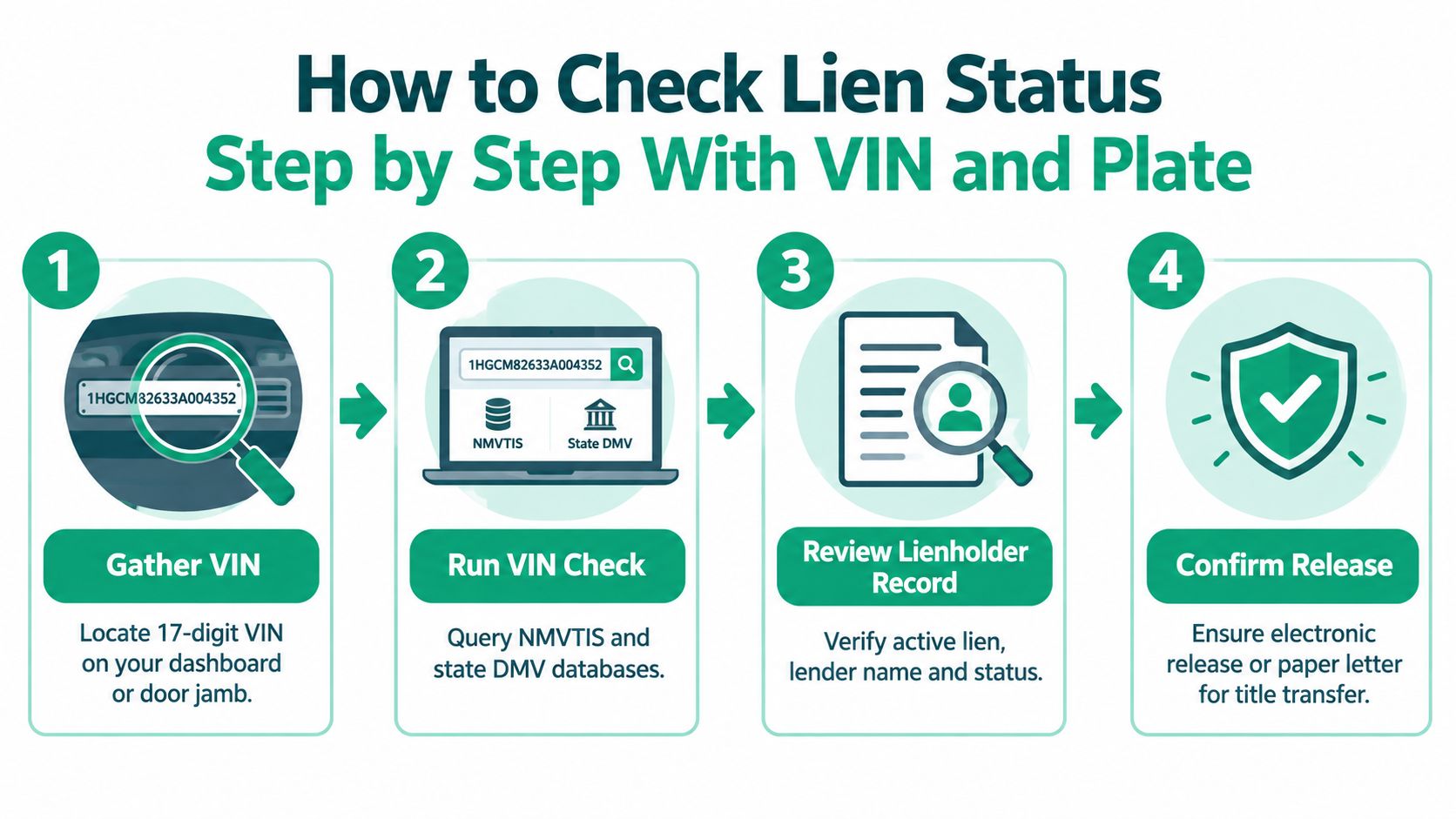
Start with the VIN, not the seller's description. Locate the vehicle identification number on the dashboard or driver-side door area, then compare it with the title, registration, insurance documents, and any finance or release paperwork. A mismatch is a stop sign because even a correct search produces the wrong answer when it uses the wrong vehicle.
Begin with an online history search
Run the VIN through an NMVTIS-based vehicle history service. Review the title state, brand history, theft information when available, odometer reporting, and any listed lienholder information. Don't read only the first summary line. Open the detailed title events and note where the vehicle was titled, because those jurisdictions determine where additional confirmation may be needed.
If you only have the license plate, use a plate lookup that can connect the plate to a VIN-linked record. Plates can change when a vehicle moves or changes owners, so use the result to recover and verify the VIN rather than treating the plate as a permanent identity.
For a second reference point, you can compare a VIN-specific vehicle page such as this Toyota Camry VIN check. The point isn't to rely on one display. It's to make sure the vehicle identity and reported title indicators remain consistent across the records you review.
Ask the issuing DMV for authoritative confirmation
Once you know the current and prior title states, contact the appropriate DMV or motor vehicle agency. Ask what its title record shows for:
- Lien count, including whether more than one security interest is recorded.
- Lienholder identity, including the exact name shown in the record.
- Lien dates, which can help distinguish current and historical interests.
- Release status, including whether the release has been entered electronically or accepted from paper documentation.
Some states provide online title or lien searches, while others require a formal record request or involvement from the owner. Follow the state's process rather than assuming a national report can replace the official record.
Validate the release, not just the payoff
If the seller says the loan is paid, request the lender's release documentation and compare the VIN. Then ask whether the lender transmitted an electronic release or whether the buyer must present an original letter or title to the DMV.
The filing process can also matter for lenders. Kansas, for example, requires a secured interest to be filed within 30 days of purchase to perfect the lien, as described in state guidance summarized through electronic lien and title practices from AAMVA. AAMVA also notes that lienholders can transmit electronic updates when releasing security interests or correcting filing errors. This reinforces the practical check: confirm the VIN, confirm the lender, and confirm that the release has been recorded.
For vehicle tax and registration context, a car tax checker from Scrap A Vehicle may help you review related vehicle details, but tax status isn't proof of clear title. Keep the ownership and lien inquiry focused on title records and lender releases.
Don't pay a private seller in full while the answer remains “the lender is handling it.” Arrange for the lender, seller, buyer, and DMV process to be clear before closing. For a dealer or lender, retain the report, title copy, VIN photographs, correspondence, and release evidence so another person can audit the transaction later.
How to Confirm a Lien Is Truly Released and Title Will Transfer
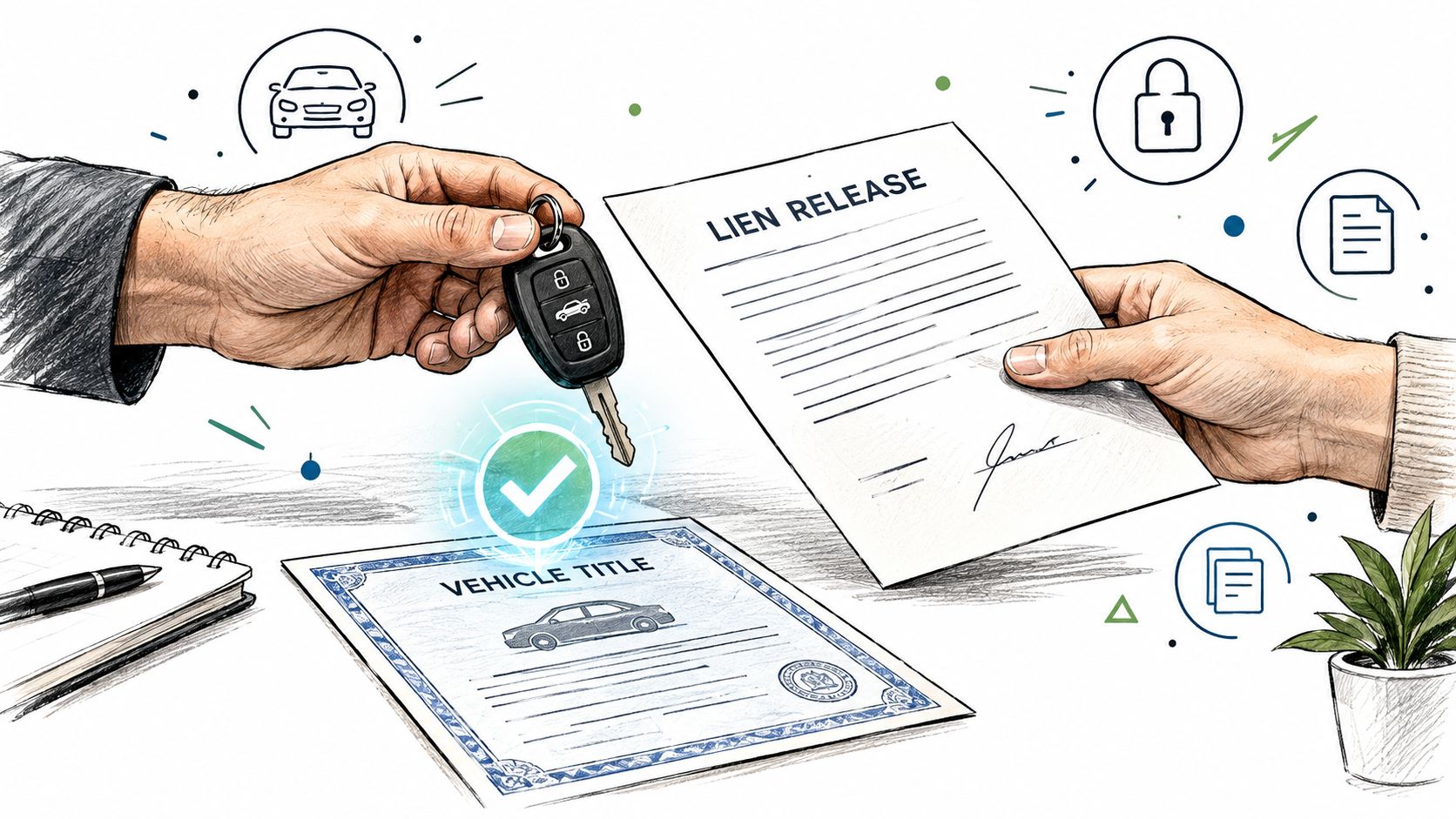
A loan payoff and a title release are related, but they aren't the same event. The borrower may have paid the balance, yet the lender still needs to file or transmit the release and the DMV must update the title record. Until that happens, the vehicle can remain encumbered in the system that controls transfer.
Paper release and electronic release are different
With a paper-based process, the lender may provide an original lien release letter or a title carrying the appropriate release information. The buyer still needs to confirm that the receiving DMV accepts that document and that no additional owner signature, inspection, or application is required.
With an electronic lien and title, or ELT, process, the lender controls the electronic title record and sends a release through the state's approved system. A paper letter in the buyer's hand may not be enough to transfer ownership if the digital record remains active.
| Record situation | What it may mean | What to verify |
|---|---|---|
| Paper title shows a lender | The lien may still be active or the release may be incomplete | Ask for the original release and DMV acceptance requirements |
| Seller provides a payoff receipt | The debt may be paid, but the title may not be updated | Confirm that the lender sent the release |
| Electronic record names a lender | The vehicle remains digitally encumbered | Obtain confirmation of electronic release |
| Lender no longer operates | Standard release contact may be unavailable | Ask the DMV about its special procedure |
Illinois' move to mandatory electronic lien and title processing for many institutions in 2026, reported in guidance on lien release procedures, shows why buyers need to ask whether a record is paper-based or digitally controlled. State procedures can also differ when a lender has closed, merged, or stopped responding.
Use a transfer-ready verification
Before paying, ask the seller to authorize direct confirmation with the lender or DMV. Match the VIN on every document, verify the exact lienholder name, and request written confirmation that the release has been recorded. If the state says the electronic release hasn't arrived, treat the lien as unresolved even if the seller shows a bank receipt.
A vehicle-specific reference such as this Toyota Highlander VIN check can help organize title and history information, but the issuing DMV remains the authority for recording the lien change. Your decision should rest on the combination of the report, the official record, and acceptable release evidence.
The question isn't whether the seller says the loan is finished. The question is whether the title system agrees.
If a lender is unavailable, don't improvise a release letter or accept an informal email as a substitute. Ask the DMV what affidavits, court documents, indemnity forms, or replacement-lender records it requires. Requirements vary by jurisdiction, so confirm the exact process before completing the sale.
Handling Multi State and Cross Border Lien Risks With Real Examples
A single-state search can miss a problem when the vehicle has moved. Consider a car first titled in Georgia and later sold to a buyer in New York. The New York record may be the current source for transfer, but the Georgia title history can explain an earlier lender interest, an unresolved release, or a title event that deserves direct confirmation.
New York DMV guidance treats title and lien status as a jurisdiction-specific record, and its title or lien status instructions emphasize the need to work with the relevant government records. The practical lesson is simple: identify every place where the vehicle was titled or registered, then decide whether each jurisdiction needs a search or confirmation.
Follow the vehicle's title trail
Use the title history to create a jurisdiction list. Search the current state first, then investigate previous states when the record shows a transfer, a prior title, or an unexplained gap. Pay particular attention to a recent interstate sale, a seller who can't produce the prior title, or a lien release issued by a lender in another state.
For example, if a Georgia lender appears on an older title and the current New York record doesn't clearly show the release, ask both agencies how the lien was carried forward and cleared. Don't assume that a new registration automatically erased the earlier interest.
Cross-border vehicles require the same discipline. Independent guidance notes that a Canadian vehicle may require searches in every province and territory where it was registered. A vehicle that moved between Canadian jurisdictions, or between Canada and the United States, may have records distributed across agencies rather than presented in one complete report.
Apply a risk-based expansion
Expand the search when you find:
- Multiple prior jurisdictions: Contact each relevant title authority when the history shows several moves.
- Unclear ownership changes: Ask for documents covering unexplained transfers or gaps.
- Different lender locations: Confirm releases with the lender or agency connected to the earlier title.
- Cross-border history: Search the relevant provinces, territories, states, and import records as applicable.
- Conflicting vehicle identity: Stop if VIN, title, plate, or history details don't align.
For a vehicle with a complicated ownership trail, a Ford F-150 VIN check can be used as an additional history reference, but it shouldn't replace direct confirmation from the jurisdictions that controlled earlier titles. The more places the vehicle has lived, the more carefully you should prove that every recorded interest was released.
Next Steps If a Lien Is Found and How to Protect Your Purchase
An active lien doesn't always end a transaction, but it changes who must participate. Ask the lienholder for a current payoff process, direct the payment to the lender when appropriate, and require the recorded release before treating the vehicle as transferable. A lender-assisted closing or controlled escrow arrangement can reduce the chance that the seller receives funds without clearing the debt.
If records conflict, pause. Give the seller a written list of the missing items, such as DMV confirmation, an electronic release, an original lien release letter, or proof that the correct state agency has updated the title. If the data is incomplete, remember that lien reporting doesn't include every vehicle or every lienholder, so combine the check with title-brand, theft, odometer, and ownership-risk review.
The safest decision is usually the clearest one: don't pay in full until the title can transfer cleanly. Sellers should resolve the record before advertising the vehicle as lien-free, while dealers and lenders should preserve the VIN match, report, title documents, and release trail.
VinCheck provides VIN and license plate lookup tools, with full vehicle history reports that can include title, lien, theft, mileage, salvage, recall, and related records. Run the vehicle's details through VinCheck before finalizing the deal, then use any flagged lien information to obtain confirmation from the responsible DMV or lender.
About the author
VinCheck Editorial Team — Editorial Standards & Review
The VinCheck Editorial Team reviews every published article against NMVTIS data accuracy and NHTSA recall validity. This byline appears on collaborative pieces and quick-update posts.