 Vin
How to Odometer Rollback Detection: A Buyer's Guide
By VinCheck Editorial Team, Editorial Standards & Review · Published 2026-09-24 · Updated 2026-09-24 · Reviewed by VinCheck Editorial Standards
You're halfway through a test drive when the car feels older than the odometer says. The dashboard shows low mileage, but the brake pedal is polished, the driver's seat bolster is crushed, and the steering wheel has the shine of a much harder life. The seller says the vehicle was “barely driven.”
The right question isn't how to odometer rollback. It's how to detect it without crossing the legal line into tampering. Treat mileage verification as a triangulation job. Compare the dashboard with physical wear, documents, title records, service history, and, where available, electronic control-module data. One clue can be explained away. Several independent clues pointing in the same direction should stop the deal.
Table of Contents
- Why Odometer Rollback Still Matters in 2026
- Where Rollback Fraud Is Hitting Hardest
- Physical and Document Clues You Can Check Today
- Reading a Vehicle History Report for Mileage Red Flags
- Digital Odometers and Cross-Border Title Transfers
- Reporting Suspected Mileage Fraud and Next Steps
- A Buyer's Checklist and Final Recommendations
Why Odometer Rollback Still Matters in 2026
Odometer fraud remains a direct buyer-protection problem, not an outdated trick involving only mechanical number wheels. The National Highway Traffic Safety Administration's odometer-fraud guidance says more than 450,000 vehicles are sold each year with false odometer readings and that the resulting consumer losses exceed $1 billion annually. A related federal safety analysis estimates a 3.47% lifetime incidence rate over the first 11 years, roughly 1 in 29 vehicles, with an estimate of about 452,000 cases per year in the United States (federal NHTSA analysis).
The law has been dealing with this problem for a long time. The nationwide prohibition on odometer tampering dates to 1972, while federal reforms in 1988 and 1994 strengthened mileage disclosures and penalties, according to NHTSA's historical summary. That history tells you something important: rollback has been persistent enough to require repeated legislative updates.
Inspector's rule: Never verify mileage from the dashboard alone. Verify the story the entire vehicle is telling.
Modern fraud can involve a digital instrument cluster, electronic memory, replacement modules, incomplete service records, and title transfers between jurisdictions. A clean-looking digital display proves very little by itself. NHTSA specifically warns that digital odometers can be reprogrammed to show lower mileage, which is why title comparisons and service-history checks matter even when the screen looks perfect.
This guide won't explain how to alter an odometer. That would help the wrong person. It focuses on detection, lawful documentation, risk assessment, and the point at which a buyer should stop negotiating and leave.
Where Rollback Fraud Is Hitting Hardest
Risk isn't distributed evenly across the used-car market. CARFAX mileage-fraud data reports more than 2.45 million vehicles on the road with rolled-back odometers, up 14% from the previous year. California accounts for 532,200 suspected cases, while Texas accounts for 333,900.
Those figures don't mean every vehicle in either state is suspect. They show where a buyer may encounter a larger pool of affected vehicles, especially in markets with high inventory turnover, large auction networks, frequent dealer transfers, and vehicles moving across state lines. Florida is also listed among the major affected markets, and cross-border or interstate movement can make a mileage trail harder to follow.
CARFAX also reports substantial year-over-year increases in several states, including Montana at 33%, Tennessee at 30%, Arkansas at 28%, Oklahoma at 25%, Kansas at 24%, New Jersey at 21%, and Florida at 20%. Those changes are useful as warning signals, not as a substitute for inspecting a particular VIN.
| State | Reported suspected cases or increase | Practical risk consideration |
|---|---|---|
| California | 532,200 suspected cases | Large vehicle market and high turnover |
| Texas | 333,900 suspected cases | High-volume inventory and interstate movement |
| Montana | 33% year-over-year increase | Rising reported exposure |
| Tennessee | 30% year-over-year increase | Rising reported exposure |
| Arkansas | 28% year-over-year increase | Rising reported exposure |
| Oklahoma | 25% year-over-year increase | Rising reported exposure |
| Kansas | 24% year-over-year increase | Rising reported exposure |
| New Jersey | 21% year-over-year increase | Rising reported exposure |
| Florida | 20% year-over-year increase | Large used-car market and frequent transfers |
The figures come from the CARFAX odometer rollback report. The supplied data doesn't provide a comparable discrepancy rate per 1,000 VIN checks, so don't pretend that a state ranking gives you one.
A buyer in a lower-ranked state isn't protected. Titles travel, auction vehicles move, and electronic records can follow a car unevenly. In a high-exposure market, triangulation is mandatory. Everywhere else, it's still the sensible default.
Physical and Document Clues You Can Check Today
Start with the parts a seller can't reset from the driver's seat. Physical wear won't prove fraud by itself, but it can expose a mileage claim that doesn't fit the vehicle.
Read wear as a pattern
Look at the brake pedal rubber, accelerator pedal, steering-wheel surface, gear selector, driver's seat bolster, and door-mounted armrest. Heavy smoothing, deep compression, or shiny surfaces on a supposedly lightly used car deserve an explanation. Check the key and ignition area too. Excessive wear around the key cylinder or a large collection of worn keys can support the impression of long use.
Tires deserve a separate check. Read the tread, then inspect the DOT date code on each tire. Fresh tires aren't proof of anything, but new rubber on a supposedly low-mileage vehicle should prompt questions about replacement history, tire damage, fleet use, or a mileage claim that doesn't fit.
The instrument cluster can reveal careless work. Look for disturbed fasteners, pry marks around the bezel, misaligned digits, uneven backlighting, scratches on the lens, and strange behavior when switching between miles and kilometers. These signs catch poor workmanship. A professional digital manipulation may leave none of them.
Match identification points
Compare the dashboard VIN with the VIN on the door-jamb label and the manufacturer plate under the hood. Check for damaged rivets, mismatched fonts, lifted labels, fresh adhesive, altered fasteners, or a plate that looks newer than the surrounding components. Confirm that the VIN matches the title, registration, history report, and seller's paperwork.
Then search the cabin and glove box for oil-change stickers, service labels, inspection receipts, and maintenance invoices. Write down every mileage reading, even if it appears on an informal sticker. A higher historical reading is not a small paperwork issue. It changes the entire purchase decision.
A worn pedal can be replaced. A complete mileage story is harder to fake across unrelated records.
Physical clues remain probabilistic, not diagnostic. A taxi, delivery vehicle, rental, or heavily used commuter car may show unusual wear without fraud. Conversely, a careful seller can replace a steering wheel, pedals, tires, or cluster trim. Use these observations to decide which records and electronic checks need deeper scrutiny.
Reading a Vehicle History Report for Mileage Red Flags
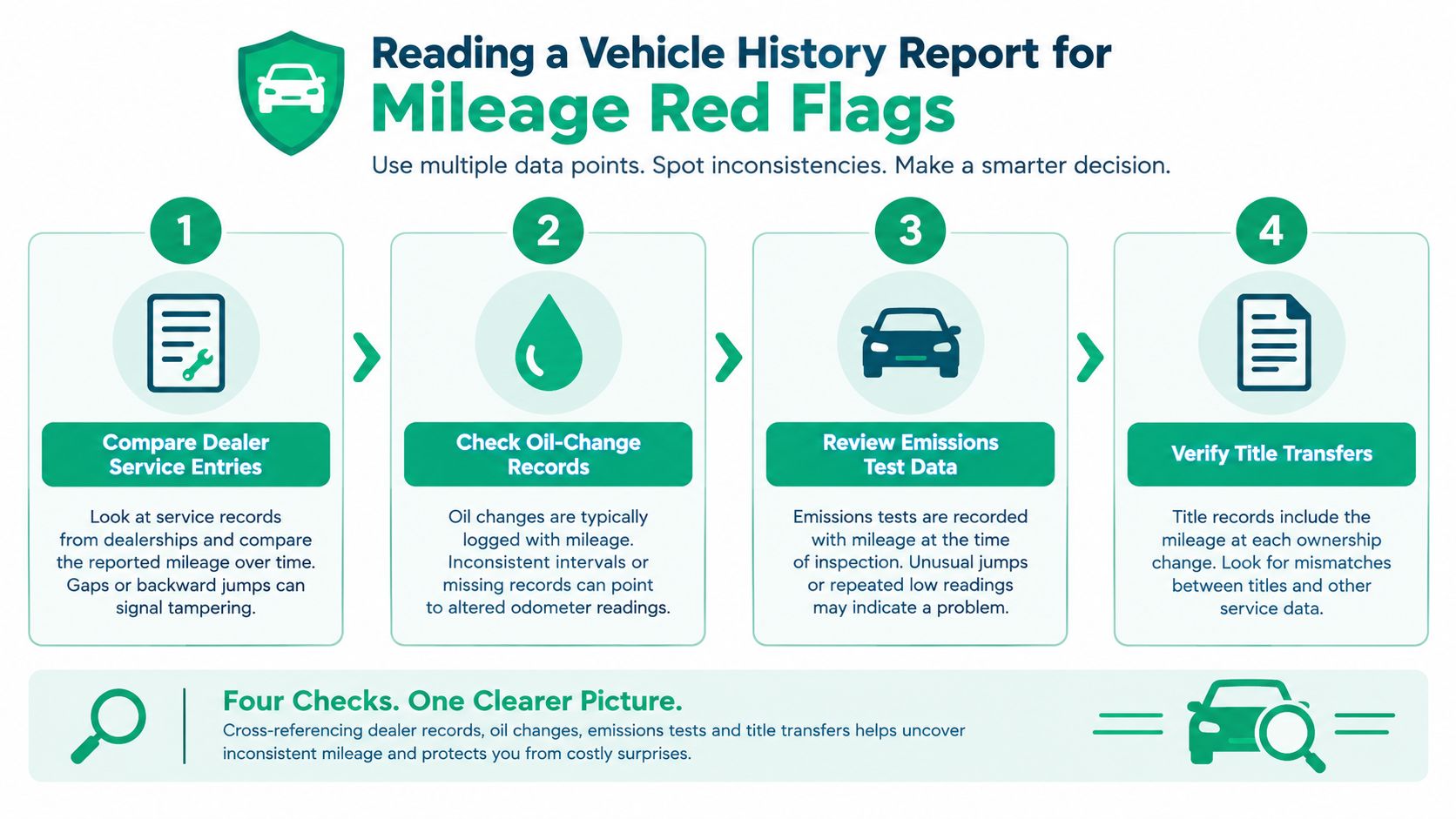
A history report is evidence, not a certificate of authenticity. Read it as a timeline and ask whether the mileage moves forward in a believable sequence.
Build the mileage timeline
Pull every recorded reading into one list. Compare:
- Dealer service entries, especially repeated visits tied to the VIN.
- Oil-change stickers and invoices, while remembering that informal records can be altered.
- State inspection or emissions records, where that jurisdiction records mileage.
- Title transfers and mileage disclosures, including transfers between states.
The strongest concern is a reading that declines. A later record should not show fewer miles than an earlier record unless there's a documented cluster or vehicle-system replacement. A long period without any mileage record also matters, particularly when the seller claims continuous use. Gaps don't prove fraud, but they create an evidence gap the seller must explain.
A single inconsistent entry may reflect a transcription mistake. Three independent sources telling the same conflicting story are different. Compare dates, mileage, location, service provider, and ownership changes together. Don't focus only on the final “last recorded mileage” line.
Understand what a clean report means
“No records found” means the provider has no accessible record for that event. It doesn't mean the event never happened. “Last recorded mileage” means exactly what it says, the latest reading supplied to that database, not necessarily the vehicle's verified mileage today.
You can use a Toyota Camry VIN check as one part of this process, then compare its findings with the title, inspection history, seller documents, and the car in front of you. Different providers may receive different records, and no report can fill a gap that nobody recorded or shared.
Oil stickers can be forged. Dealer records may be absent if an owner used independent repair shops. Inspection data may not exist in every state. That's why you're looking for convergence, not a reassuring green screen.
Digital Odometers and Cross-Border Title Transfers
Digital odometers changed the fraud problem because the displayed mileage can be only one value in a network of vehicle modules. A dashboard cluster may show one reading while the engine, transmission, steering, telematics system, or factory service record contains another. The buyer's job is to find out which systems were checked and whether the seller can explain a mismatch.
A dealership diagnostic scan may reveal stored mileage snapshots. Connected-car services may retain telematics events, and manufacturer service records may tie mileage to the VIN. But coverage is uneven. A replacement cluster can create a legitimate mismatch, while a skilled correction may leave an incomplete trail. An aftermarket scan isn't automatically a verdict.
| Data source | Catches digital rollback? | Limitation |
|---|---|---|
| Dashboard display | Sometimes | It may be the manipulated value |
| Dealer diagnostic scan | Often useful | Coverage depends on vehicle and stored module data |
| Telematics records | Potentially useful | Access and retention vary |
| Factory service records | Useful when available | Records may be missing or incomplete |
| Title and inspection records | Useful for historical conflicts | Jurisdiction coverage varies |
| Physical inspection | Can expose careless work | Professional manipulation may leave no visible sign |
Cross-border transfers create another weak point. A vehicle moving between the United States, Canada, or another market may accumulate records under different systems, labels, or reporting practices. Flood-rebuilt vehicles and branded-title cars can also re-enter a market after a change in jurisdiction, leaving gaps between the old record and the new title.
Recent coverage cited in the brief reports 20,642 suspected rollbacks flagged in Canada in 2025 through vehicle history reports, and European estimates place annual losses from odometer fraud at about €9.6 billion (Carscoops coverage of the 2026 report). Those figures underline the cross-border nature of the problem, but they don't verify an individual vehicle.
Watch closely when the title changes state soon before sale, a branded title appears to return as clean, or a report conflicts with manufacturer records. A border crossing isn't proof of fraud. It is a reason to demand more documentation, not less.
For a second example of a model-specific research path, review a Honda Civic VIN check and compare the reported timeline with records supplied by the seller.
Reporting Suspected Mileage Fraud and Next Steps
If the evidence looks wrong, preserve it before the seller repairs, retitles, or resells the vehicle. Don't rely on memory and don't confront the seller with an accusation you can't document.
Preserve the evidence
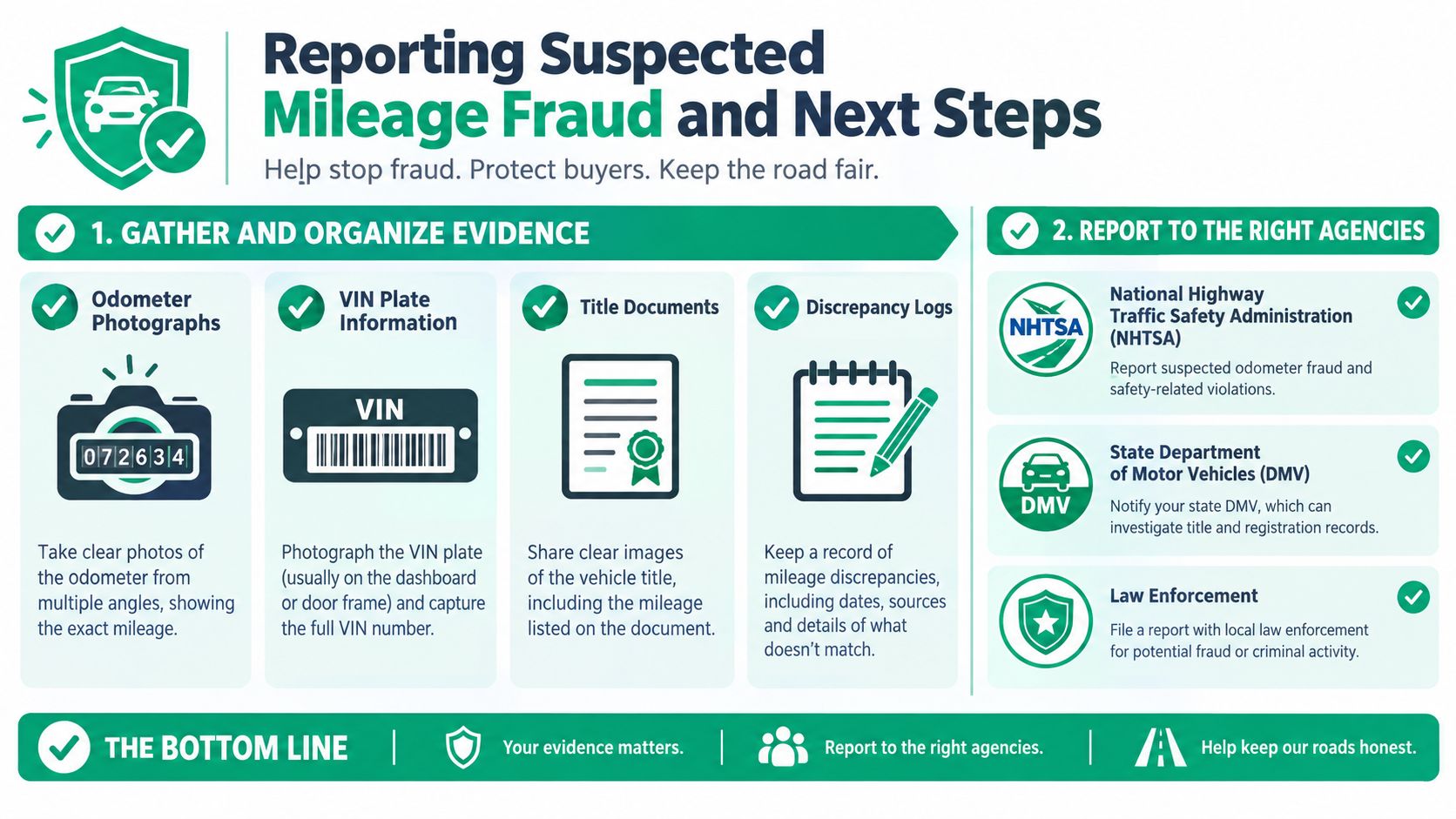
Photograph the dashboard with the ignition on, the VIN on the dashboard, door-jamb and under-hood VIN points, the title, registration, inspection stickers, and any mileage written on service documents. Save the listing, purchase agreement, odometer disclosure, text messages, emails, and payment records. Write a dated timeline showing what the seller said and when each mileage reading appeared.
Then use this order:
- State DMV or titling agency: Submit the title, mileage disclosure, VIN photographs, and conflicting records.
- State attorney general: File through the consumer-protection division and include the seller's representations and financial documents.
- NHTSA: Report suspected odometer fraud through the agency's vehicle-safety and fraud channels, with the VIN and supporting evidence.
- FTC: Submit a consumer-fraud complaint and attach the transaction record.
- History provider: Send the discrepancy to CARFAX or AutoCheck so the record can be reviewed and potentially flagged.
- Attorney or police: Speak with a consumer attorney about civil remedies, and contact local law enforcement when the evidence indicates intentional criminal conduct.
A report may not produce an immediate prosecution. Realistic outcomes include a corrected record, title branding, regulatory action, negotiation, or civil recovery. Keep copies of everything you submit and use neutral language such as “mileage discrepancy” until the evidence establishes intent.
Never alter the display yourself, erase records, or sign a document that states mileage you know is incorrect. Detection and reporting are lawful buyer protection. Tampering is not.
A Buyer's Checklist and Final Recommendations
Before you make an offer
- Pull the VIN history: Review title events, mileage entries, damage, imports, theft indicators, and ownership changes.
- Request original records: Ask for service invoices, inspection documents, oil-change history, and the current title.
- Inspect the vehicle in daylight: Check pedals, seat bolsters, steering wheel, tires, cluster trim, VIN labels, and signs of replacement.
- Run an independent scan: Ask a qualified technician whether the vehicle's modules can be compared and whether stored readings support the dashboard.
- Test the seller's story: Ask why the car changed states, why parts were replaced, and why any mileage gap exists.
For pricing context, a Toyota Camry value check can support negotiation, but value estimates don't verify mileage. A vehicle that looks inexpensive may still be overpriced if its mileage history is unreliable.
Legal red lines
Don't attempt rollback yourself. Don't buy or use mileage-correction equipment to “test” a car. Don't sign an odometer disclosure with an incorrect reading, and don't accept a seller's request to leave mileage information blank. Photograph questionable paperwork before you leave and ask for corrections in writing.
Know when to leave
Walk away when the seller refuses a VIN inspection, blocks an independent scan, won't provide the title, gives changing explanations, or pressures you to sign immediately. Negotiate only when the discrepancy is documented, plausibly explained, and reflected in a written agreement. Pay for a professional pre-purchase inspection when the car is expensive, imported, heavily modified, branded, or does not match its claimed mileage.
The inspection fee is cheaper than buying an undocumented problem. A qualified inspector can compare wear, records, diagnostic data, title history, and mechanical condition in one visit. Your protection comes from the pattern, not from one polished dashboard.
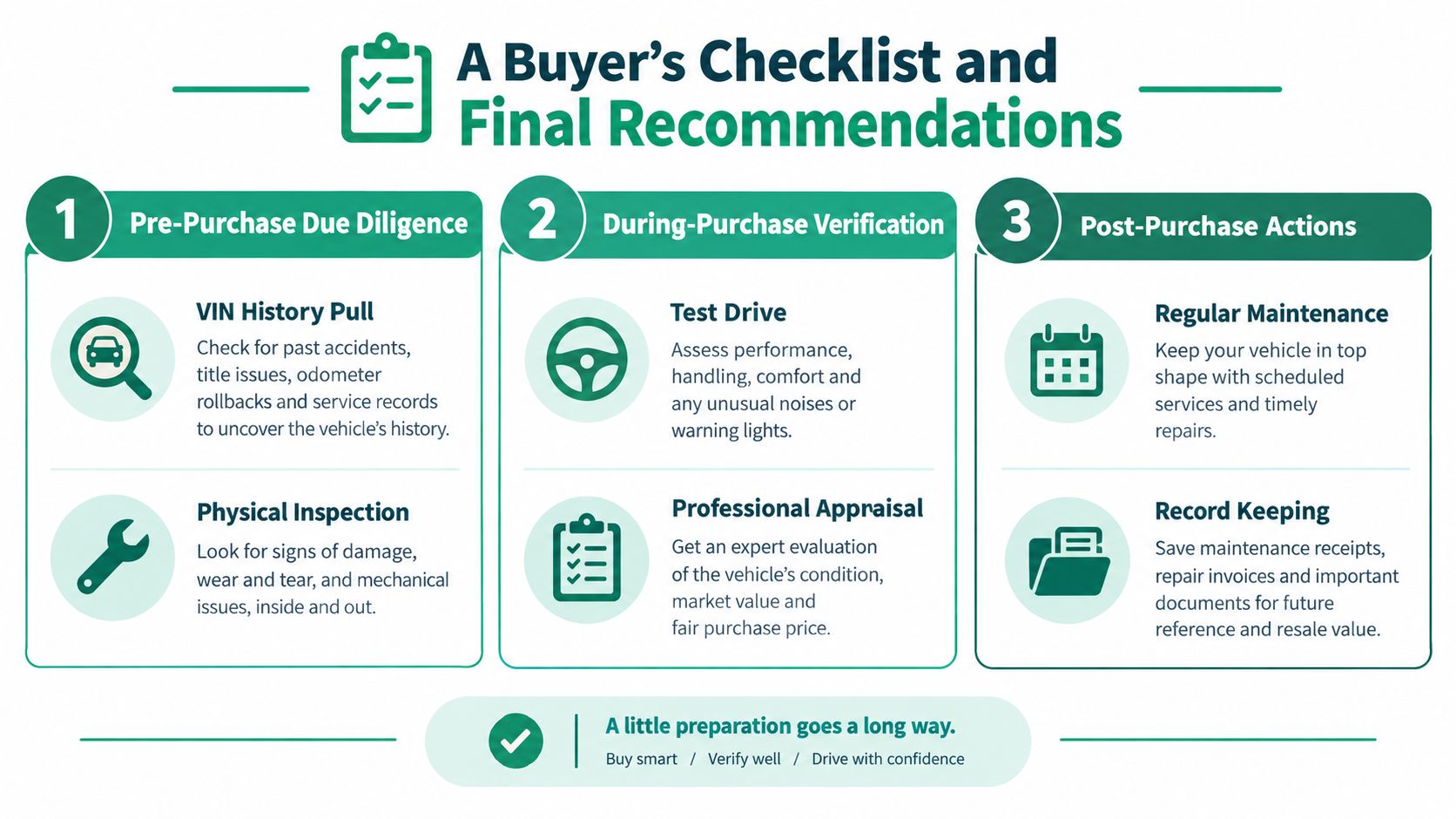
Before you pay, run the VIN, demand the mileage documents, inspect the wear points, and make the seller explain every gap. If the explanation doesn't survive comparison with the records and the vehicle itself, leave the car behind.
VinCheck lets you review VIN-linked vehicle history, title events, mileage anomalies, salvage records, recalls, and related risk indicators before you commit to a purchase. Use the VinCheck report to organize the mileage trail, then verify its findings against the car, its documents, and an independent inspection.
About the author
VinCheck Editorial Team — Editorial Standards & Review
The VinCheck Editorial Team reviews every published article against NMVTIS data accuracy and NHTSA recall validity. This byline appears on collaborative pieces and quick-update posts.