 Vin
How to Look Up a License Plate Number
By VinCheck Editorial Team, Editorial Standards & Review · Published 2026-09-13 · Updated 2026-09-13 · Reviewed by VinCheck Editorial Standards
You're looking at a used car listing, and the only detail you have is a license plate in the photos. You want to know whether the car is legitimate, whether its history matches the seller's story, and perhaps who owns it. Those are different questions, and a plate lookup answers some far better than others.
The practical rule is simple: a license plate can lead you to vehicle information, but it usually can't lead you to the owner's identity. Start with the vehicle, verify the legal purpose of your search, and move to a VIN-linked history report when the data supports it.
Table of Contents
- What a License Plate Lookup Can and Cannot Do
- The Legal Rules Behind Plate Lookups
- Step-by-Step Plate Lookup Workflow
- Comparing Free DMVs, NMVTIS Tools, and Paid Reports
- Handling Cross-Border and International Plates
- Troubleshooting When a Plate Returns Limited Data
- Smart Next Steps After Your Lookup
What a License Plate Lookup Can and Cannot Do
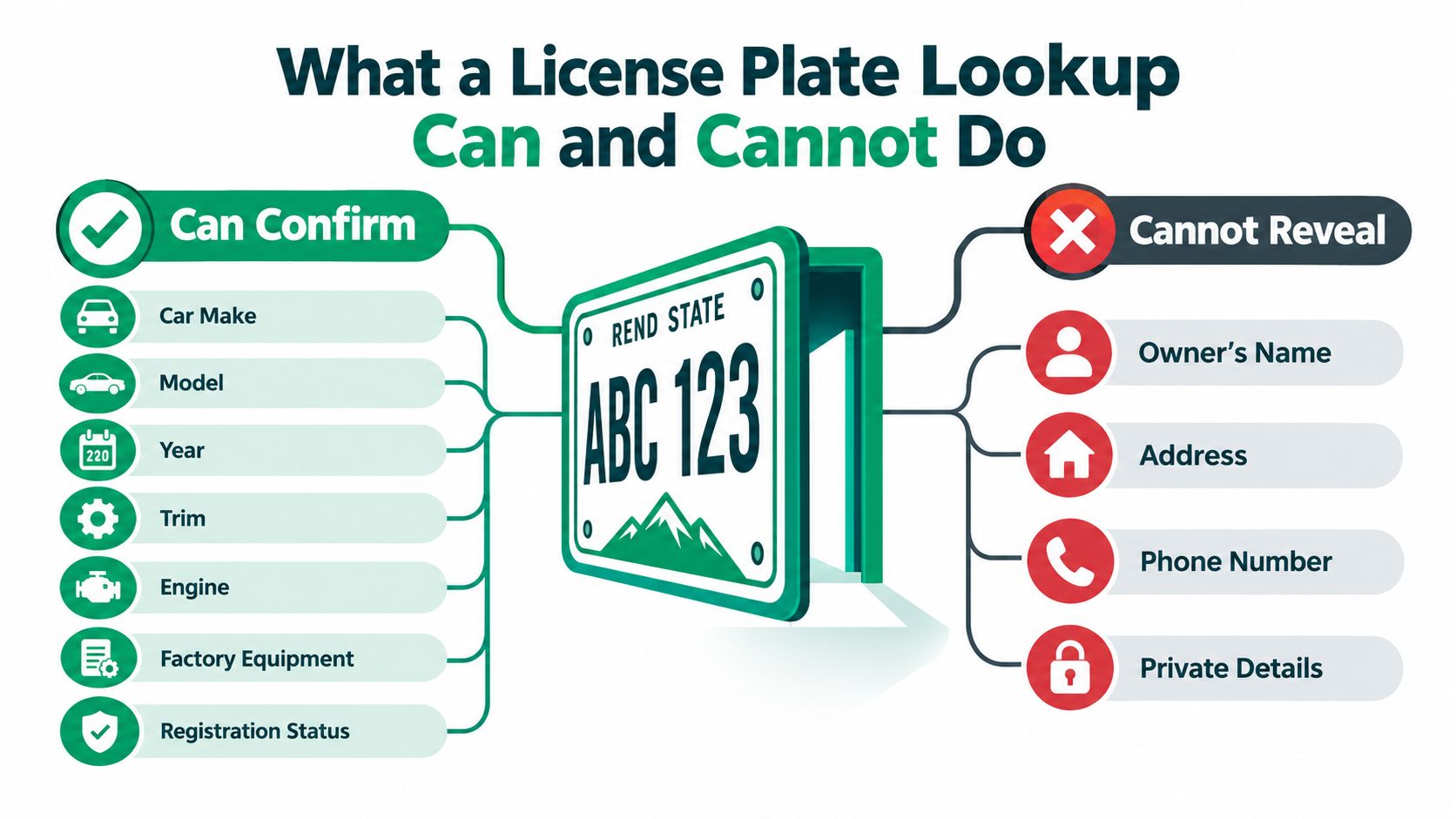
A plate is best treated as a doorway into vehicle records, not a backdoor into someone's private life. Depending on the jurisdiction and the service, a lawful lookup may help confirm the make, model, year, trim, engine, factory equipment, registration status, title state, recalls, theft indicators, salvage branding, mileage records, or auction history.
That information can expose a bad purchase before you hand over money. A seller may advertise a clean-title sedan while a vehicle-history source shows a branded title, an inconsistent mileage record, or prior salvage-auction activity. The plate itself doesn't prove every detail, however. The strongest workflow uses the plate to locate the VIN, then checks the VIN against the car, title paperwork, and seller's description.
What usually stays private
In the United States, the Driver's Privacy Protection Act, or DPPA, was enacted on March 12, 1994, and is codified at 18 U.S.C. § 2721. It generally restricts disclosure of a registered owner's name, address, phone number, and similar identifiers unless the requester has a legally recognized permissible purpose. The legal framework is summarized in this overview of the legal status of license plate lookup tools.
That means ordinary consumer searches generally won't lawfully reveal the owner's full name, home address, phone number, or driver's-license details. Permitted situations can include law enforcement work, insurance claims, litigation, and other authorized uses, but you can't create a permissible purpose merely by typing a plate into a search box.
Practical rule: If a service promises unrestricted owner identity data to anyone, treat that promise as a warning sign, not a feature.
Define your objective before choosing a tool:
- Vehicle verification: Use a plate-to-VIN search and history report.
- Safety or theft concern: Contact law enforcement and provide the plate, location, and circumstances.
- Insurance or legal matter: Use the insurer, attorney, court, DMV, or another authorized channel.
- Owner contact: Don't keep buying consumer reports. The legal route depends on your permitted purpose and jurisdiction.
The Legal Rules Behind Plate Lookups
The DPPA controls the central privacy question, but it isn't the only rule that matters. Federal law restricts DMV-derived personal information, while state law and agency policy can govern automated license-plate-reader data, data sharing, retention, and audit access. The result is a system where the same plate may produce vehicle attributes through one channel while owner-level information remains blocked through another.
The important distinction is what you're requesting, not whether you know the plate number. Vehicle specifications and title indicators are different from DMV-derived personal identifiers. State agencies can also impose their own procedures, documentation requirements, and restrictions on automated plate-reader searches.
That matters because plate data increasingly moves through law-enforcement and commercial systems. Recent policy disputes in the United States have focused on improper searches, cross-agency access, retention, and surveillance, not just consumer vehicle identification. The Automated License Plate Readers documentation from Chula Vista describes official searches using a full or partial plate and filters such as area and time, while also treating the resulting data as confidential and restricted to official purposes.
DPPA permitted uses and typical penalties
The table below is a practical guide, not a substitute for legal advice. A requester must meet the applicable statutory requirements, and the exact civil or criminal consequences depend on the facts and governing law.
| Permitted Use | Eligible Requester | Civil Penalty |
|---|---|---|
| Law enforcement or public-safety investigation | Authorized law-enforcement agency or official | Civil exposure may apply for unlawful access or disclosure |
| Insurance claim investigation | Insurer, adjuster, or authorized representative | Civil exposure may apply when access exceeds the permitted purpose |
| Litigation, court order, or legal process | Attorney, party, court, or authorized investigator | Civil exposure may apply to misuse or unauthorized disclosure |
| Vehicle or title verification for an authorized business purpose | Eligible business or requester meeting statutory conditions | Penalties depend on the violation and applicable law |
The source brief establishes that misuse can create civil and criminal exposure, but it doesn't provide a verified penalty amount for this article. Don't rely on a vendor's vague claim that “all records are public.” Read its terms, identify whether it screens for DPPA eligibility, and avoid any service that blurs vehicle history with personal identity.
Plate-related legality can also involve the physical plate itself. For example, Florida drivers dealing with plate covers or visibility issues can consult this explanation of the Florida statute on plate cover tickets from Ticket Shield, PLLC. That issue is separate from owner-data privacy, but both show why state-specific rules matter.
Step-by-Step Plate Lookup Workflow
Start with the plate as a vehicle-identification problem. If you're trying to learn whether a car is worth buying, don't begin by searching the owner. Begin by turning the plate into a VIN and checking the vehicle record attached to that VIN.
Clean the plate before searching
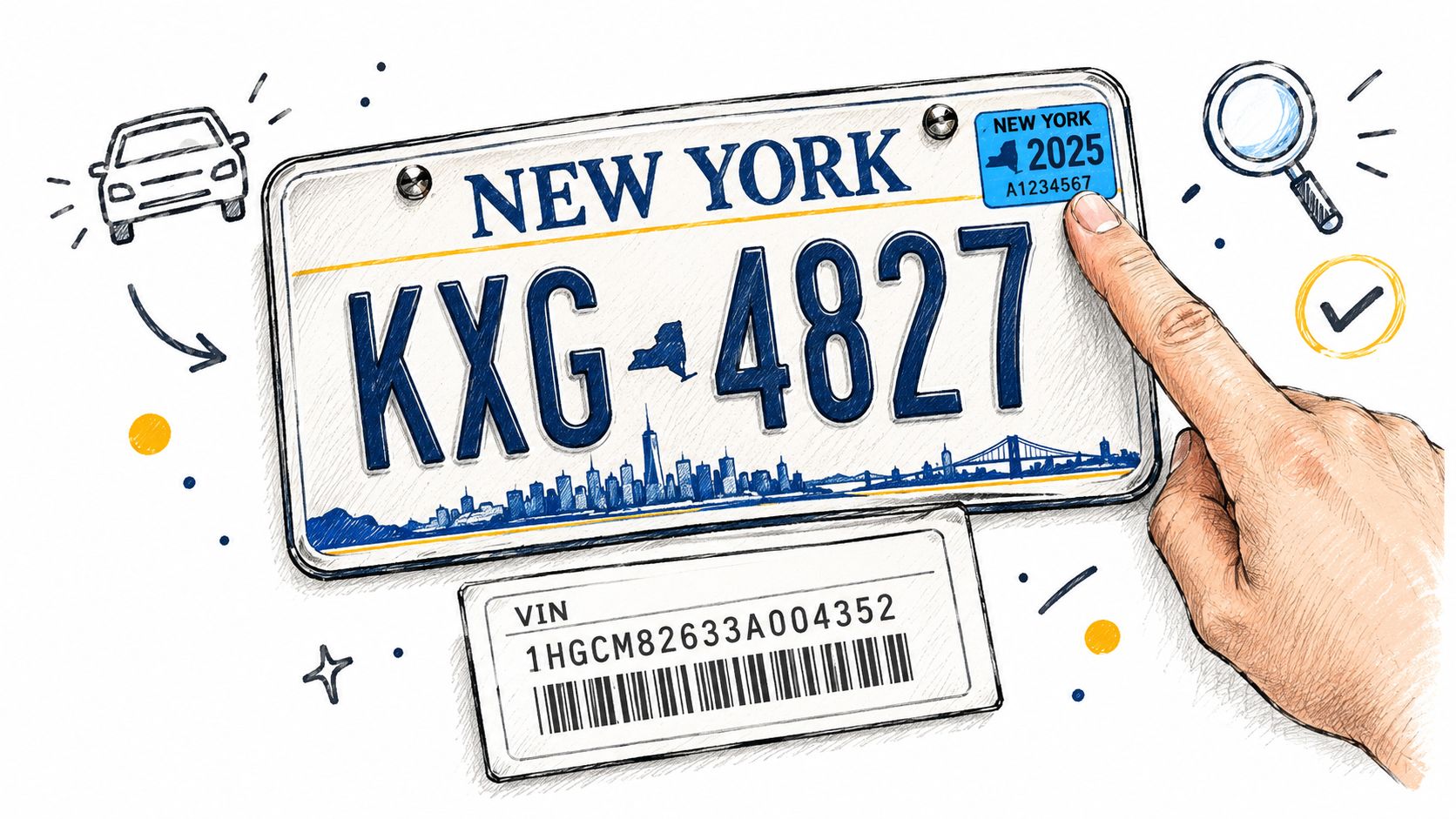
Remove spaces and punctuation, then compare every character with the photograph. Pay close attention to letters and numbers that look alike, such as “B” and “8” or “O” and “0.” Select the issuing state, not the state where you found the car. The state design, color scheme, and registration sticker can help when the seller hasn't identified it.
Enter the plate and state into a plate-search tool that supports a plate-to-VIN match. A service such as VinCheck's 2024 Toyota Camry VIN check can be useful as a reference point for the VIN-linked workflow, but the returned information still depends on the records connected to the vehicle.
Verify the VIN, then inspect the history
When the search returns a VIN, decode it and compare the result with the car in front of you. Confirm the model year, engine information, body configuration, and other identifying details. If the VIN describes a different vehicle, stop. A mismatched VIN can indicate a transcription error, an incorrect plate, swapped paperwork, or a more serious problem.
Open the vehicle-history summary and scan for:
- Title brands: Look for salvage, rebuilt, flood, or other branding.
- Mileage consistency: Compare recorded readings and flag unexplained gaps.
- Theft and safety indicators: Check stolen-vehicle records, recalls, and related warnings.
- Auction activity: Review salvage or auction records for signs of prior damage.
- Liens and ownership records: Treat available fields as indicators, then verify with the appropriate title authority.
Save the report, record its identification details, and keep the search date with your purchase notes. Most straightforward queries should resolve quickly, but a state-record pull can fail or time out, so retrying with the exact plate and issuing state is sensible. Don't treat a successful match as proof that every historical event has been reported.
Comparing Free DMVs, NMVTIS Tools, and Paid Reports
The right lookup tier depends on the question. A DMV may be the correct place for a title or lien issue, while a VIN-linked history platform is more practical for initial screening. Paid reports can add commercial records that government title systems don't contain, but paying for a report doesn't eliminate the need to inspect the vehicle and verify the paperwork.
| Tier | Typical Cost | Data Source | Typical Returned Fields | Turnaround |
|---|---|---|---|---|
| State DMV | Often free or fee-based, depending on the request and jurisdiction | State titling and registration agency | Title status, lien information, and other fields permitted by state procedure | Varies by state and request method |
| NMVTIS tools | Free or low-cost for initial checks, with paid options possible | State-reported title and branding records | VIN-linked identity, title brands, and some theft or salvage indicators | Usually quick, subject to data availability |
| Paid vehicle-history services | Subscription or per-report | Commercial feeds, auctions, service providers, insurers, and other sources | History details may include auction images, service records, accident entries, and ownership counts | Usually immediate online delivery |
A free DMV search is authoritative for the fields that agency makes available, but it may not provide a convenient plate-to-VIN workflow or a broad history view. NMVTIS-connected tools are useful for screening title brands and state-reported events. Their weakness is scope. A state can only report what appears in its records, and different data sources don't necessarily update at the same time.
Paid reports can add auction photographs, repair entries, service records, and commercial ownership information. Those additions can help explain why a title changed, but commercial coverage varies by vehicle and provider. Never assume “paid” means complete or “free” means useless.
For a buyer checking whether a listing deserves an in-person inspection, start with an NMVTIS-grade or comparable VIN check. If the car survives that screen, add a paid report when the purchase price and risk justify deeper commercial history. A used-car value check for a 2024 Toyota Camry can also provide valuation context, but value guidance should support, not replace, title and condition verification.
Handling Cross-Border and International Plates
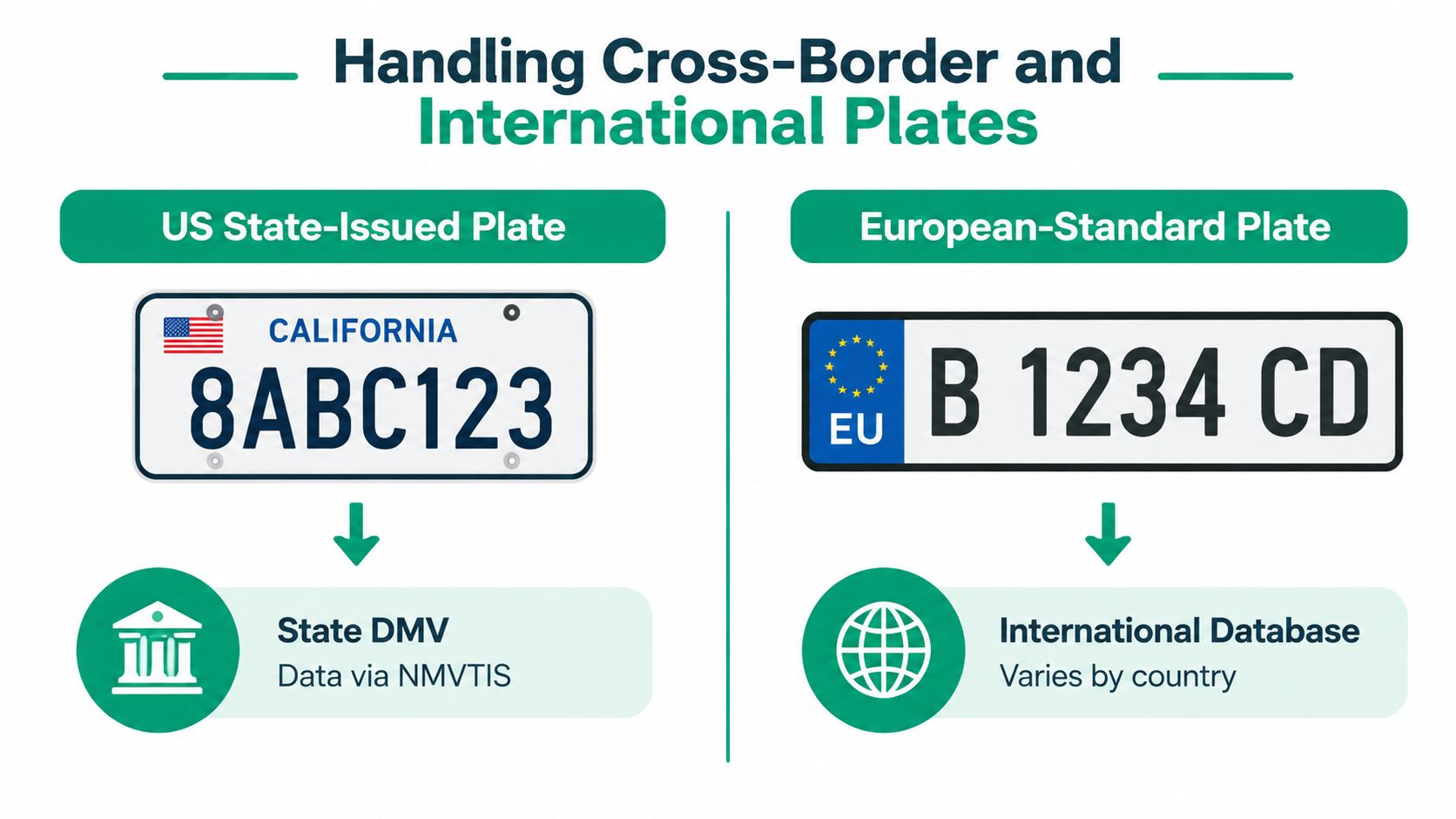
A United States plate search usually depends on the issuing state and the state titling records connected to that vehicle. A European plate follows a different path. The plate identifies the country, and often a regional authority or registration area, but the accessible records vary sharply by jurisdiction.
The European Union counted about 249 million passenger cars in 2022, according to the European Commission passenger-car statistics. That scale makes registration-number searches commercially important, but it doesn't create one universal European owner database. Country-specific rules determine what a consumer service can retrieve.
Choose the region before the provider
For a European vehicle, identify the registration country first. Then use an official national register where one is available, or choose a country-supported commercial service such as CarVertical or AutoDNA. The report's fields can differ by country, and privacy rules generally make owner identity especially restricted.
A U.S.-focused plate-to-VIN workflow usually stops at the border because it relies on U.S. state titling data and related feeds. Don't force a U.S. tool to interpret a European plate. You'll get either no result or a misleading match.
For formal cross-border matters, an insurer, embassy, attorney, or authorized government channel may be more appropriate than a consumer report. Diplomatic plates, military plates, temporary transit plates, and other special registrations may not be indexed in ordinary databases because their records follow separate administrative systems.
Regional rule: Pick the database that matches the issuing jurisdiction. The plate format is only the starting point, not the data source.
Troubleshooting When a Plate Returns Limited Data
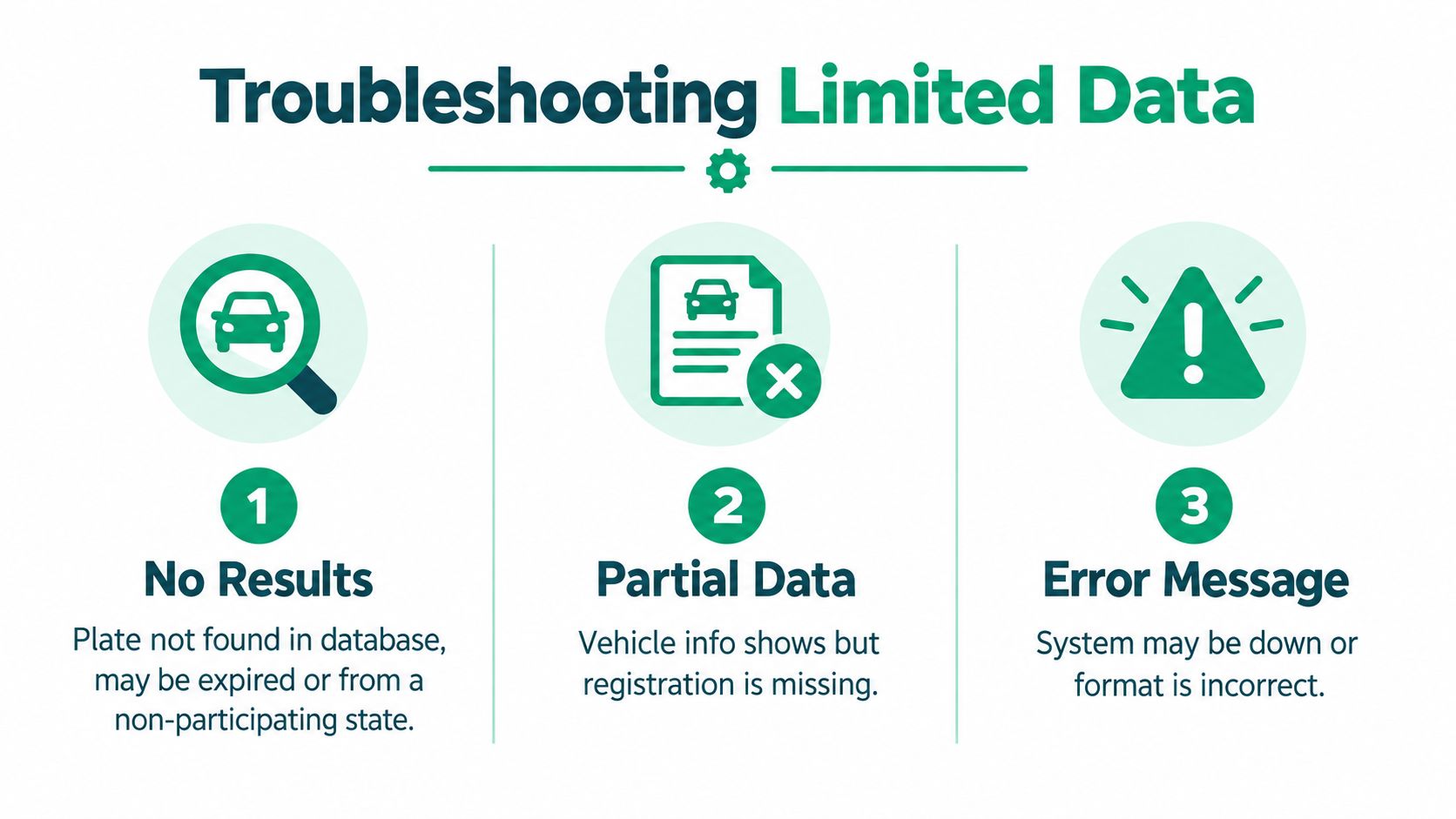
A thin report doesn't automatically mean the vehicle is clean, and an empty search doesn't automatically mean the plate is fake. It usually points to one of three problems: the input is wrong, the database lacks the record, or the jurisdiction restricts the available fields.
No results
First, recheck the characters and state. Compare the plate with the original photograph, confirm the issuing jurisdiction, and remove spaces or decorative characters. Vanity plates, expired registrations, non-participating data feeds, and records that haven't propagated between agencies can also produce an empty result.
Try an alternate vehicle-history source, then ask the seller for the VIN. A legitimate seller should understand why you want to match the VIN to the vehicle, title, and listing. If the seller refuses to provide it, that refusal is more useful than another round of speculative searching.
Partial plate reads
Automated plate-recognition systems can misread a character when the plate is dirty, angled, obstructed, or photographed under poor lighting. Official systems may support partial-plate searches with time and location filters, but they restrict access to authorized users and treat the data as confidential.
If you're working from a photo, inspect the plate at full resolution and compare it with the registration sticker or another image of the same vehicle. Don't assume the first readable string is correct. One wrong character can send the search to an entirely different vehicle.
Jurisdiction-blocked records
The most legally significant failure occurs when a tool returns vehicle details but suppresses owner information. That isn't necessarily a weak database. It may be the correct result under privacy law, especially where DMV-derived personal information is restricted or where local rules limit automated plate-reader sharing.
Separate the problem into two questions:
- Vehicle data missing: Try the correct state, a plate-to-VIN tool, or a paid history source.
- Personal data missing: Don't bypass the restriction. Use police, insurance, legal, or DMV channels only when your purpose qualifies.
Stop searching when the law is the barrier. Buying another consumer report won't turn protected identity data into public information.
Smart Next Steps After Your Lookup
A plate report is a screening tool, not a final verdict. Before you negotiate, make sure the VIN from the report matches the dashboard, door-jamb label, title, and seller's paperwork. Then compare the title brand, mileage sequence, recall status, and accident or auction entries with the car's physical condition.
Use the report to ask precise questions. A vague “Has it ever been damaged?” invites a vague answer. Ask why the title changed, when the mileage was recorded, whether the seller has repair invoices, and why the vehicle's current condition doesn't match any prior damage record. Keep copies of the report and the seller's responses.
Walk away from unresolved risk
Some findings deserve more than a lower offer:
- Branded title without full documentation: Don't accept a seller's verbal explanation as proof of proper repair.
- Mileage gap or rollback indicator: Require records that explain the sequence before considering the car.
- Flood or severe damage history: Hidden corrosion and electrical problems can emerge long after purchase.
- VIN mismatch: Stop the transaction until the identity of the vehicle is fully resolved.
- Unreported damage with evasive answers: The seller's behavior is part of the risk assessment.
If the history is consistent and the vehicle passes an independent inspection, a documented report can strengthen your negotiation. A clean result doesn't guarantee a perfect car, but a mismatch gives you a clear reason to pause.
For additional vehicle research, Toyota vehicle history resources can help organize model-specific checks, but don't let a broad make page replace the VIN report for the exact car.
Owner contact requires a different escalation path. For a hit-and-run, suspected theft, harassment, or an immediate safety concern, report the incident to police and provide the plate, state, time, location, photographs, and vehicle description. For an insurance or legal matter, use the authorized process instead of trying to identify a person through a consumer lookup.
Retain the lookup PDF, timestamp the search, and document what the seller told you. That record gives you a defensible pre-purchase file if the vehicle history changes or the seller's claims later prove incomplete.
VinCheck provides plate-to-VIN lookup, VIN decoding, and vehicle-history information for issues such as title brands, salvage events, mileage anomalies, recalls, theft indicators, liens, and auction records. If you're checking a used car from a plate photo, visit VinCheck to start with vehicle-level data and follow up with the VIN before making an offer.
About the author
VinCheck Editorial Team — Editorial Standards & Review
The VinCheck Editorial Team reviews every published article against NMVTIS data accuracy and NHTSA recall validity. This byline appears on collaborative pieces and quick-update posts.