 Vin
How to Detect Odometer Rollback in 2026
By VinCheck Editorial Team, Editorial Standards & Review · Published 2026-09-20 · Updated 2026-09-20 · Reviewed by VinCheck Editorial Standards
More than 450,000 vehicles are sold each year in the United States with false odometer readings, and the average consumer loss is $2,336 per fraud case, adding up to about $1.056 billion annually according to NHTSA's odometer fraud overview. Most buyers still treat mileage like a single number on a dashboard. That's the mistake.
If you want to know how to detect odometer rollback, stop staring at the cluster and start comparing sources. Fraud gets exposed when the dashboard reading, VIN-linked history, module data, and physical wear stop agreeing with each other. One number can be faked. A timeline is harder to fake. Multiple control modules are harder to fake. Wear on pedals, seat bolsters, and steering wheel is harder to fake without leaving clues.
Table of Contents
- Why Odometer Rollback Is Harder to Spot Than Ever
- Paper-Trail Checks That Catch Most Rollbacks
- Reading VIN-Linked Mileage Reports Like an Investigator
- Diagnostic Scans That Expose Digital Tampering
- Physical Wear Evidence You Can Verify On the Spot
- What to Do When the Numbers Don't Line Up
- Your Pre-Purchase Odometer Verification Checklist
Why Odometer Rollback Is Harder to Spot Than Ever
Digital odometers fooled a lot of people into thinking rollback died with old mechanical clusters. It didn't. It just changed shape.
Modern fraud is cleaner. You won't always see crooked digits, scratched screws, or a hacked-up dash bezel. A late-model car can show a believable number on the cluster and still carry a false mileage story. That's why buyers who only look at the dashboard get burned.
The old shortcut doesn't work anymore
A major U.S. government study estimated that odometer fraud occurs in 3.47% of vehicles over their first 11 years of life, based on a nationally representative sample of 10,000 passenger vehicles, and the core detection method was simple but powerful: compare odometer readings across multiple title-transfer points and flag sequences where a later reading is lower than an earlier one, as documented in the NHTSA technical study on odometer fraud.
That's still the backbone of real detection. Not guesswork. Not “the interior looks clean.” A mileage sequence either moves forward logically or it doesn't.
Triangulation
Here's the method that catches people:
- Start with the paper trail: Title disclosures, inspection records, emissions entries, dealer invoices, and service receipts.
- Pull a VIN-linked history: Use it to build a mileage timeline and look for drops, stalls, and suspicious gaps. If you're checking a common used-car model, even a basic Toyota VIN lookup gives you the right starting point for matching the car to its records.
- Scan the car: Read mileage where the vehicle stores it beyond the cluster.
- Inspect wear: Steering wheel, pedals, driver seat, tires, and general touch points need to match the story.
Practical rule: If the odometer is the only thing telling you the mileage, you don't know the mileage.
Digital cars are both harder and easier to verify. Harder, because the fraud looks cleaner. Easier, because modern vehicles often leave extra traces in module data and recorded histories. Buyers miss that second part all the time.
Paper-Trail Checks That Catch Most Rollbacks
Before anyone plugs in a scanner, the paperwork usually tells on the car.
Most rollback jobs fall apart when you line up dated records in chronological order. You're looking for one thing above all else: a mileage story that moves forward without weird reversals. Clean history doesn't need explaining. Bad history always needs a story.
Start with records inside the car
Look in the glovebox, center console, owner's manual pouch, and door jambs. Sellers forget how much mileage gets written down during routine ownership.
Check for:
- Oil-change stickers: Windshield or door-jamb stickers often show date and mileage.
- Dealer invoices: These usually record mileage at service write-up.
- Warranty paperwork: Campaigns, repairs, and dealer visits often include odometer entries.
- Tire and battery receipts: They won't prove exact mileage, but they help build a timeline.
A seller claiming low mileage should have records that support low usage. If the paperwork disappears for years and then suddenly returns, pay attention.
Read the title carefully
The title isn't just a transfer document. It often carries one of the most important mileage clues on the car.
Look for the mileage disclosure field and any branding language such as:
- Not Actual Mileage
- Exceeds Mechanical Limits
- Exempt
Those labels don't automatically prove fraud, but they absolutely change how you should value and trust the car. If a seller shrugs off a title brand, walk slower, not faster.
A clean exterior means nothing if the title history says the mileage can't be trusted.
Use consistency, not wishful thinking
What you want is rhythm. The vehicle should show a believable progression through time. Service and inspection records don't have to be perfect, but they should make sense.
A pattern like this reads clean:
- Regular service entries with mileage moving upward.
- Inspection or registration events that fit the same sequence.
- No backward jumps in any official record.
- Wear items and dates that feel appropriate for the claimed use.
What reads dirty is different:
- Mileage freezes for long stretches with no explanation.
- Missing middle years where the car somehow avoided all documentation.
- A low odometer claim with no supporting paper trail.
State inspection and emissions systems can also help because shops often log odometer readings during those visits. If the seller can't explain a missing segment in the history, ask for DMV title-history records and copies of prior service receipts. Also remember this: commercial vehicle-history reports only reflect mileage that got reported into participating systems. They're useful, but they're not omniscient.
Reading VIN-Linked Mileage Reports Like an Investigator
A mileage report is not a verdict. It's a timeline. Read it like an investigator, not like a shopper looking for reassurance.
The strongest signal is simple: a later recorded mileage that is lower than an earlier one. Independent guidance also emphasizes that the highest recorded mileage often sets a minimum actual mileage, and that missing service or inspection history can hide tampering, as explained in Bumper's guide to odometer rollback fraud.
Which entries matter most
Some entries deserve more weight than others.
Prioritize these:
- Title transfer mileage
- Registration or inspection-related mileage
- Auction announcements or sale records
- Dealer service entries
- Insurance or total-loss records when mileage is listed
If a retail listing says one thing but a prior title or auction record says another, trust the recorded event over the ad copy.
What a rollback pattern looks like
Use the report to find downward jumps, suspicious stalls, and timeline gaps.
| Report Date | Source | Recorded Mileage | Flag |
|---|---|---|---|
| 2022-05 | State title event | 34,000 | Normal upward sequence |
| 2023-08 | Service record | 52,000 | Normal upward sequence |
| 2024-02 | Retail listing | 41,000 | Major red flag. Mileage decreased |
| 2024-04 | Inspection entry | 42,000 | Still suspicious. Sequence remains below prior high |
That pattern doesn't need a creative explanation. It needs documentation.
Count gaps as aggressively as drops
A rollback report isn't always obvious. Sometimes the fraud sits inside the blank spaces.
Check for:
- Long periods with no mileage entry
- A sudden low reading after the gap
- A repeated mileage figure across multiple events that should show movement
- An auction listing before retail sale that doesn't match the dealer's mileage claim
If you're researching a specific vehicle, a model-specific Camry VIN check can help you line up reported events around one VIN instead of relying on the seller's screenshots or memory.
Diagnostic Scans That Expose Digital Tampering
A lot of buyers quit too early. They run a generic scan, see no check-engine light, and think the car passed. That's not an odometer inspection. That's a basic fault check.
A proper rollback check compares the cluster reading to mileage or distance data stored elsewhere in the vehicle. Technical guidance on modern fraud detection points to a multi-module consistency check: scan available control units, compare stored distance values to the dashboard, then match those findings against wear on high-contact components, as described in the ScienceDirect abstract on odometer fraud detection methods.
What to scan and what to compare
Use a scanner that can access more than generic OBD-II emissions data. Tools like Autel, OBDeleven, or BlueDriver are common names buyers and shops recognize, but capability depends on make and model.
Focus on these module categories:
| Module | Stores Mileage | Authoritative? |
|---|---|---|
| Instrument cluster | Often yes | It's the displayed number, but not enough by itself |
| Engine control module | May store distance-related data | Strong comparison source |
| Transmission control module | May store distance-related data | Useful comparison source |
| Body control module | May store mileage or related data | Useful comparison source |
| ABS or other chassis modules | Sometimes | Supplemental evidence |
| Telematics or gateway modules | Sometimes | Very useful when available |
Late-model vehicles may store mileage outside the cluster, and guidance for consumers notes that a mismatch between ECU or other module mileage and the cluster reading is strong evidence of tampering, as noted in iSeeCars' article on spotting odometer rollback.
The scan procedure
Do it in this order:
- Photograph the dashboard odometer before scanning.
- Connect a make-capable scan tool and pull all accessible module data.
- Record every module that shows distance or mileage-related values.
- Compare those values to the cluster reading.
- Check VIN consistency if the scanner can display module-identification data.
- Look for communication faults or replacement clues that suggest a cluster swap or module mismatch.
Don't get hung up on one module if the vehicle only exposes one or two useful readings. The point is comparison. Fraudsters count on buyers never making one.
Physical Wear Evidence You Can Verify On the Spot
Paper and scan data do the heavy lifting. Physical wear keeps everyone honest.
Start with the obvious contact points. A car with low mileage usually feels tight where the driver touches it every day. A rolled-back car often gives itself away through gloss, flattening, erosion, and general fatigue that the odometer claim can't explain.
This quick comparison helps: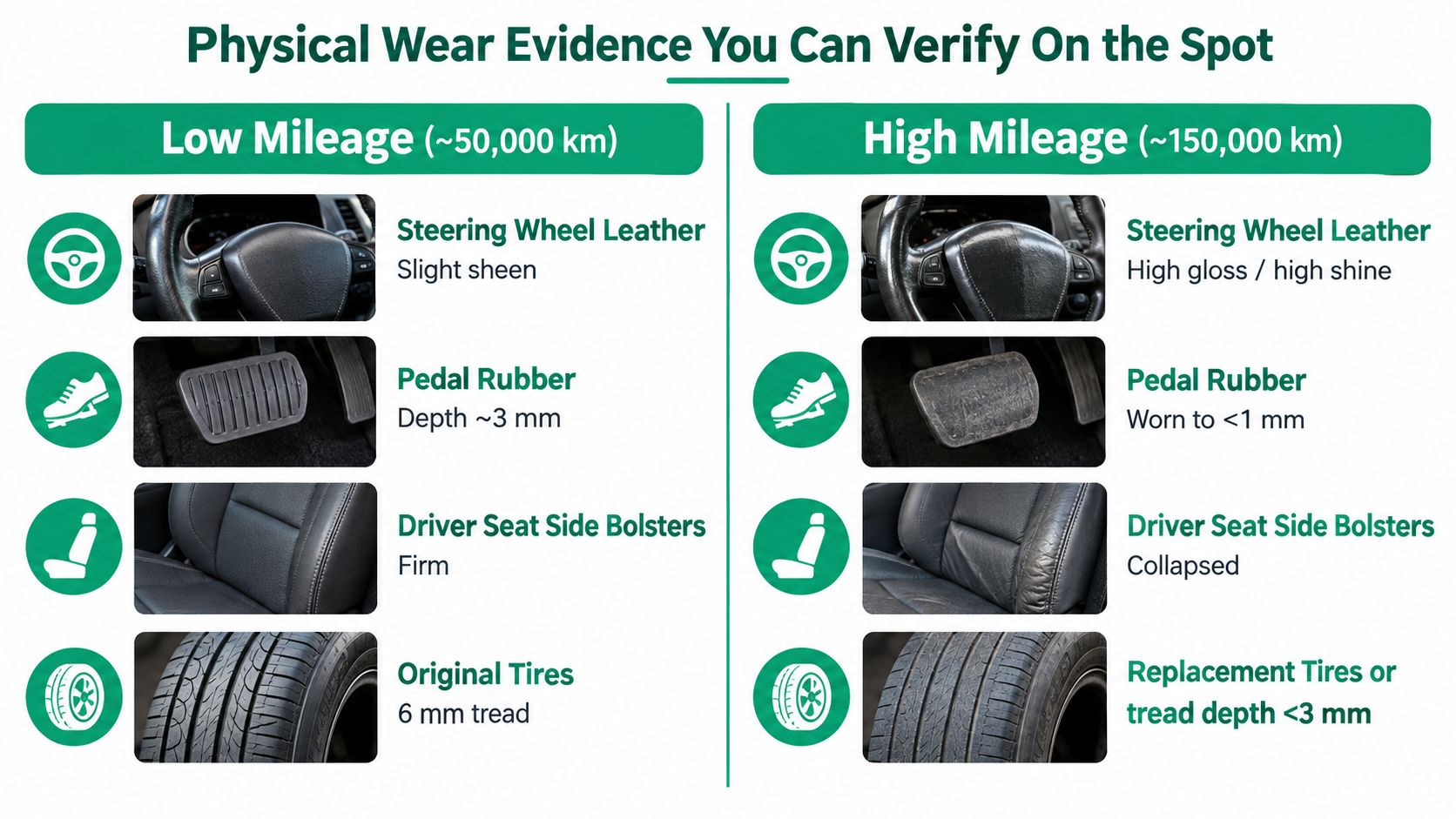
What should match the mileage story
Compare the claimed mileage against these areas:
- Steering wheel: Heavy shine, smoothed texture, or worn leather on a supposedly low-mileage car is a bad sign.
- Pedal rubber: Brake and accelerator pads wear where shoes hit them. Deep wear suggests more use than the dash may admit.
- Driver seat bolster: Flattened outer bolster, loose upholstery, or torn piping usually means repeated entry and exit over time.
- Shift knob and buttons: Worn markings and polished surfaces often out mileage claims quickly.
- Tires: Date codes, brand mix, and tread condition should fit the usage story.
A five-year-old car with a very low odometer reading shouldn't look like a commuter shuttle in all the touch points.
Use wear as a cross-check, not a verdict
No single worn part proves rollback. People replace steering wheels. They install seat covers. They change tires. That's why you look for clusters of inconsistency, not one dramatic clue.
Good examples of mismatch:
- Low claimed mileage, but worn pedals and collapsed driver seat
- Fresh cluster reading, but old service stickers showing higher use
- Very clean cabin, but scanner data showing distance stored beyond the displayed number
For a visual walkaround, this video shows the kinds of interior clues worth checking before you believe the dashboard:
Wear has to support the mileage claim. If it doesn't, the seller needs better evidence than “that's just how the previous owner kept it.”
What to Do When the Numbers Don't Line Up
Mileage mismatches kill clean-car pricing. The moment the dashboard, module data, and dated records disagree, treat the car as a mileage-problem car until someone proves otherwise on paper.
Stay disciplined here. Sellers will try to pull you back to paint shine, smooth shifting, or a recent detail. Ignore all of it. Odometer fraud is first a value problem, then a trust problem, and only after that a mechanical one.
Build your proof before you say a number
Make your case with evidence the seller cannot talk around.
Collect:
- A clear photo of the dash odometer
- Photos of the VIN at the windshield and door label
- Scan results showing mileage stored in the ECU or other modules
- Service invoices, inspection records, and title disclosures with dates and mileage
- Screenshots of the listing, including any mileage claim
- Photos of any conflicting stickers or paperwork in the car
Then ask one question: Which number is wrong, and what document proves it?
If the seller cannot answer that cleanly, stop treating the lower dashboard reading as real. The mistake many buyers make is looking at one mismatch in isolation. The right move is triangulation. If the cluster shows 82,000, the ECU stores more, and a repair invoice from two years ago already shows a higher number, you are not dealing with a harmless typo. You are looking at a car with a mileage story that can hurt resale, financing, warranty coverage, and title accuracy.
Use the inconsistency to negotiate
Say it plainly:
“The dash reading does not match the stored module mileage and service timeline. Until that is cleared up with records, I am pricing this as an actual-mileage risk.”
That puts the burden where it belongs. On the seller.
If you still want the car, price the risk aggressively. Start with a neutral baseline such as a used car value estimate for a Toyota Camry, then cut from there based on what is missing or contradictory. A car with an unresolved mileage discrepancy is worth less because the next buyer will ask the same questions you are asking now, and many lenders, dealers, and appraisers will discount it for the same reason.
No proof, no premium.
Know when to walk
Leave the deal if any of these show up:
- Official records show mileage going backward
- The seller refuses to share documents or scan the car
- ECU or module mileage is higher than the cluster with no repair records explaining it
- Title wording suggests the mileage may not be actual
- The explanation keeps changing
You are not buying only the car. You are buying its paper trail.
If you already bought it, save every listing screenshot, text message, bill of sale, scan report, and service record. Report the issue through your state motor vehicle agency, title office, or consumer protection office. Keep the VIN attached to every complaint and every document.
A dishonest odometer reading is not a small paperwork glitch. It changes what the car is worth, how easily you can resell it, and how much trouble you inherit the day you sign for it.
Your Pre-Purchase Odometer Verification Checklist
Most buyers don't need a complicated fraud lab routine. They need an order of operations. Run the same sequence every time and you'll catch the majority of bad cars before money changes hands.
Here's the visual version first: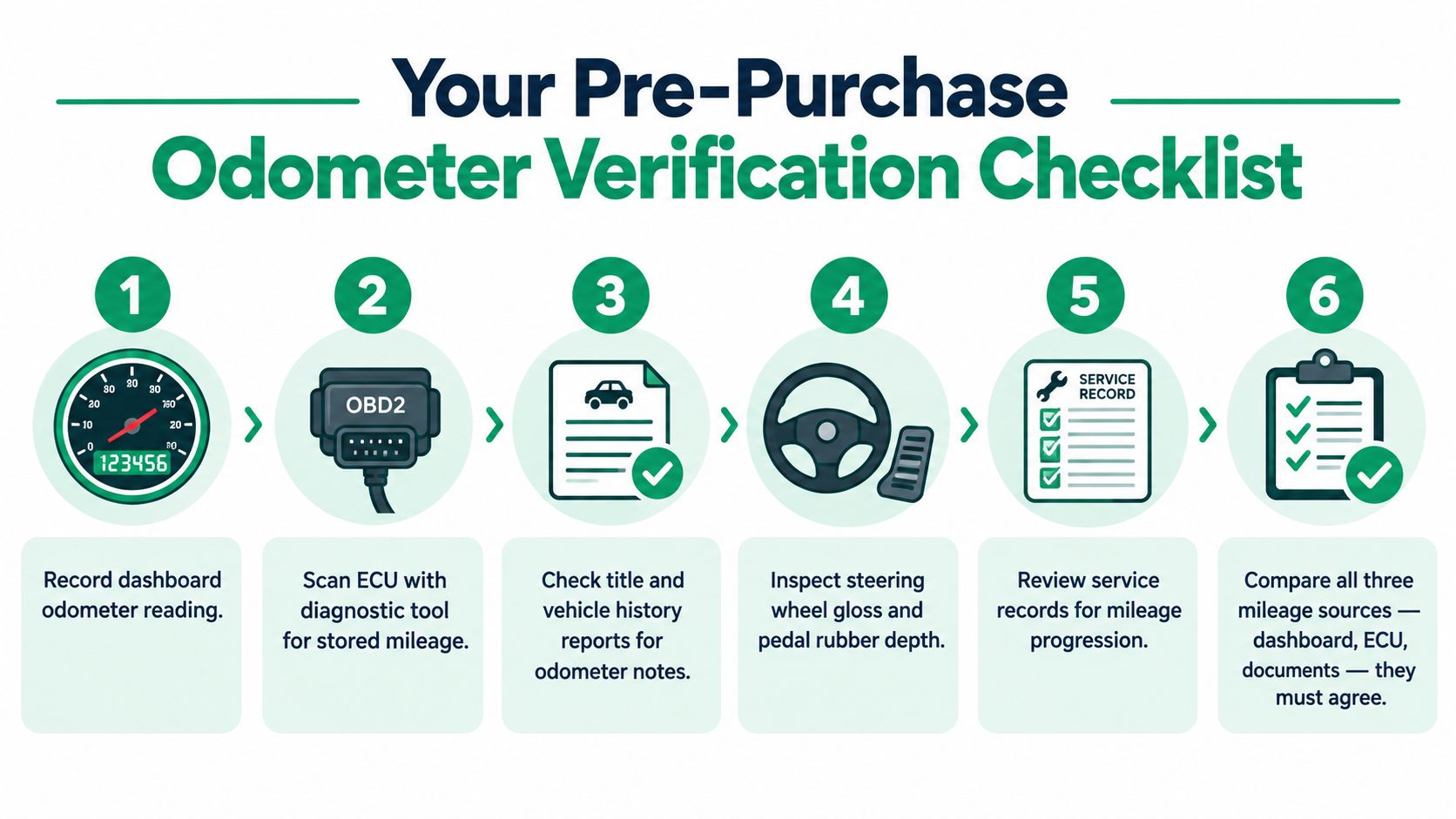
The four-layer sequence
Do these in order:
Run the VIN history first
Build the mileage timeline before you ever meet the seller. One practical option is VinCheck, which provides VIN-linked history reporting, mileage checks, title brands, and related vehicle records in one place.Cross-check the documents
Match the seller's title, service invoices, inspection slips, and windshield stickers against the VIN report timeline.Scan the vehicle
Compare the cluster reading to whatever the car stores in accessible modules.Inspect wear surfaces
Check steering wheel, pedals, seat bolster, tires, and general touch points.
The pass-fail checklist
Print this or keep it on your phone:
Dashboard reading recorded
Pass if you photographed it and wrote it down.VIN matched to title and vehicle
Pass if the windshield VIN, door label, and paperwork all match.History timeline reviewed
Fail if any recorded mileage goes backward.Title disclosure checked
Fail if branding or disclosure language raises unresolved mileage questions.Service records reviewed in date order
Pass if mileage climbs logically over time.Diagnostic scan completed
Fail if another module conflicts with the displayed reading and nobody can document why.Physical wear checked
Fail if heavy wear contradicts a low-mileage claim.Seller explanation documented
Fail if explanations are verbal only.
The decision rule that keeps buyers out of trouble
Don't let a seller drag you into “probably fine.” That phrase costs people money.
Use this rule instead:
- Everything agrees: proceed.
- One minor inconsistency with records to explain it: slow down and verify.
- A downward mileage jump, contradictory module data, or obvious wear mismatch: renegotiate as a mileage-problem car or walk away.
Clean mileage survives comparison. Fake mileage usually survives only one layer at a time.
If you're serious about learning how to detect odometer rollback, this is the habit that matters most. Don't rely on one source. Force the car to tell the same story four different ways.
If you're checking a used vehicle and want the mileage story before you waste time on a test drive, VinCheck lets you pull VIN-based vehicle history, title details, and mileage-related records into one report. Use it early, compare it against the dashboard and scan data, and make the seller answer the gaps before you sign anything.
About the author
VinCheck Editorial Team — Editorial Standards & Review
The VinCheck Editorial Team reviews every published article against NMVTIS data accuracy and NHTSA recall validity. This byline appears on collaborative pieces and quick-update posts.