 Vin
How to Check Used Car Value Accurately
By VinCheck Editorial Team, Editorial Standards & Review · Published 2026-09-26 · Updated 2026-09-26 · Reviewed by VinCheck Editorial Standards
A single “book value” number won't tell you what a used car is worth. It can miss a branded title, an odometer inconsistency, a regional pricing gap, a weakening segment, or dealer fees that inflate the advertised deal. How to check used car value accurately means building a defensible range from the vehicle's history, condition, local comparables, current market direction, and real out-the-door cost.
Start with a baseline, but don't stop there. A pricing guide is a reference point, not a verdict. The buyer who verifies the VIN, compares similar cars nearby, and adjusts for defects is far better positioned than the buyer who just repeats an online estimate.
Table of Contents
- Understanding How Depreciation and Market Cycles Affect Value
- Gathering Vehicle History and VIN Data
- Benchmarking Against Market Comps and Pricing Indices
- Adjusting for Condition, Mileage, and Title Brands
- Using Your Valuation to Negotiate the Final Price
- Avoiding Common Valuation Mistakes Before You Buy
Understanding How Depreciation and Market Cycles Affect Value
A free estimator can produce a precise-looking number that is already wrong for the car, location, or market. Used-car value changes for two separate reasons: the vehicle loses value as it ages, and market demand moves around it. Build a defensible range instead of accepting one supposed book value.
Depreciation is front-loaded. U.S. Bureau of Labor Statistics data reports average annual depreciation of 12.1% for new automobiles and 10.3% for used automobiles. Brand-new vehicles show an especially steep 23.9% loss in the first year, while annual depreciation during years two through five ranges from 10.8% to 14.0%.
That pattern explains the gap between a one-year-old car and a five-year-old car that look similarly clean. The newer vehicle has absorbed less of its initial value loss. Mileage, maintenance, condition, and remaining useful life then create wider differences among older examples.
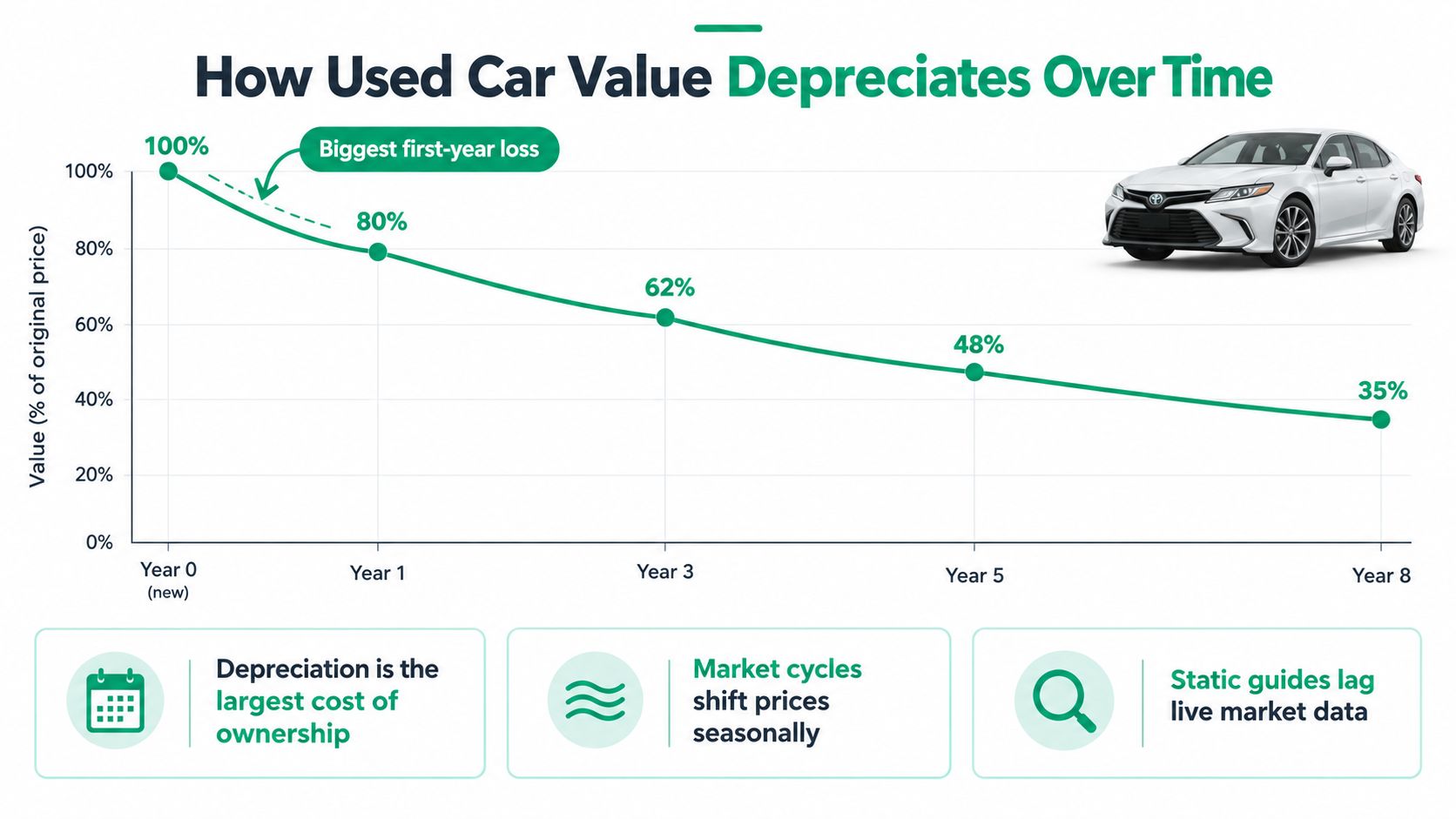
Why a static estimate misses the market
Pricing guides become unreliable during sharp market swings. The Manheim Used Vehicle Value Index recorded a 54.3% year-on-year increase in April 2021, followed by a 14.9% year-on-year decline in December 2022, according to the used-car pricing series reported by Trading Economics. An old reference figure can therefore lag behind what buyers and sellers face now.
A national average still cannot price your specific car. A compact SUV may be overpriced in one town and fairly priced in another because local supply, trim preferences, climate, and dealer inventory differ. Add registration charges, documentation fees, taxes, financing costs, and other out-the-door adjustments before comparing deals. The advertised price is not the amount you will pay.
Practical rule: Use a guide as the opening estimate. Set your range with vehicle history, current local comparables, market direction, and total out-the-door cost.
Use a vehicle-specific starting point such as this 2024 Toyota Camry value reference, then test it against comparable cars and current market conditions. The defensible question is, “What would a comparable, clean, properly documented vehicle sell for today?” That answer is more useful than any single database figure.
Gathering Vehicle History and VIN Data
A clean-looking car can hide a costly past. Paint quality, panel gaps, and a polished interior matter, but they won't reliably reveal a salvage title, flood exposure, an insurance total-loss event, a mileage rollback, or an unresolved lien.
The VIN gives you a chance to test the seller's story against recorded evidence. Pull the report before you negotiate seriously, and don't treat a missing record as proof that nothing happened. Vehicle-history databases depend on events being recorded and shared, so an incomplete report still calls for a physical inspection and documentation review.
Read the history in the right order
Start with the title and status section. Look for salvage, rebuilt, flood, junk, lemon, or other branding that changes how lenders, insurers, and future buyers will treat the vehicle. A repaired car may run well and still deserve a materially lower value because the title limits resale demand and can complicate coverage.
Next, trace the mileage chronologically. Compare inspection entries, service invoices, auction records, and registration information. A mileage number that suddenly drops, repeats without explanation, or conflicts with wear on the steering wheel and pedals is a valuation problem, not just a paperwork problem.
Then review ownership and location changes. Rapid transfers, movement between regions, commercial use, taxi or rental use, and auction appearances can explain unusual wear or a low asking price. An auction photo may reveal damage that was repaired before the current listing appeared.
Use this workflow:
- Confirm identity: Match the VIN on the dashboard, door label, title, and seller paperwork.
- Check title status: Record every brand and ask for the document that supports the current title.
- Audit mileage: Compare every recorded odometer reading with service and inspection evidence.
- Review damage records: Look for accident, flood, theft recovery, and total-loss indicators.
- Verify liens: Confirm that no lender or administrative restriction can block a clean transfer.
- Inspect auction evidence: Compare recorded damage with the vehicle's current repairs.
- Check recalls: Separate open safety work from completed repairs before setting your offer.
For a related technical task, T1A Auto's part fitment guide is useful when you need to confirm whether replacement parts match the exact vehicle configuration. Correct fitment doesn't raise a car's value by itself, but it can prevent you from pricing a repair using the wrong component or trim.
A full history report should support the valuation, not replace an independent inspection. If the records conflict with the seller's explanation, pause the purchase and reassess the price. You can also begin with a VIN check for a 2024 Toyota Corolla to see the kind of identity and history information a vehicle-specific lookup can organize.
Benchmarking Against Market Comps and Pricing Indices
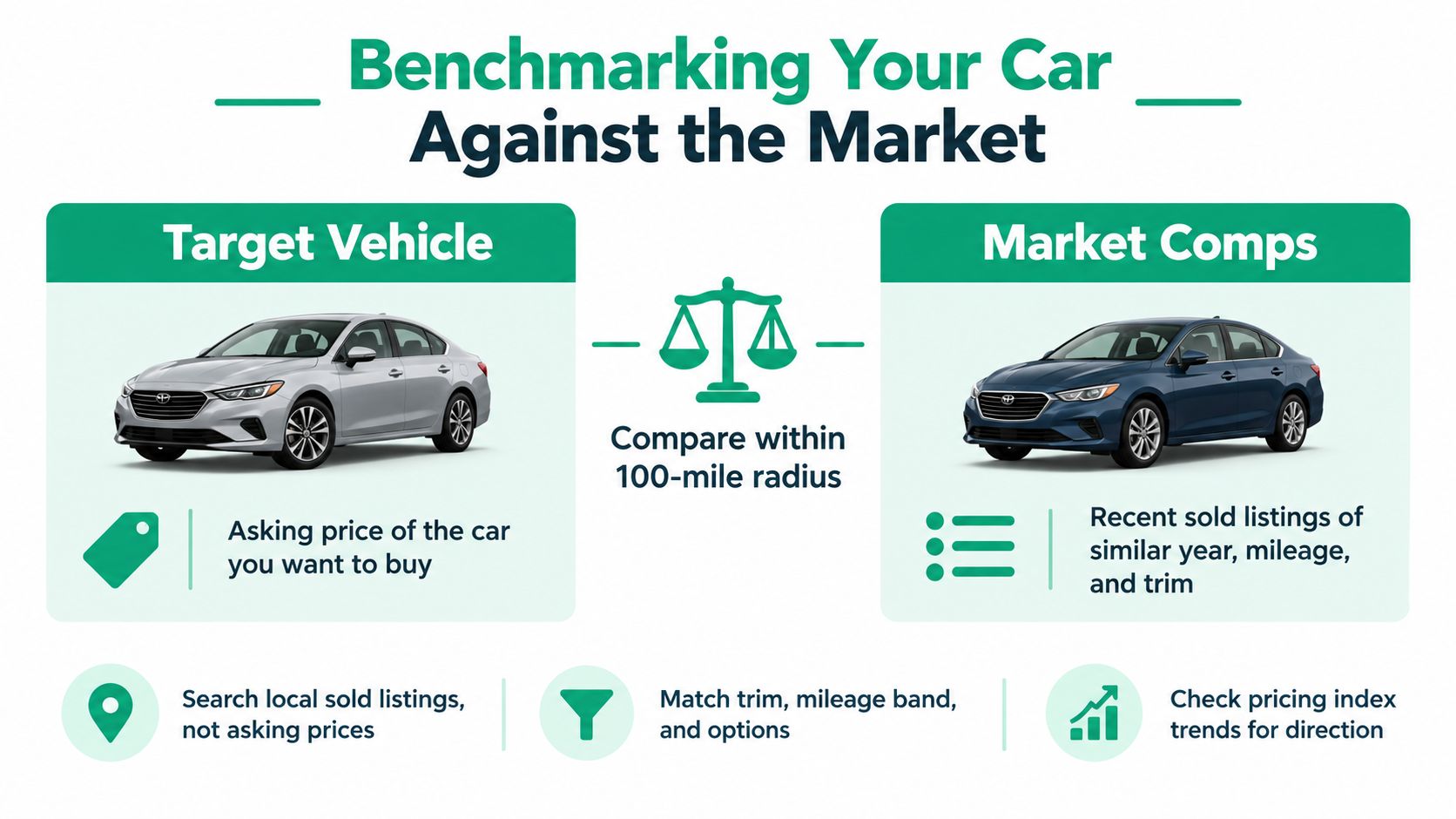
A single “book value” number is too blunt for a real purchase. Build a defensible range by comparing the target with local vehicles, checking VIN history, reading micro-market trends, and adjusting for fees before you judge the deal.
A retail listing shows the seller's target, not the final transaction. A recent transaction reflects what a buyer accepted. A wholesale index tracks dealer and auction direction, while a trade-in offer includes convenience, reconditioning risk, inventory demand, and the dealer's expected margin. Keep these figures separate because each answers a different valuation question.
Build a residual-value workflow
Use this sequence:
- Identify the target: Record year, make, model, trim, mileage, options, title status, location, and condition.
- Find local comparables: Search the same regional market, then narrow the set by generation, drivetrain, equipment, and mileage.
- Remove weak matches: Exclude different powertrains, branded titles, extreme mileage, and clearly different equipment.
- Separate channels: Group private-party, retail, trade-in, and wholesale evidence independently.
- Check direction: Use a current pricing index to see whether the relevant segment is rising, flat, or falling.
- Set a range: Let the strongest comparable vehicles establish a realistic low and high boundary.
The Edmunds appraisal methodology offers a useful structure because it adjusts for year, make, model, trim, mileage, features, condition, and depreciation. It also uses average transaction prices and information from dealer and consumer channels. Its market model accounts for age, vehicle mix, mileage, and seasonality. The methodology reports that its ordinary least squares regression explains 85% of variation in used-vehicle values with a 3% to 4% error rate, as described in the Edmunds appraisal reference.
Read the segment, not only the headline index
Broad averages can conceal major differences between vehicle types and sales channels. In August 2026, U.S. wholesale used-vehicle prices were up 0.4% year over year, while the EV sub-index rose 4.5% and the non-EV index fell 0.9%, according to WardsAuto's report on used-vehicle pricing.
Match the index to the vehicle. An EV buyer should not apply a broad non-EV trend, and a pickup buyer should not rely on an SUV average. Use Toyota vehicle research by make to narrow the starting comparison set, then verify local listings and transaction evidence yourself.
One current pricing index reports a segment-wide average of $28,815, with a 30-day change of -1.16% and a 90-day change of -1.76%, as reported by Kelley Blue Book's used-car market reference. Those figures do not price the target directly. They show whether the market supports a firm offer or gives you room to negotiate.
Finally, convert the range into an out-the-door figure. Add taxes, registration, documentation charges, dealer accessories, and financing-related costs before comparing offers. A car priced near the middle of the range can still be expensive once those fees are included.
Adjusting for Condition, Mileage, and Title Brands
The comparable set gives you a baseline. The car in front of you still needs its own adjustments. Two vehicles with the same year, trim, and mileage can have very different values if one has complete maintenance records and fresh tires while the other needs immediate mechanical work.
Don't make vague deductions. Write each adjustment down, identify the evidence, and assign a cost or risk allowance. This creates a valuation that another buyer, lender, or seller can understand.
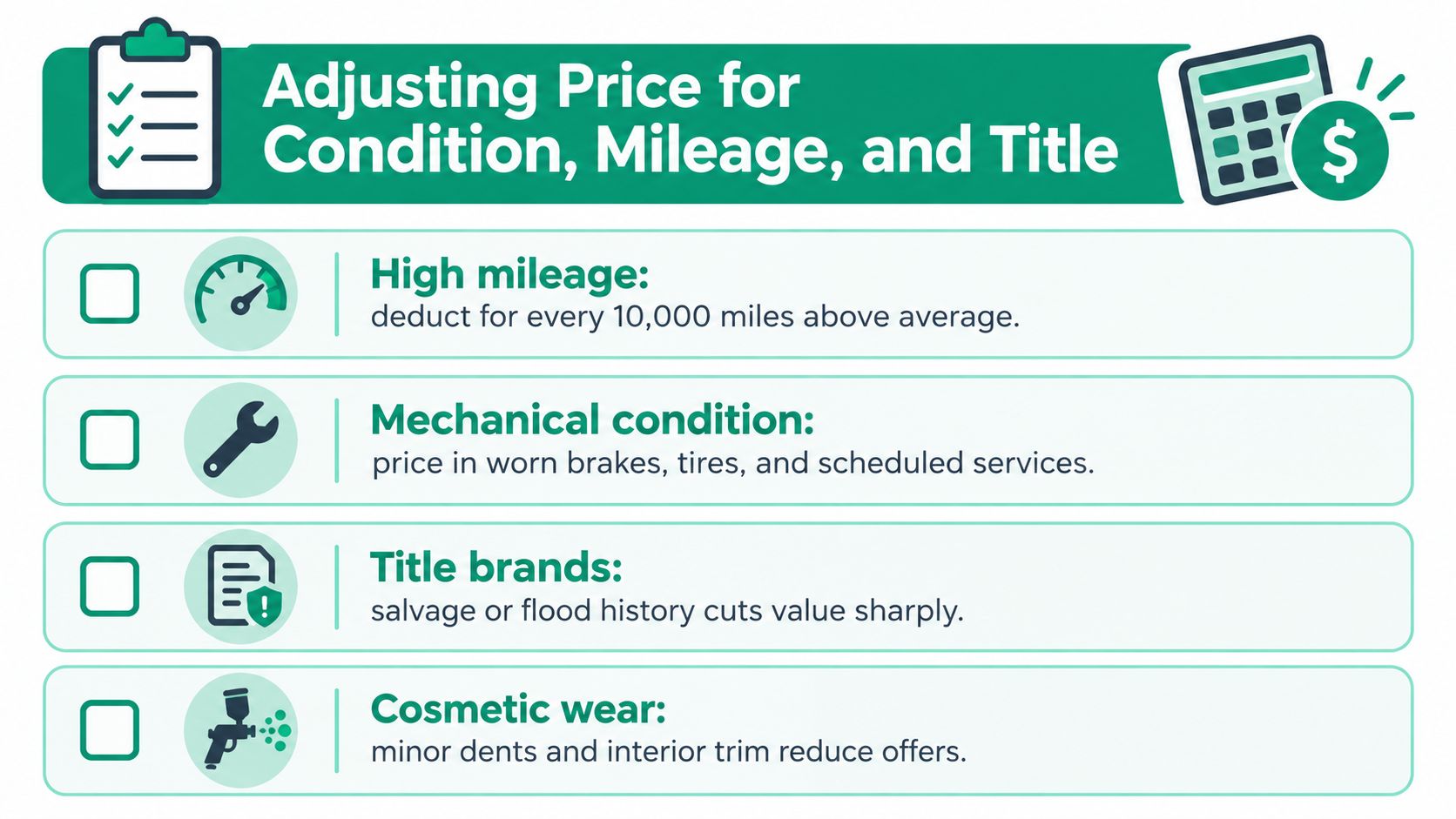
Turn defects into explicit adjustments
Begin with the items that affect safety and immediate ownership cost. A mechanic's inspection should identify worn tires, brake work, fluid leaks, suspension noise, warning lights, cooling-system concerns, and overdue scheduled service. Get written estimates where possible, then subtract the reasonable repair exposure from the clean-comparable baseline.
Mileage needs context, not a simplistic penalty. Compare the target car with the actual mileage band in your local comps. A high-mileage example with excellent records may deserve more confidence than a lower-mileage car with gaps, but the higher-mileage vehicle still faces a shorter remaining service horizon and a narrower resale audience.
Use a worksheet like this:
| Adjustment area | Evidence to collect | Valuation effect |
|---|---|---|
| Mechanical condition | Inspection findings and repair estimates | Subtract immediate repair exposure |
| Tires and brakes | Tread, pad, rotor, and replacement evidence | Subtract replacement cost and inconvenience |
| Maintenance history | Invoices, service intervals, ownership records | Add confidence for documentation, reduce it for gaps |
| Options and equipment | Window sticker, VIN data, working features | Adjust against genuinely comparable trims |
| Cosmetic condition | Dents, paint mismatch, glass, interior damage | Subtract repair or resale allowance |
| Mileage | Local comparable mileage and odometer history | Adjust for remaining life and marketability |
Title brands deserve separate treatment because they affect more than appearance. Salvage or flood history can reduce the buyer pool, complicate insurance, make financing harder, and create a permanent resale question even after repairs. Don't average a branded-title vehicle into clean-title comparables. Build a separate range or walk away if the documentation and inspection aren't convincing.
For a broader framework on assigning resale value to imperfect goods, Ruit's guide on cómo tasar ropa de segunda mano offers a useful reminder: condition, demand, completeness, and presentation all influence what a buyer will pay. Cars require more technical evidence, but the valuation principle is the same.
Inspection rule: If you can't explain an adjustment in writing, you probably haven't measured it properly.
Keep additions conservative. Desirable options can help a car compete, but don't pay twice for equipment already included in the comparable vehicle's trim. A clean title, credible records, and a sound inspection support the upper end of your range. Deferred maintenance, poor repairs, and title problems push the car toward the bottom.
Using Your Valuation to Negotiate the Final Price
A valuation only saves money when you use it at the desk. Bring a short evidence file, not a dozen loose screenshots. Your file should contain the VIN history, inspection findings, comparable listings or transaction evidence, the market-direction reference, and your calculated out-the-door target.
Separate the vehicle price from every other charge. In September 2026, the FTC reiterated that an advertised vehicle price must be the actual price a consumer can pay at the dealership, excluding only government-required charges, as summarized in the FTC price-transparency guidance. That distinction matters because add-ons, documentation charges, protection packages, and other fees can make a seemingly fair car materially more expensive.
Use evidence instead of emotion
A clean opening script sounds like this:
“I'm valuing the vehicle against comparable cars with the same trim and mileage profile. The history shows these items, the inspection identifies these repairs, and the current market points in this direction. I'm prepared to buy at this out-the-door amount, provided the paperwork matches it.”
If the seller focuses on monthly payment, redirect the conversation:
“I'm deciding the vehicle price and total purchase cost first. We can discuss financing only after we agree on the out-the-door figure.”
If an add-on appears late in the process, ask:
“Is this required by law, or is it optional? If it's optional, remove it and show me the revised buyer's order.”
Don't negotiate from the dealer's monthly payment. A longer loan can make an inflated vehicle look affordable while increasing total financing cost. If financing is part of your decision, review the practical trade-offs in this guide to whether refinancing a car is worth it separately from the vehicle's market value.
A seller who refuses to show the buyer's order, title status, or fee breakdown is giving you valuation information through behavior. Leave if the numbers won't stay transparent. Another car is easier to find than a clean way out of a bad purchase.
Avoiding Common Valuation Mistakes Before You Buy
The costliest valuation errors are basic: using a national estimate for a local purchase, comparing a clean-title car with a rebuilt one, treating an asking price as a transaction price, or trusting a polished vehicle without verifying its VIN. Build a defensible range instead of relying on one book-value number.
Before signing, verify:
- Identity: Match the VIN on the vehicle, title, history report, and purchase documents.
- History: Check title brands, damage, theft, liens, mileage records, ownership changes, and auction activity.
- Comparables: Match year, trim, drivetrain, mileage, options, title status, and condition.
- Location: Use local and micro-market evidence. Prices vary across more than 100 geographic regions in the United States, as noted in the Edmunds appraisal methodology.
- Market direction: Check whether this vehicle segment is moving differently from the broad used-car market.
- Condition: Price tires, brakes, service, mechanical faults, cosmetic repairs, and missing records.
- Fees: Demand the actual out-the-door price. Separate government charges from optional products.
- Inspection: Hire an independent mechanic, even when the seller provides a recent inspection.
- Exit plan: Walk away if records conflict, repairs are concealed, or paperwork is unclear.
A quiet market does not make every deal fair. A car listed below a national benchmark can still be overpriced locally because of weak history, limited equipment, or deferred maintenance. A documented, clean example can justify the top of your range because it carries less uncertainty.
Your answer to “what is this used car worth?” should be a documented range supported by VIN history, comparable vehicles, local demand, market direction, condition, and total purchase cost. Adjust the range for every out-the-door fee before making an offer.
Use VinCheck to review VIN-linked history, title brands, mileage issues, auction activity, recalls, and used-car value information. Visit VinCheck, enter the vehicle's VIN, and base your offer on documented risk rather than the seller's first number.
About the author
VinCheck Editorial Team — Editorial Standards & Review
The VinCheck Editorial Team reviews every published article against NMVTIS data accuracy and NHTSA recall validity. This byline appears on collaborative pieces and quick-update posts.