 Vin
First Lien vs Second Lien Explained for Vehicle Buyers
By VinCheck Editorial Team, Editorial Standards & Review · Published 2026-09-12 · Updated 2026-09-12 · Reviewed by VinCheck Editorial Standards
You've found a used vehicle at a price that works, the seller says the title is clean, and you're ready to send the money. Then the clerk tells you a lender still has a claim on the vehicle, or a second creditor appears during the transfer. The purchase pauses because the title cannot move freely until every relevant lien is addressed.
That situation is avoidable. First-lien versus second-lien priority affects who gets paid, who controls the release process, and whether a buyer receives transferable title. The same basic priority rule applies to homes and vehicles, but vehicle liens have practical recording and verification steps that many general explainers skip. This guide puts those steps into plain language, with separate guidance for buyers, sellers, dealers, and lenders. For broader background on priority principles, investors can also review this resource on lien priority for real estate investors. Before you negotiate a Toyota purchase, a Toyota VIN lookup can also help identify title and lien indicators that deserve follow-up.
Table of Contents
- Why Lien Priority Matters Before You Buy or Sell a Vehicle
- What First and Second Liens Mean on Property and Vehicles
- First Lien vs Second Lien Side by Side Comparison
- How Priority Plays Out in Repossession and Sale Scenarios
- How to Check for First and Second Liens on a Vehicle
- Financing and Selling Implications for Buyers Dealers and Lenders
- How to Clear or Manage a Second Lien Before Transfer
Why Lien Priority Matters Before You Buy or Sell a Vehicle
A lien isn't the same thing as a person's name appearing on a title. It's a legal claim connected to an unpaid debt, and it gives the creditor rights against the collateral. With a vehicle loan, the lender may keep control of the title record until the loan is paid and the lien is released. A seller can possess the car, maintain it, and advertise it, yet still lack the ability to transfer clear ownership.
The most common surprise occurs when a seller knows about the primary auto loan but forgets, overlooks, or doesn't disclose another secured claim. A second lien might come from additional financing tied to the same vehicle. The title can look ordinary to a buyer who only glances at the front page, while the state or clerk record still requires another creditor's release.
The payment order controls the outcome
Priority matters because the collateral is limited. If a vehicle is sold or repossessed, the proceeds are distributed according to the applicable claims and recording order. The senior lienholder is generally paid before a junior lienholder. If the money runs out after the first claim, the second creditor may receive only part of the balance or nothing from that collateral sale.
That creates different risks for each person in the transaction:
- Buyers face transfer risk: You may pay the seller but still be unable to register the vehicle if the lien release isn't available.
- Sellers face closing risk: An unpaid lien can delay the sale, reduce the proceeds available to the seller, or require additional money to clear the title.
- Dealers face inventory risk: A trade-in with an unresolved subordinate claim can become difficult to retail or finance.
- Lenders face collateral risk: A second lien reduces the equity cushion available if the borrower defaults.
Practical rule: Never treat a seller's verbal assurance as proof that a vehicle is free of liens. Verify the record and obtain written payoff and release instructions before funds change hands.
The key question isn't whether a second lien is allowed. It's how it was recorded, whether the first lienholder consented where required, and what documentation the state uses to update the title. Those details determine whether a clean-looking document reflects a clear title.
What First and Second Liens Mean on Property and Vehicles
Start with the collateral. A lien attaches a creditor's claim to an asset that supports repayment. For a home, that asset is real property. For an automobile, it's the vehicle identified through the title and related state records.
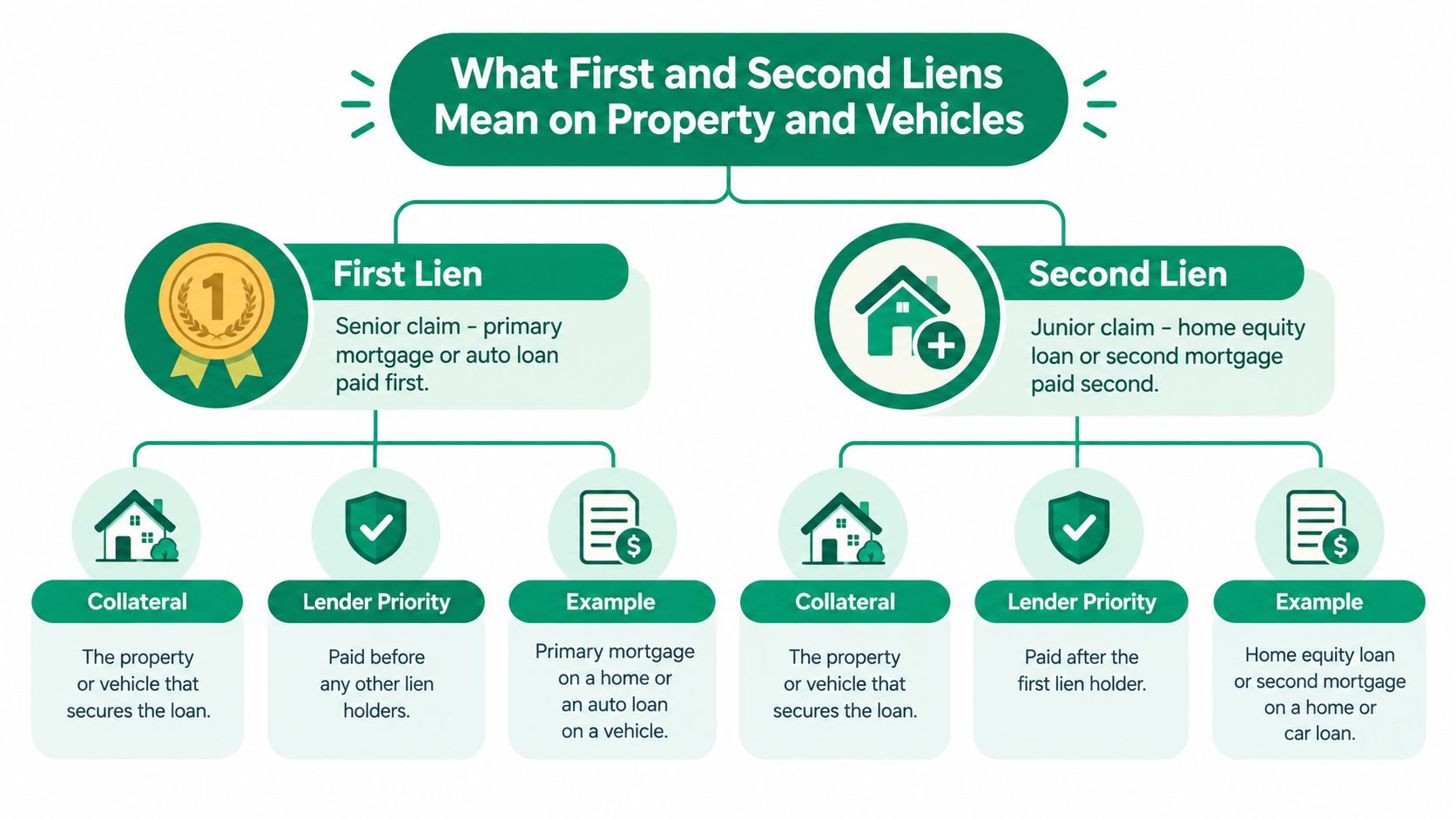
A first lien is the senior claim. In U.S. mortgage and real-estate practice, it's typically the primary mortgage. In vehicle finance, it's commonly the original auto lender's claim. A second lien is a junior claim on the same collateral, such as a home equity loan or HELOC on a property, or additional secured vehicle financing where state procedures allow it.
Why recording order matters
The traditional rule is “first in time, first in right.” The claim recorded first generally has priority over a later claim, subject to applicable state law and special statutory rules. That means recording isn't a clerical detail. It can determine which creditor gets the sale proceeds first and which creditor absorbs the loss when the collateral value is limited.
A second lien doesn't replace, cancel, or move ahead of the first lien. Both claims may remain attached to the same asset. The first lienholder holds the senior position, while the second lienholder waits for whatever value remains after the senior debt and permitted sale costs are addressed.
Vehicles use a different record system
Property liens are commonly recorded in land records. Vehicle liens are usually reflected through the certificate of title and state motor-vehicle records, with clerks, title offices, or designated state workflows handling filings. The exact process varies by jurisdiction, so a buyer shouldn't assume that the title document alone tells the complete story.
The Tennessee County Clerks Association notes that a second lien may be processed through the clerk or state workflow while the title remains with the first lienholder, and other guidance indicates that permission from the first lienholder may often be needed. That makes the answer to “Can a car have two liens?” practical rather than universal: it can be possible, but the state's recording process and the first lender's requirements control the result. Review the vehicle lien noting process for an example of how that workflow can operate.
For a buyer, the important distinction is simple. A visible first lien doesn't prove there is no subordinate claim, and an apparently clean title doesn't eliminate the need for an official search when the transaction raises questions.
First Lien vs Second Lien Side by Side Comparison
The difference between the two positions is best understood as a difference in priority, control, and recovery, not merely a difference in loan labels. Both claims can be secured by the same home or vehicle, but they don't carry the same protection when the borrower defaults.
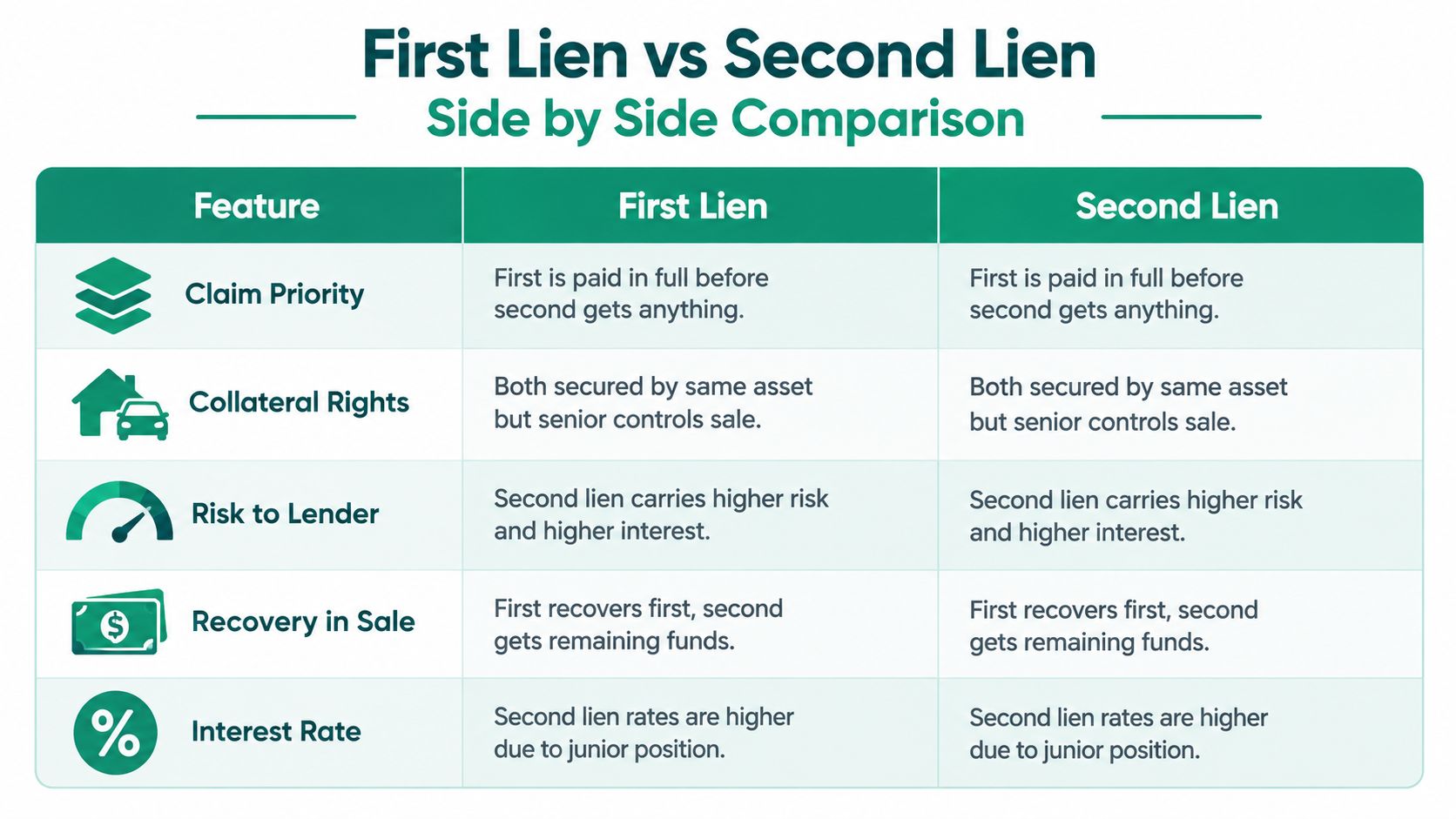
| Issue | First lien | Second lien |
|---|---|---|
| Claim priority | Senior claim, paid before a junior claim from the same collateral | Junior claim, paid after the first lien is satisfied |
| Collateral position | Has the strongest secured position in the asset | Shares the collateral but has less protection |
| Default exposure | Usually has the clearest economic path to the collateral value | Depends heavily on the remaining value after the senior balance |
| Sale or liquidation recovery | Receives proceeds before the second lienholder | Receives only the remaining proceeds |
| Transaction approval | May control title, payoff, or sale requirements | May require coordination with the first lienholder and state recording office |
Priority changes the lender's risk
A first-lien lender benefits from being paid first. That senior position doesn't guarantee full recovery, because collateral values, enforcement costs, and market conditions still matter. It does, however, give the lender the first claim on the available collateral pool.
A second-lien lender carries more risk because the first balance comes out of the same asset. Long-run recovery studies cited in independent credit-market coverage put first-lien recoveries around 70 to 80 cents on the dollar, compared with roughly 30 to 45 cents for second-lien debt. The difference reflects the collateral value left after the senior claim is satisfied, as described in this analysis of subordinate-debt recovery rates.
Priority rule: Both creditors may have valid claims, but the first lienholder gets the first opportunity to recover from the shared collateral.
Why consent and pricing can differ
A first lienholder may control the title or require its debt to be paid before releasing the vehicle. A later creditor can't assume that it can independently sell or transfer the asset without addressing the senior claim. The second creditor may also need documentation showing how its claim fits into the state's title process.
Because the junior position is less protected, second-lien credit generally carries higher risk and may carry higher pricing than comparable senior debt. For a borrower, adding a second lien can provide access to funds, but it also reduces the equity cushion and complicates a later sale, refinance, or title transfer.
How Priority Plays Out in Repossession and Sale Scenarios
Priority becomes clear when the collateral is converted into money. Suppose a vehicle has a first lien and a second lien. The vehicle is sold after default, and the sale proceeds are deposited into the payoff process. The first lienholder's eligible claim is addressed first. Only the remaining amount can move to the second lienholder.
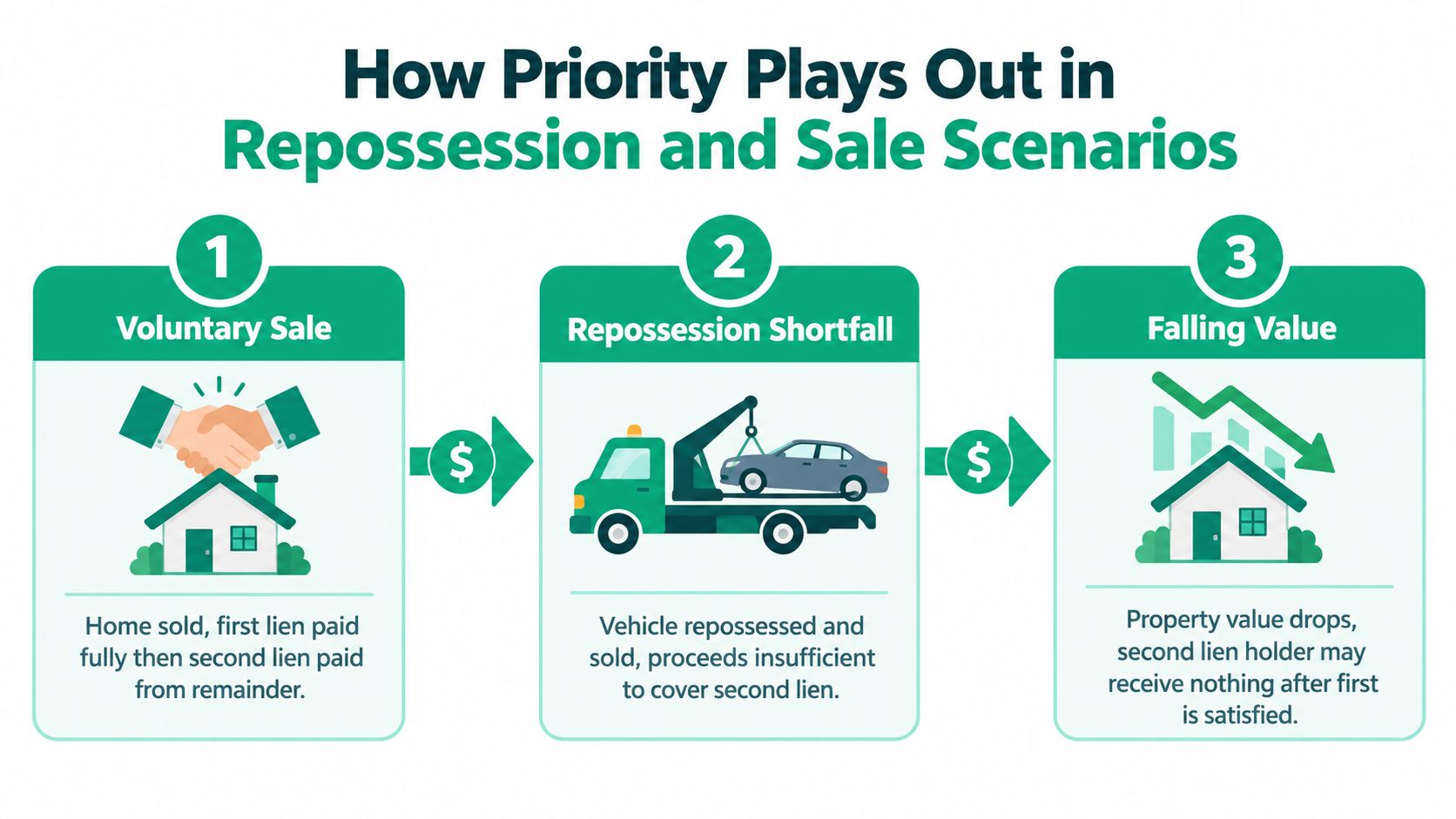
Three outcomes to keep in mind
A voluntary sale with enough value is the cleanest scenario. The seller or closing agent obtains payoff figures from both creditors, directs the required funds to the first lienholder, and uses the remaining proceeds for the second lienholder. If enough money exists to satisfy both claims, each lender can issue the appropriate release documentation.
A repossession with a shortfall produces a different result. The vehicle may sell for less than the combined balances. Sale expenses and the first lien balance consume the available proceeds, leaving the second lienholder with a reduced recovery or no recovery from that sale. The unpaid balance might still create a separate obligation, depending on the contract and applicable law, even though the lien's collateral value has been exhausted.
A falling-value market makes the junior position more fragile. If the vehicle's value declines while the senior balance remains substantial, the first lien can consume the available equity. The second lien may then be effectively wiped out as a secured recovery from the vehicle. Broader secured-lending guidance describes this general principle: junior liens absorb losses first when proceeds don't cover the senior debt. The explanation in this overview of first-lien and second-lien debt is useful for understanding that risk.
The same waterfall applies to property, though foreclosure and sale procedures differ by jurisdiction. Recent bankruptcy-recovery reporting illustrates how cycle timing and deal structure can compress recoveries. One industry summary of Moody's data reported 2024 first-lien term-loan recovery at 49.2%, compared with a 1987 to 2024 long-run average of 76.4%, while second-lien loans averaged 46.5% over the 1987 to 2019 baseline. These figures don't predict a particular vehicle outcome, but they show why seniority alone doesn't eliminate market and collateral risk. See the bankruptcy recovery rate report for the cited context.
A borrower dealing with a future home purchase should also separate lien mechanics from credit readiness. If past payment problems are affecting approval, resources about rebuild credit before buying a home may help frame the next steps, although credit repair doesn't replace title or payoff verification.
How to Check for First and Second Liens on a Vehicle
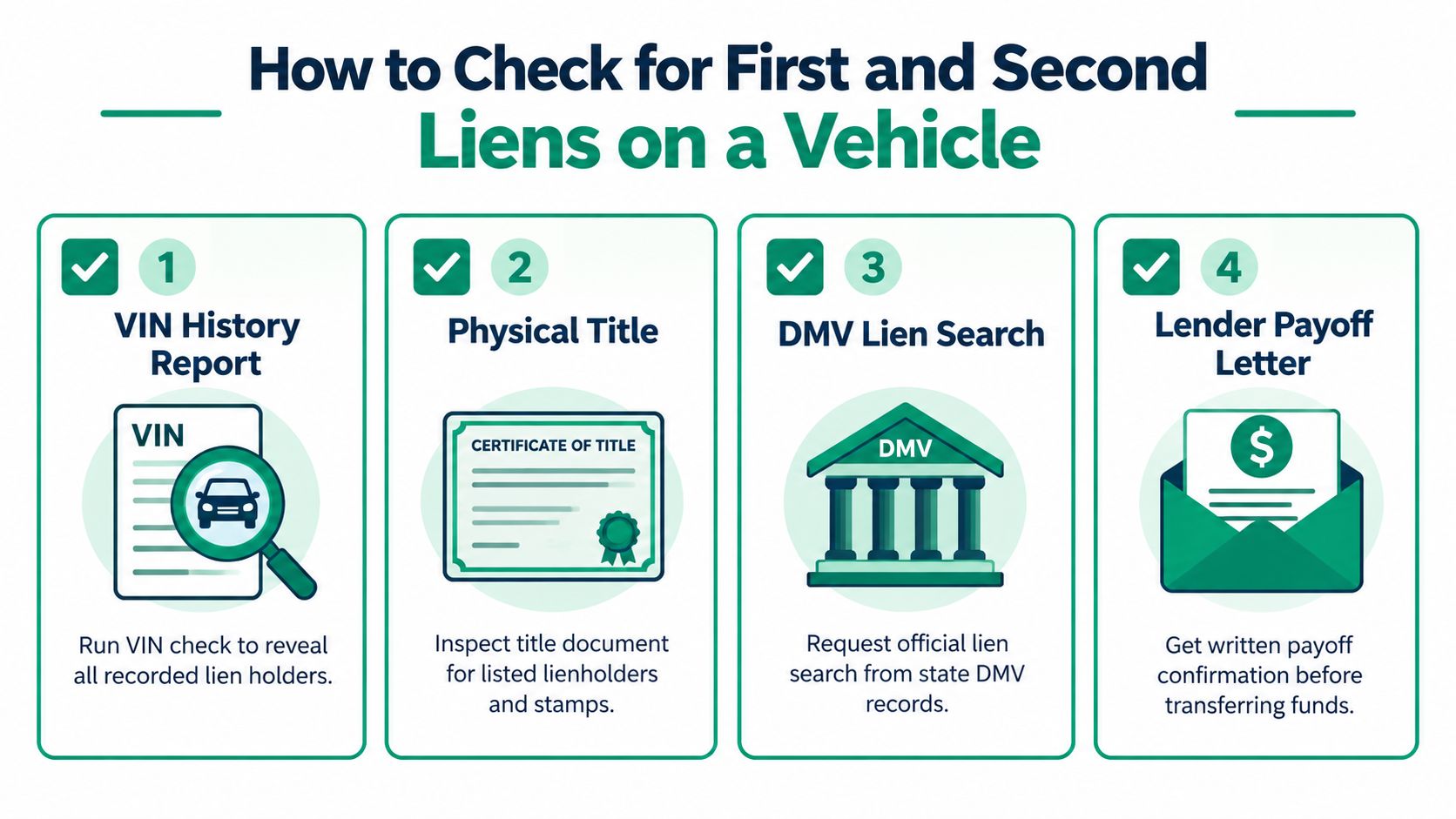
A reliable search uses more than one document. Start with the vehicle identification number, compare the history data with the physical title, and then confirm the result through the relevant state or clerk record before closing.
Use a layered verification process
Run a VIN history report. Look for lien indicators, title brands, theft records, salvage events, and ownership or auction entries. A report is a screening tool, not a substitute for an official state confirmation, but it can reveal discrepancies worth investigating.
Inspect the title itself. Check every lienholder field, notation, stamp, reassignment, and release entry. Compare the VIN, seller's identity, odometer information, and title status. A seller who can't produce the original title or offers only an informal payoff promise should not receive unrestricted payment.
Request an official state search. Ask the DMV, title agency, or county clerk which record controls for the vehicle. This step matters because a second-lien filing may be handled through a clerk or state workflow while the title remains with the first lienholder. State rules can also determine whether the first lender must consent.
Obtain written payoff confirmation. Request current payoff letters from each identified creditor. The letter should explain the amount, expiration date, payment instructions, lien-release procedure, and where the release will be sent.
Buyers researching the process in another market can compare it with this guide on how to check outstanding car finance in the UK. The legal systems differ, but the practical lesson is similar: verify finance status before treating possession as ownership.
Match the records before sending funds
A VIN report can surface recorded indicators, while an official search confirms the state's current record. A clean-looking title may still warrant further review if the seller recently refinanced, used the vehicle as collateral for another loan, or cannot explain a lender notation.
For a specific vehicle, a 2024 Toyota Camry VIN check can be one part of the review. Ask the seller to authorize lender communication when necessary, and direct payoff funds to the creditors rather than relying on the seller to clear the debt later.
Before closing: The safest file contains the title, VIN match, official lien search, written payoff instructions, proof of payment, and a release or documented state update.
Financing and Selling Implications for Buyers Dealers and Lenders
A vehicle with multiple liens can turn an ordinary sale into a coordinated closing. The buyer needs a path to transferable title. The seller needs to know whether the price will cover each secured balance. Dealers and lenders must calculate what collateral remains after the senior claim is considered.
Buyers should make lien resolution a closing condition
The purchase price and monthly payment tell only part of the story. Ask for the current balance on every lien, the correct payoff recipient, and the expected release timing. A seller's promise to fix the title later does not protect the buyer if a creditor still has a recorded interest.
Valuation also matters. A 2024 Toyota Camry value estimate can help frame the discussion, but it does not replace an official lien search or written payoff information. A buyer may proceed when the payoff process is documented and the funds are controlled. Pausing or walking away is more sensible when the seller refuses verification, a lienholder will not confirm the payoff, or the combined debt appears higher than the vehicle's realistic value.
Sellers need a payoff plan before advertising
A seller should identify every lienholder before agreeing to a final price. If sale proceeds will not cover the senior and junior balances, the seller may need to contribute funds, negotiate with a creditor, or delay the sale. A signed bill of sale does not by itself remove a lien or create clear, transferable title.
The recording process also deserves attention. A second lien on a vehicle is typically recorded through the title or the state's electronic lien and title system after the creditor receives an enforceable security interest and submits the required filing. The exact paperwork and timing vary by jurisdiction, so the seller should confirm how the state records and releases that interest rather than assuming the first lender's record is the only one.
Dealers and lenders need a collateral review
Dealers should verify title status before accepting a trade-in or adding a vehicle to inventory. A junior lien can affect acquisition cost, resale timing, floor-planning decisions, and the amount required for release. Lenders should determine whether the first lien leaves enough collateral support for proposed financing.
Mortgage history offers a related underwriting lesson. The relationship between piggyback second liens and first-mortgage performance was viewed more favorably in the late 1990s and early 2000s, but had turned negative by the mid-2000s, with the probability of negative outcomes 3 to 7 percentage points higher for loans with subsequent seconds than for solo mortgages, according to the historical discussion summarized by Rocket Mortgage's first-lien and second-lien guide.
That history does not predict an auto-loan result. It does show why lenders should test collateral under a weaker sale outcome. If the first lien consumes the available proceeds, a junior lien may lose its secured claim against the vehicle, while the underlying debt may still remain owed under the loan contract.
How to Clear or Manage a Second Lien Before Transfer
Start by building a complete payoff file. Obtain a current statement from the first lienholder and a separate statement from the second lienholder. Confirm that each creditor has the correct VIN, borrower name, balance, payment instructions, and release procedure.
Then coordinate the payments in priority order:
- Confirm the senior payoff. Ask the first lienholder what it requires to release its title interest and how long processing takes.
- Confirm the junior payoff. Get written instructions from the second lienholder and ask whether it requires first-lien consent or a separate state filing.
- Route funds correctly. Use a closing agent, lender, dealer, or other controlled process when possible. Don't rely on an informal promise that the seller will forward money.
- Collect releases. Keep the paid-in-full letters, lien releases, receipts, and delivery confirmations.
- Verify the updated title record. Check with the state or clerk after processing. A payment receipt alone doesn't prove that the title record has been updated.
If sale proceeds are insufficient, the parties may need to negotiate a short payoff, arrange additional funds, restructure the debt, or consider subordination where the transaction permits it. A junior lien can be wiped out as a secured claim against the collateral when the first lien consumes the available sale value, but that doesn't automatically erase every contractual debt obligation.
Don't close until the paperwork matches the money flow. Use a vehicle history and title review service as an early screening step, then confirm final status through the lienholders and the official state record.
VinCheck offers VIN decoding and vehicle history reports that can surface title, lien, theft, salvage, mileage, recall, and related status indicators for review. Visit VinCheck before you negotiate or transfer funds, then pair the report with official state records and written payoff confirmations.
About the author
VinCheck Editorial Team — Editorial Standards & Review
The VinCheck Editorial Team reviews every published article against NMVTIS data accuracy and NHTSA recall validity. This byline appears on collaborative pieces and quick-update posts.