 Vin
How to Estimate Car Resale Value Accurately in 2026
By VinCheck Editorial Team, Editorial Standards & Review · Published 2026-09-28 · Updated 2026-09-28 · Reviewed by VinCheck Editorial Standards
Maya is standing on a Phoenix dealership lot, looking at a 2021 Toyota RAV4 with a windshield price of $27,400. She opens three valuation tabs on her phone and gets $24,800, $26,100, and $28,900. That's a $4,000 spread before she's checked the tires, decoded the VIN, or asked whether the vehicle has ever been damaged.
That situation is common because a car's value isn't one fixed number. It's a market estimate shaped by configuration, location, mileage, history, condition, supply, and the type of buyer involved. If you want to estimate car resale value accurately in 2026, stop looking for one magic calculator. Build a defensible number from real transactions, then adjust it for the specific vehicle in front of you.
Table of Contents
- Why Estimating Resale Value Feels Harder Than It Should
- Prepare Before You Estimate
- Build a Transaction-Based Baseline
- Apply Mileage, Condition, and Depreciation Adjustments
- How Vehicle History Changes the Number
- The Levers That Matter and the Ones That Don't
- A Pre-Offer Checklist You Can Run in Five Minutes
Why Estimating Resale Value Feels Harder Than It Should
Most online estimators give you a weighted average, not a personal appraisal. They may blend dealer transactions, private-party listings, auction activity, supply, demand, incentives, options, mileage, location, and condition. Platforms also weigh those inputs differently, so two tools can produce different answers without either one being broken.
The market adds another layer of confusion. Used-vehicle prices have stabilized from the pandemic-era surge, but inventory can still vary sharply from one ZIP code to the next. A popular all-wheel-drive crossover in a cold-weather market may draw stronger bids than the same vehicle in a region crowded with similar inventory.
Dealer's rule: A valuation range is a starting point. It isn't the number you should accept, pay, or write into a negotiation.
The mistake is treating every estimate as equally relevant. A book value may reflect broad market patterns, while a local dealer's recent sale reflects what buyers paid nearby. A private-party listing may show what a seller hopes to receive, not what the vehicle eventually brings.
Why identical cars produce different numbers
A 2021 RAV4 with the same odometer reading can carry different values if one has the XLE Premium package, factory navigation, better tires, complete service records, and a clean history. The other may have base equipment, worn tires, an accident record, or an unresolved lien.
The estimator often can't see those details unless you enter them correctly. It also may not know whether the local market has too many similar vehicles sitting unsold or whether dealers are actively seeking that configuration.
A strong appraisal therefore has three layers:
- Market baseline, based on recent transactions for comparable vehicles.
- Vehicle-specific adjustments, covering trim, options, mileage, condition, warranty, and maintenance.
- History correction, covering accidents, title brands, liens, odometer issues, and auction evidence.
The objective isn't to make every calculator agree. It's to explain why your number differs from the calculator's midpoint and support that explanation with evidence.
Prepare Before You Estimate
Don't open a valuation tool until you know exactly what you're valuing. The VIN should settle the vehicle's identity first, including model year, trim, drivetrain, engine, factory equipment, and applicable packages. A 2021 RAV4 XLE and an XLE Premium can look nearly identical from the driver's seat, yet the equipment difference can materially change the resale estimate.
Build the vehicle file
Start with a written inventory rather than relying on memory. Record:
- Trim and drivetrain: Confirm the exact badge, engine, transmission, and front-wheel-drive or all-wheel-drive configuration.
- Factory options: Note technology packages, safety equipment, premium audio, tow equipment, roof systems, wheels, and other original features.
- Current condition: Photograph body panels, wheels, glass, seats, dashboard warnings, tires, and any fluid leaks.
- Ownership documents: Gather the title, payoff information, service invoices, warranty details, and recall-completion records.
Factory options matter because an estimator may identify the wrong version if you select a generic model name. Aftermarket accessories deserve separate treatment. A dealer may appreciate a useful roof rack or bed cover, but many cosmetic modifications don't recover their purchase cost at resale.
Clean presentation still helps the appraisal process, even though detailing won't erase a branded title or poor maintenance history. If you're arranging professional preparation, this practical guide on how to prepare for car detailing covers the information and condition checks worth handling before the appointment.
Pull local comparable vehicles
Search dealer inventory, auction-result feeds, and any dealer-accessible market sources you can use. Filter aggressively for the same model year, trim, drivetrain, equipment, and region. Start with vehicles close to your ZIP code, then expand outward only when the local sample is thin.
Use closed transactions whenever possible. A listing is an asking price, and asking prices often include room for negotiation, dealer reconditioning costs, financing assumptions, or a margin that the market won't support. Your preparation is successful when the estimator receives a verified configuration and a realistic local comparison set.
Build a Transaction-Based Baseline
A seller can polish a listing all week and still miss the market by thousands if the starting number comes from asking prices. Anchor the estimate to comparable vehicles that sold. Edmunds describes market-value models built from dealer transactions, supply and demand, incentives, options, nearby transactions, mileage, location, and condition. Its Edmunds appraisal methodology supports using those inputs instead of a sticker-price guess.
Match the model year, trim, equipment, drivetrain, and region as closely as possible. Three to five credible closed sales can establish a useful midpoint. Remove obvious outliers first. The midpoint is only the opening figure, since mileage, condition, title history, and equipment still move the final number.
For example, a 2022 Hyundai Tucson SEL with 28,000 miles in the Southeast might show a transaction group centered near $26,400. Use that figure as the baseline, then check the details that separate your Tucson from those sales: tire condition, service documentation, accident records, remaining warranty, and factory equipment.
Choose the right type of evidence
Book values from Black Book and J.D. Power provide consistent trade-in and retail reference points. They are useful for comparing valuation frameworks, but closed transactions sit closer to wholesale reality because they record prices at which vehicles cleared the market.
Use Manheim or dealer-network transaction data when available. Manheim's index is calibrated on millions of U.S. used-vehicle transactions annually, as tracked in the Trading Economics used-car price index. Do not paste an index value into your appraisal. Use the relevant market-class benchmark, then adjust for the exact vehicle.
| Source Type | Data Inputs | Best Use |
|---|---|---|
| Transaction-based | Closed dealer and auction sales, market class, mileage, region | Establishing a realistic market baseline |
| Book-only | Aggregated valuation formulas and broad market assumptions | Comparing trade-in, retail, and wholesale reference points |
| Live listings | Advertised prices, equipment, location, seller strategy | Checking competition, not proving the final value |
| Vehicle history data | Title, accident, lien, mileage, auction records | Correcting the baseline for hidden risk |
Original MSRP tier, title-brand severity, and auction-grade evidence can outweigh small cosmetic differences. That is the practical edge in current resale work. For a model-specific cross-check, review the 2026 Toyota Camry value guide, then verify the exact configuration against local transactions. Treat the guide as one input, not the answer.
Apply Mileage, Condition, and Depreciation Adjustments
A 40,000-mile sedan with complete records can be worth more than a 30,000-mile example with neglected service. Mileage matters, but it is not the whole appraisal. Original MSRP tier, title-brand severity, and auction-grade evidence can swing the number more than small cosmetic differences.
Do not apply a flat annual depreciation rule and stop there. Time and mileage affect economy cars, luxury vehicles, trucks, hybrids, and performance models at different rates because repair costs, expected use, and buyer demand vary by segment.
The current used-car mileage adjustment follows an exponential decay curve. In practical terms, extra miles at the high end usually reduce value by fewer absolute dollars than the same mileage increase on a lower-mileage vehicle. A flat percentage can therefore distort the estimate.
Correct the mileage gap
Start with a matched transaction and calculate the odometer difference between that vehicle and yours. Apply a segment-appropriate adjustment, then check whether the comparison shares the same configuration, drivetrain, equipment, region, and market position. A mileage adjustment is only useful when the underlying vehicle is genuinely comparable.
Mileage needs context. Service records can indicate whether the vehicle spent its life on long highway trips or in severe stop-and-go use, while the odometer cannot. A well-documented higher-mileage car may deserve a stronger valuation than a lower-mileage car with overdue maintenance.
Score the condition objectively
Use four practical tiers:
- Outstanding: Clean panels, strong tires, no warning lights, minimal interior wear, and complete maintenance documentation.
- Clean: Normal cosmetic marks, serviceable tires, no major mechanical concerns, and useful records.
- Average: Noticeable scratches or interior wear, mixed records, older consumables, or minor repairs needed.
- Rough: Warning lights, poor tires, damaged upholstery, mismatched panels, leaks, or deferred maintenance.
Give credit only for items a buyer can verify. Recent tires, completed brakes, transferable factory warranty coverage, and documented recall work can support a positive adjustment. Undisclosed mechanical problems, expired coverage, questionable modifications, and missing records should reduce the estimate.
| Adjustment Category | Typical Impact Range | Notes |
|---|---|---|
| Mileage difference | Model and class dependent | Compare against matched transactions and market class |
| Condition | Qualitative to material | Use tires, warning lights, panel gaps, wear, and records |
| Remaining warranty | Positive when transferable | Verify coverage, exclusions, and expiration |
| Recent maintenance | Positive when documented | Receipts matter more than verbal assurances |
| Aftermarket modifications | Often neutral or negative | Include only when buyers in that segment clearly want them |
| Depreciation | Model and age specific | Use a curve, not a universal annual percentage |
The used-car market requires a current reset. Edmunds' Q2 2025 used-car report says Black Book projected about 15% annual depreciation for 2025, and later reported that vehicles aged two to six years depreciated 13.9% in 2025. Older pandemic-era assumptions can therefore overestimate resale value.
Keep the final adjustment disciplined. Explain the largest changes, especially mileage, condition, MSRP tier, title severity, and verified auction evidence. Leave minor preferences out. A number that cannot survive inspection is not an estimate, it is an asking price.
How Vehicle History Changes the Number
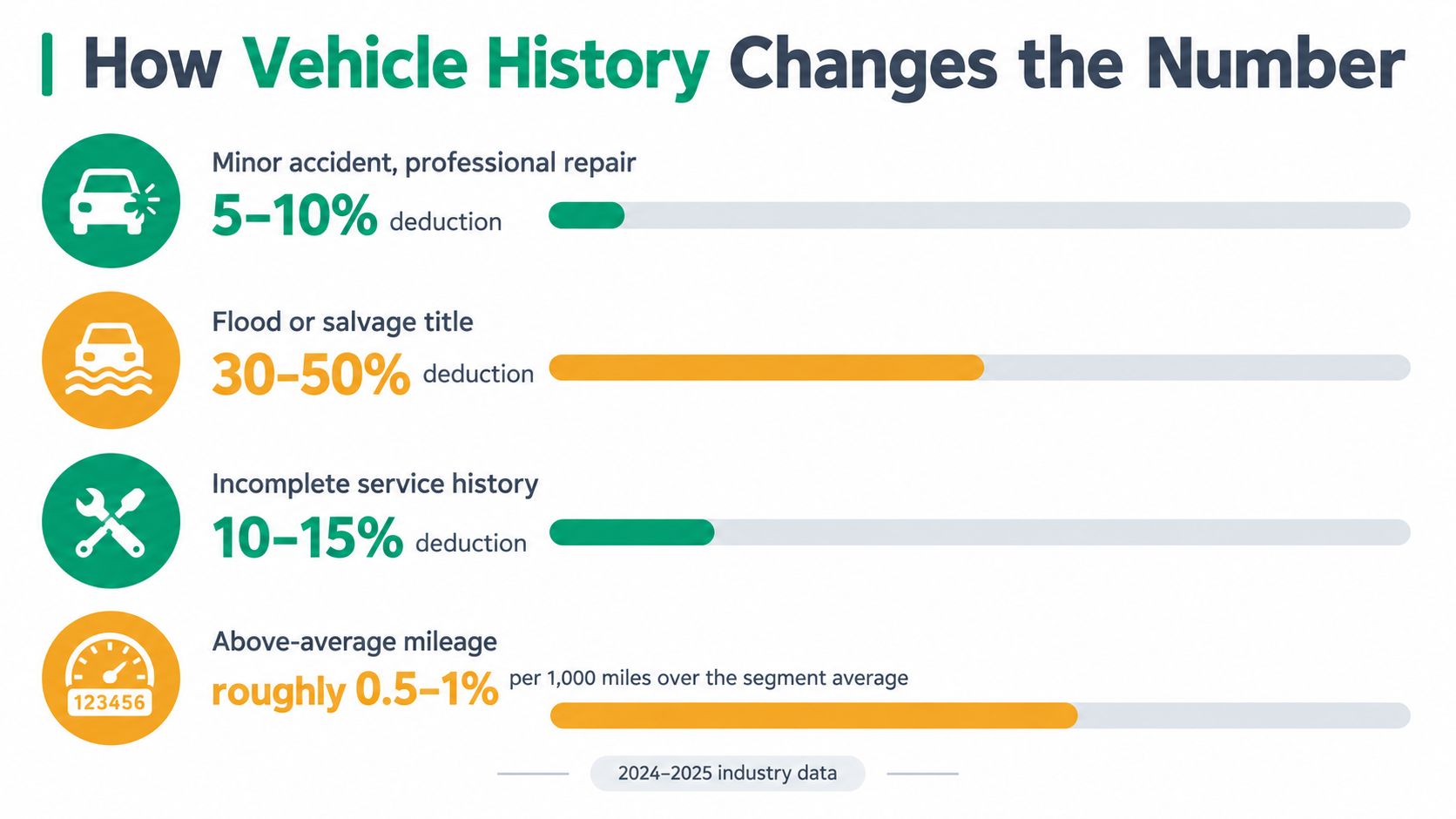
A vehicle history report can move an appraisal from a guess to a negotiation position. It can reveal prior auction grading, branded titles, ownership changes, odometer inconsistencies, lien records, and damage that a seller didn't mention.
The severity of the event matters more than the word “accident.” A minor collision repaired professionally may reduce buyer confidence, but clear invoices, photographs, and a quality inspection can limit the damage. Structural damage, flood exposure, salvage branding, and odometer problems are different categories of risk, and dealers typically treat them accordingly.
Separate repairable concerns from permanent stigma
The requested infographic uses deductions attributed to 2024–2025 industry data, but those figures aren't included in the verified data provided for this article. The practical ranking is still clear:
- Minor documented accident: Usually negotiable when repairs were professional and the title remains clean.
- Structural or flood damage: A serious risk that can follow the vehicle through multiple resale transactions.
- Salvage or rebuilt title: A major valuation problem because many lenders, insurers, dealers, and retail buyers apply restrictions.
- Mileage rollback or title washing: A trust and compliance issue that can make traditional resale extremely difficult.
A clean title is the baseline assumption in most negotiations. If an active lien exists, the seller must verify the payoff process before you treat the vehicle as transferable. Lien status isn't a cosmetic adjustment. It can determine whether the deal can close at all.
Use auction evidence, not just a summary
A generic history summary may show that an incident occurred without showing how severe the damage was. Auction photographs can reveal bent rails, missing airbags, flood residue, mismatched panels, deployed restraints, or a repair that looks better in person than it did before reconstruction.
Use a Toyota Camry VIN check to investigate title brands, accident records, mileage anomalies, liens, recalls, theft indicators, and related history before you accept a seller's description. Don't automatically deduct the same amount for every accident entry. Match the adjustment to the title status, structural severity, repair quality, and available documentation.
History rule: A clean-looking car with a bad history is still a bad appraisal. Condition tells you what the vehicle looks like today. History tells you what risk the next buyer inherits.
The Levers That Matter and the Ones That Don't
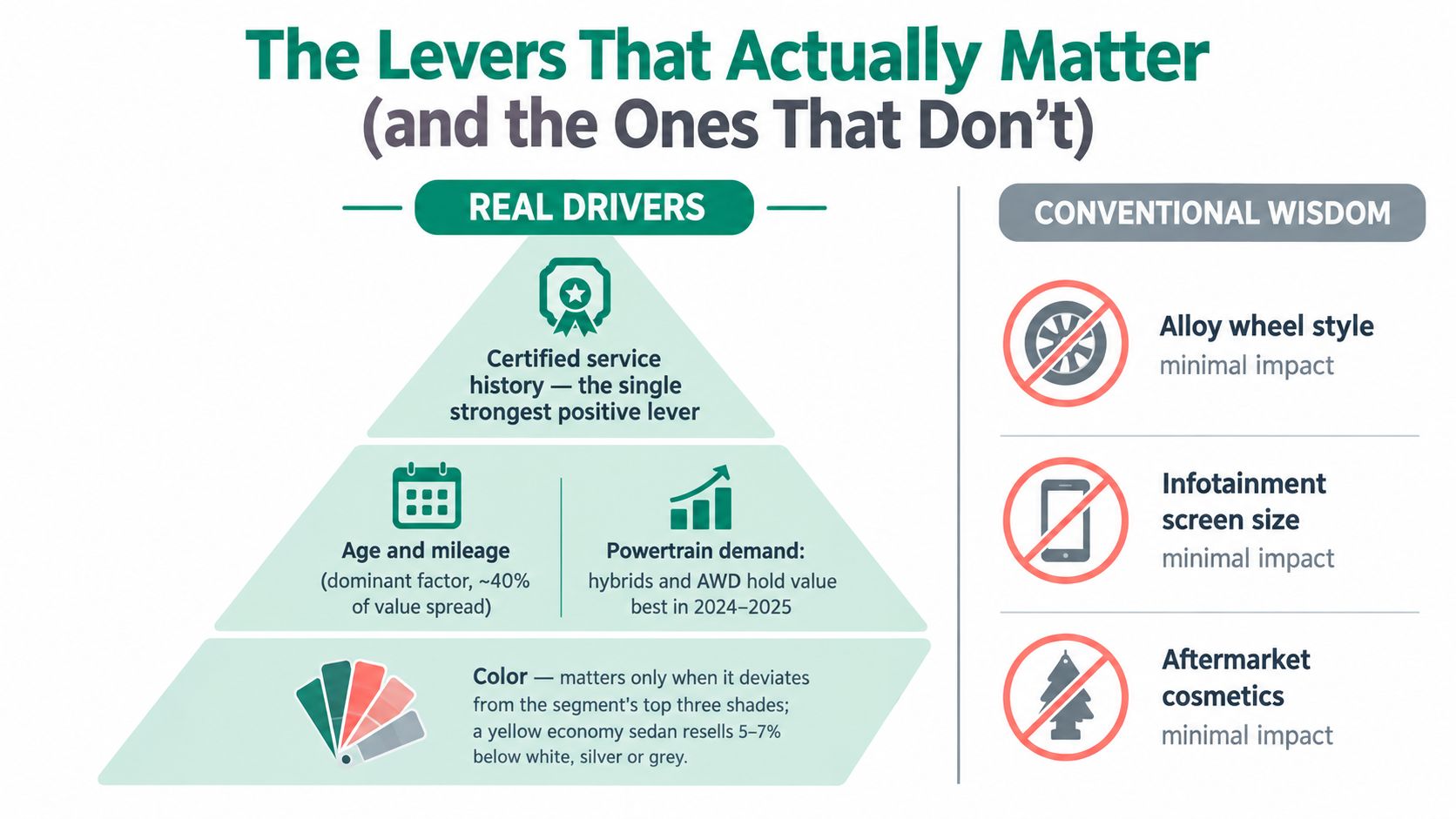
A buyer may praise the paint, mats, or large screen, then negotiate hard over the trim, title, or service file. Minor equipment can help at the margin. The number on the windshield is driven more by trim, title status, documented maintenance, age, mileage, original MSRP tier, powertrain demand, and proof from comparable sales.
A 2025 academic study found that color and fuel consumption were not statistically significant in its sample, according to the study on vehicle resale value factors. Treat color as a tie-breaker at most. A branded title, missing maintenance, or mismatched trim will move the appraisal much further.
Rank the vehicle's real value drivers
First, verify the trim and equipment. A base model and a highly equipped version can share body panels while attracting different buyers. Count factory options only when the market recognizes them and your comparison vehicles match the same specification.
Second, assess history and ownership. A clean title, consistent mileage, and first-resale status make the vehicle easier to explain. Multiple owners, unclear records, liens, or unresolved history create questions, and dealers price that uncertainty into the offer.
Third, account for original MSRP tier and vehicle age segment. Edmunds reported that in Q2 2025, vehicles that originally cost more than $100,000 retained 57% of value, while vehicles originally priced at $10,000 to $20,000 retained 77%, as shown in its Q2 2025 used-car market analysis. Put original price tier directly into the estimate. It deserves more weight than small cosmetic preferences.
Fourth, check demand for the powertrain and body style. Hybrid, electric, all-wheel-drive, truck, and crossover demand shifts by market. Compare against local buyers rather than relying on a national average.
Enthusiast vehicles require their own comparison set. Originality, documentation, and factory specification can outweigh personalized cosmetics. SwiftJet's collector guide to Saleen illustrates why a special vehicle should be appraised differently from an ordinary commuter car.
Use the 2024 Toyota Camry safety ratings to compare safety equipment and buyer expectations. Safety information supports an appraisal, but it does not replace transaction evidence, inspection results, or title review. Dealers and lenders verify those high-impact items first.
A Pre-Offer Checklist You Can Run in Five Minutes
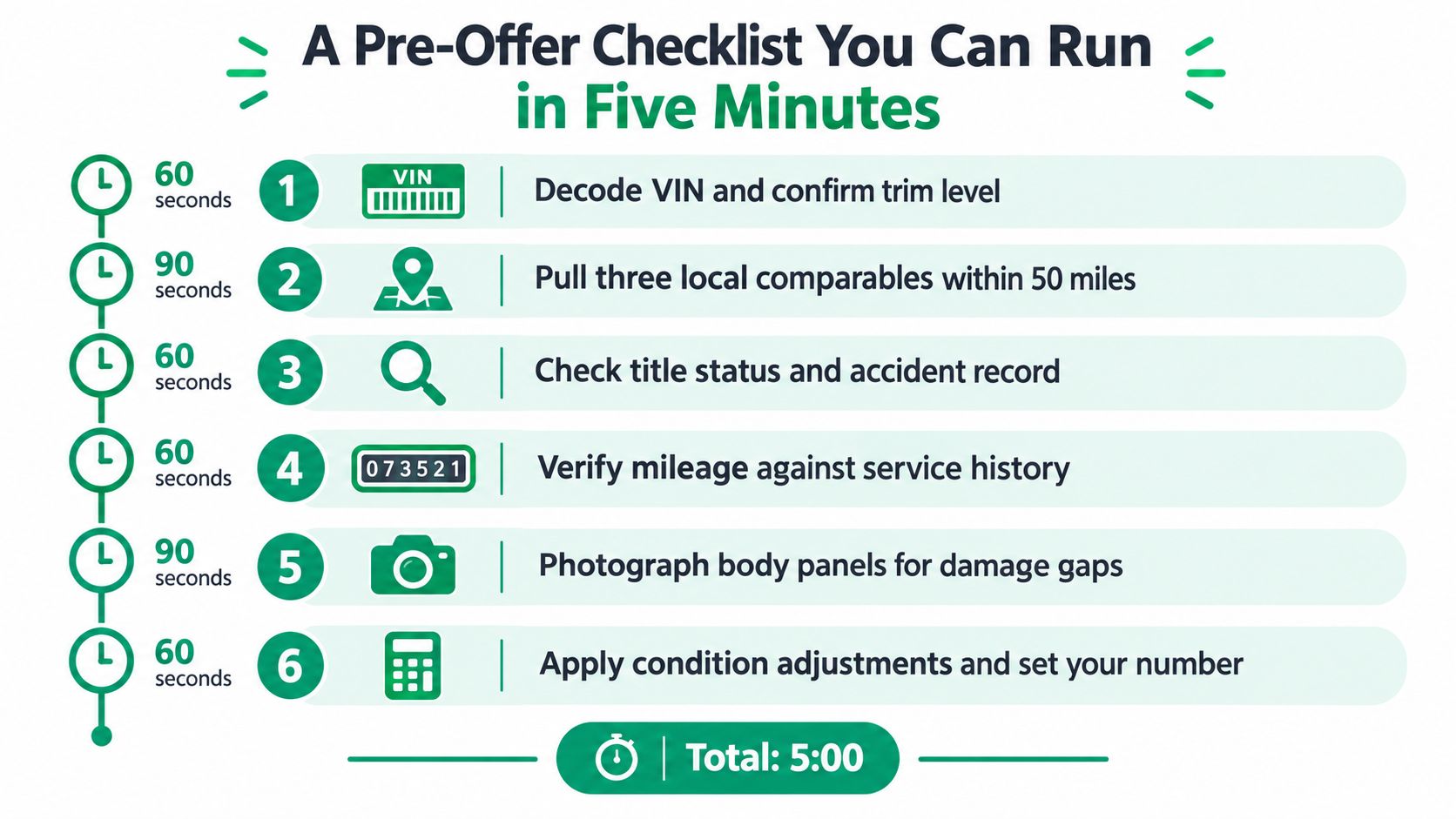
Use this sequence on your phone before you make an offer. It isn't a theoretical exercise. It's the same kind of fast screening that keeps a dealer from overvaluing the wrong car.
- Decode the VIN, 60 seconds: Confirm the model year, trim, drivetrain, engine, and factory equipment.
- Pull local comparables, 90 seconds: Find three closed or strongly comparable transactions in the same market, expanding the search radius only when necessary.
- Check history, 60 seconds: Verify title status, accident records, liens, theft indicators, recalls, and auction evidence.
- Verify mileage, 60 seconds: Compare the odometer with service records, inspection entries, and history data.
- Inspect the body, 90 seconds: Photograph panel gaps, paint mismatch, glass, wheels, tires, and signs of repair.
- Set the number, 60 seconds: Start with the transaction baseline, then apply only the condition, mileage, depreciation, and history adjustments you can defend.
The final sanity check is simple: if the asking price sits more than 10% above your adjusted baseline without a documented reason such as rarity, fresh service, or remaining factory warranty, walk away or counter hard. That threshold is a negotiation rule, not a market statistic, so use it alongside the evidence rather than treating it as an automatic rejection.
Write your adjusted number down before speaking with the salesperson. If the dealer can produce better transaction evidence, revise your estimate. If the only defense is a glossy listing and a vague claim that the vehicle is “priced to market,” keep your number and let the seller decide.
VinCheck can help you verify a VIN, review title and accident history, check mileage and lien indicators, and compare vehicle-value information before you negotiate. Use the VinCheck tools to turn the vehicle's history and configuration into evidence, then take that evidence with you when you set your offer.
About the author
VinCheck Editorial Team — Editorial Standards & Review
The VinCheck Editorial Team reviews every published article against NMVTIS data accuracy and NHTSA recall validity. This byline appears on collaborative pieces and quick-update posts.