 Vin
Do Motorcycles Have VIN Numbers? a Complete Guide
By VinCheck Editorial Team, Editorial Standards & Review · Published 2026-09-23 · Updated 2026-09-23 · Reviewed by VinCheck Editorial Standards
Yes, motorcycles do carry VINs. In the United States, modern on-road motorcycles use a 17-character VIN, following the federal standard harmonized in 1981, and the number is typically placed on a permanent label near the steering head.
So why do buyers still ask where the VIN is, or whether the number on the frame is the same as the one on the title? Motorcycles don't use the same visible dashboard layout as cars, and labeling practices can vary by manufacturer and market. A buyer inspecting a used bike needs more than a definition. You need to know how the code works, where to look, what it can reveal, and when a history lookup is necessary.
Table of Contents
- Do Motorcycles Really Have VIN Numbers
- How Motorcycle VINs Are Structured
- Motorcycle VINs vs Car VINs
- Where to Find the VIN on a Motorcycle
- Decoding a Motorcycle VIN Step by Step
- Using VinCheck to Verify Motorcycle History
- A Buyer's Motorcycle VIN Checklist
- Motorcycle VIN Questions Buyers Ask Most
Do Motorcycles Really Have VIN Numbers
Do motorcycles really have VIN numbers, and does the code work exactly like a car's? Yes, a street-legal motorcycle in the United States has a Vehicle Identification Number. That number links the physical bike to its title, registration, insurance records, recall information, and theft records.
For a used-bike buyer, the VIN is the motorcycle's official identity. The engine may be replaced, fairings changed, or paint applied over earlier repairs, while the assigned VIN remains tied to the frame and its records.
Federal rules require manufacturers to assign a unique VIN and display it on a permanent label that inspectors can read. Under the modern U.S. system, the code has 17 characters, following the standards harmonized in 1981. NHTSA guidance on motorcycle VIN requirements explains the identification and display requirements.
Rules still vary by market, and older motorcycles may use different numbering systems. Motorcycle labels also do not always appear in the same visible locations or formats as car labels. A VIN therefore answers “which motorcycle is this?” but not “what has happened to it?”
Practical rule: Read the VIN directly from the motorcycle. Compare every character with the title and registration, then run a history lookup for accident, theft, salvage, and title problems. Decoding the characters can identify the bike, but it cannot reveal every event recorded in its past.
The following sections explain the code, labeling differences, inspection points, and history checks.
How Motorcycle VINs Are Structured
Why does a motorcycle VIN need several groups of letters and numbers? Each group works like a label on a different part of the bike's identity. Older motorcycles may follow manufacturer-specific numbering systems, so a pre-standard bike can require its maker's records or a specialist reference rather than a modern decoder. The NHTSA material on VIN errors and motorcycle identification discusses these identification challenges and the move toward consistent VIN practices. NHTSA material on VIN errors and motorcycle identification
For a modern motorcycle, read the VIN in three zones:
- Characters 1 through 3, the WMI: The World Manufacturer Identifier shows the manufacturer and regional or country code.
- Characters 4 through 9, the VDS: The Vehicle Descriptor Section contains manufacturer-defined details about the model, engine, body, frame, and related features. Position 9 is the check digit, used to help detect a transcription error.
- Characters 10 through 17, the VIS: The Vehicle Identifier Section identifies information such as model year, assembly plant, and production sequence.
These positions provide a framework, not a universal dictionary. For example, a 2022 Yamaha YZF-R1 can use positions 4 through 8 for model and engine information according to Yamaha's VDS table, while Harley-Davidson assigns meaning to those positions differently. Use manufacturer documentation or a reliable decoder before treating a character group as a specific feature.
The letters I, O, and Q are left out because they can resemble the numbers 1 and 0. Read the complete VIN from the motorcycle, then compare it with the title and registration. An engine number or partial frame marking identifies a component, not necessarily the motorcycle's official record.
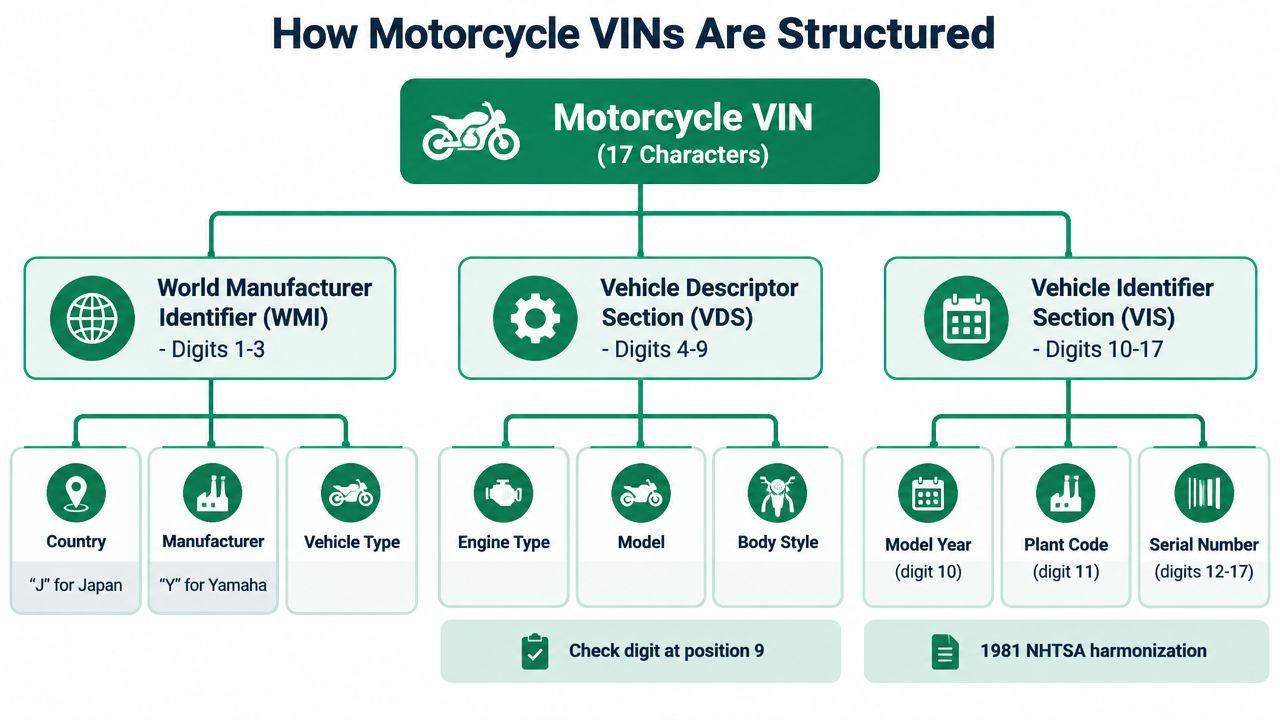
The format can also cover motorcycles and moped-class vehicles under ISO 3779. Market rules and older numbering practices still vary, so decoding identifies the bike, while a history lookup is needed to check records for accidents, theft, salvage, or title problems.
Motorcycle VINs vs Car VINs
Why can a motorcycle follow the same VIN logic as a car yet require a different inspection routine? The answer lies in how manufacturers display the identifier. Both vehicle types use a 17-character framework in modern U.S. on-road applications, but motorcycles usually place the VIN where the steering assembly meets the frame rather than behind a windshield.
A car often shows its VIN through a small dashboard panel visible from outside. A motorcycle has no dashboard window, so its permanent certification label is commonly positioned near the steering post or steering-head area. The label may carry the official VIN even when the frame has no separately stamped number. A missing frame stamp alone therefore does not prove that the motorcycle is illegal. NHTSA VIN guidance can help clarify how certification labeling differs from assumptions based on car inspections.
| Attribute | Motorcycles | Passenger Cars |
|---|---|---|
| Identification framework | Uses the modern 17-character system in applicable markets | Uses the same broad 17-character system |
| Primary viewing area | Certification label near the steering post or steering head | Commonly visible through the windshield |
| Frame marking | May not appear as a separate stamped number | May have additional identification markings |
| Market presentation | Label format and language can vary by country | Label placement and wording can also vary by market |
| Inspection priority | Steering-head label, nearby frame areas, and documents | Dashboard VIN, door or structural labels, and documents |
Market rules add another layer. In EU markets, the same 17-character VIN is required under ISO 3779, but certification-label placement and language may differ from U.S. practice. A motorcycle imported from another country can therefore look unfamiliar without having an invalid identifier.
An engine number supports service-record or manufacturer checks, but it identifies the engine, not automatically the motorcycle's official record. For comparison, a Honda Civic VIN record shows the same basic verification principle used with cars. A decoder identifies the motorcycle, while a history lookup can reveal accident, theft, salvage, or title issues.
Where to Find the VIN on a Motorcycle
Start at the steering head, also called the steering neck. Turn the handlebars enough to expose the area where the front fork assembly meets the main frame, then inspect both sides with a flashlight. The VIN may be printed, riveted, etched, or attached on a permanent certification label, and NHTSA guidance places the required label near the steering post and handlebar intersection where it can be read without moving the motorcycle.
Don't assume every bike has an obvious stamped number on the frame. The federal rule allows the motorcycle VIN to appear on the certification label, and labeling details can vary between manufacturers and countries. Motorcycle VIN location guidance also highlights why buyers should check more than one likely location when a label is difficult to access.
Use this inspection order:
- Steering head: Look for the permanent VIN label and record every character.
- Nearby frame area: Inspect the down tube and neck for a separate factory marking, but don't treat an absent stamp as conclusive by itself.
- Engine cases: Find the engine number if present. It can support a paperwork check, but it isn't a substitute for the official VIN.
- Additional labels: Check frame rails, areas under the seat, and other manufacturer-specific locations.
- Documents: Compare the motorcycle with its title, registration, certificate of origin, and insurance records.
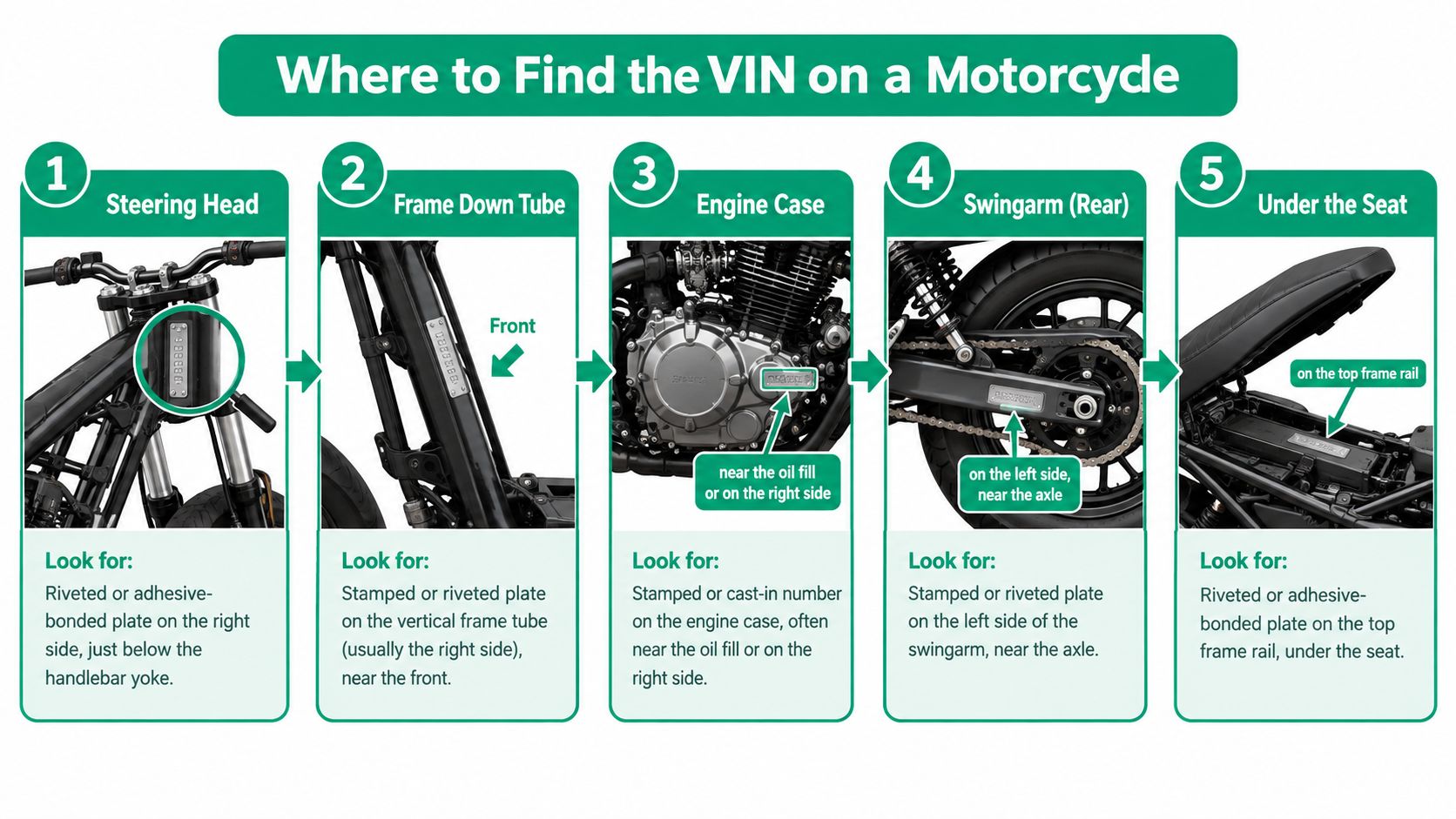
A replaced fairing usually isn't meaningful, but a damaged steering neck, fresh paint around the label, uneven rivets, grinding marks, or a replacement-looking plate deserves caution. A mismatch between the physical VIN and the paperwork should stop the sale until the seller provides official correction or ownership documentation.
For an imported motorcycle, the registration and insurance documents may be easier to access than the physical label. Use them as supporting references, not as permission to skip the frame-area inspection.
Decoding a Motorcycle VIN Step by Step
A VIN decoder can translate the broad identity of a motorcycle, but manufacturer-specific codes still matter. Harley-Davidson and Indian, for example, publish model-specific position information rather than one universal key for every motorcycle brand.
Read the number from left to right:
| Position | Code Segment | Meaning | Example |
|---|---|---|---|
| 1 to 3 | WMI | Manufacturer and regional or country identifier | A brand-specific WMI such as 1HD may identify Harley-Davidson production in the United States |
| 4 to 8 | VDS | Model, engine, frame, body, and other manufacturer-defined attributes | Brand-specific descriptor code |
| 9 | Check digit | Mathematical validation character used to catch certain entry errors | A digit or permitted character calculated from the VIN |
| 10 | VIS | Model-year code | Manufacturer and standard year code |
| 11 | VIS | Assembly plant | Plant-specific code |
| 12 to 17 | VIS | Production sequence | Individual serial sequence |
Suppose a seller gives you a 17-character VIN beginning with a manufacturer identifier and ending with a six-character production sequence. First, copy it exactly, including letters that may resemble numbers. Next, confirm that the decoded manufacturer and model year make sense for the motorcycle sitting in front of you. Finally, compare the entire sequence with the steering-head label and title.
The check digit is useful for catching transcription mistakes, but it isn't a complete fraud detector. A failed check can result from a typo or a record problem, so recheck the physical VIN before drawing a conclusion.
A VIN can describe how a motorcycle was built. It can't, by itself, describe everything that happened to it afterward.
The VIN alone won't reliably reveal hidden crash damage, theft status, or title brands. Those details require linked external records and a physical inspection.
Using VinCheck to Verify Motorcycle History
Decoding answers, “What vehicle is this?” A history search addresses a different question, “What records are connected to this vehicle?”
Enter the full VIN from the motorcycle's steering-head label into a motorcycle history service, then compare the returned make, model, and year with the actual bike. A report may surface title brands, salvage indicators, theft records, liens, accident-related entries, recalls, mileage concerns, or auction history when those records are available in the underlying datasets.
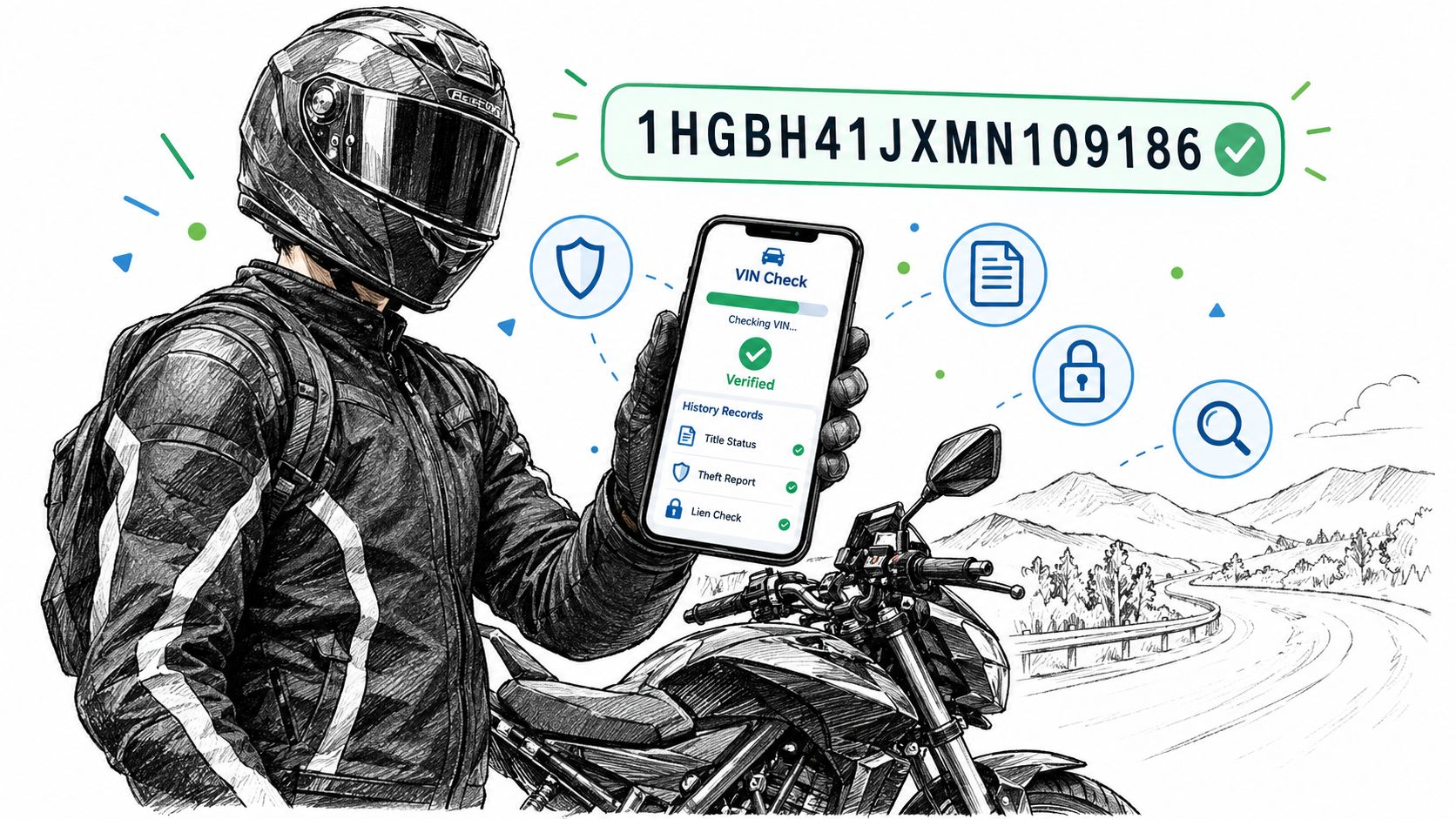
A clean result doesn't replace a hands-on inspection. It means the available records don't show a listed problem, while unreported or poorly documented damage may still exist. If the report returns a salvage, rebuilt, theft, or lien entry, ask the seller for the underlying title and release documents before considering payment.
VinCheck provides motorcycle VIN decoding and vehicle-history reporting, with records and datasets designed to connect a VIN to vehicle identity and available status information. You can also compare the process with a sample Ford F-150 VIN check, but use the motorcycle's own VIN and category-specific details for the actual purchase.
Treat every mismatch as a separate issue:
- Identity mismatch: The report describes a different make, model, or year.
- Ownership problem: The title contains a brand, lien, or theft concern.
- Physical inconsistency: The VIN looks altered or doesn't match the paperwork.
- Condition gap: The history looks clean, but the frame, forks, wheels, or welds show damage.
Don't send money until you understand each discrepancy and have supporting documents.
A Buyer's Motorcycle VIN Checklist
A useful inspection combines the number on the bike, the documents, the history report, and the motorcycle's physical condition. Work through the checks before signing a bill of sale.
- Confirm the full VIN: Use a phone photo and a flashlight. Compare all 17 characters on the steering-head label with the title and registration. A single-character difference needs an explanation.
- Inspect the label: Look at rivets, adhesive, alignment, font, surface scratches, and paint. A freshly replaced-looking label or disturbed surrounding metal is a reason to pause.
- Examine the frame area: Check the steering neck and nearby frame for grinding, rewelding, distortion, or heavy overpaint. A history report can't assess the quality of a structural repair.
- Record the engine number: Photograph it and compare it with manufacturer or registration records where applicable. Remember that the engine number identifies the engine, not necessarily the motorcycle.
- Run a history lookup: Use the complete VIN to check available title, salvage, accident, theft, lien, recall, and mileage records. A vehicle value reference can illustrate how VIN-linked research supports broader buying decisions, although the motorcycle's condition and market determine its actual value.
- Verify ownership: Ask to see the seller's identification, title, registration, and bill of sale. Confirm that any lien release is documented by the appropriate authority.
- Keep an evidence file: Save timestamped photos of the VIN, frame, engine number, title, and report. Written records make it easier to resolve a discrepancy with the seller, insurer, or motor-vehicle agency.
A VIN lookup can identify record problems, but it can't tell you whether the steering head is straight or whether a repaired weld is safe. Hire an independent motorcycle shop when you see frame damage, inconsistent paint, fork alignment concerns, unexplained engine replacement, or a seller who refuses an inspection. Walk away when the seller won't let you verify the VIN or produce ownership documents.
Motorcycle VIN Questions Buyers Ask Most
Do dirt bikes and off-road motorcycles have VINs
Many motorcycles intended for public-road registration follow the standard VIN system, while competition-only machines and some specialty vehicles may use different manufacturer identification practices. Check the frame, title requirements, and manufacturer documentation for the specific category and market. Don't assume that an off-road bike follows the same labeling pattern as a street-legal model.
What if the motorcycle has a title from another state
Ask the seller for a clear photograph of the out-of-state title before arranging transport. When the motorcycle arrives, compare the title's VIN with the physical label and any accessible frame marking, then follow your local motor-vehicle agency's verification process.
What if one or two characters don't match
Stop the transaction until the discrepancy is explained through official paperwork. A seller may need a correction document, a title amendment, or a formal VIN verification, depending on the jurisdiction. Never alter, restamp, or replace a VIN yourself.
How should I handle an imported motorcycle
Imported motorcycles can involve foreign-market documentation, customs records, and local inspection requirements. Ask the seller for the import paperwork and confirm with the relevant registration authority whether a licensed inspector must verify the VIN before the bike can be titled.
A motorcycle VIN is a starting point, not a guarantee. The number identifies the bike, the documents establish the ownership trail, the history lookup checks available records, and an independent inspection evaluates condition.
Before buying a used motorcycle, use VinCheck to decode the VIN and review available history records connected to it. Compare the report with the steering-head label and title, then arrange an independent inspection if the bike shows structural repairs, altered identification, or any unresolved mismatch.
About the author
VinCheck Editorial Team — Editorial Standards & Review
The VinCheck Editorial Team reviews every published article against NMVTIS data accuracy and NHTSA recall validity. This byline appears on collaborative pieces and quick-update posts.