 Vin
Best VIN Decoder: Compare Top Tools for Accuracy
By VinCheck Editorial Team, Editorial Standards & Review · Published 2026-09-16 · Updated 2026-09-16 · Reviewed by VinCheck Editorial Standards
You're standing beside a used car while the seller says it has a clean past. The dashboard VIN matches the paperwork, the paint looks presentable, and a quick lookup returns the expected make, model, engine, and year. That feels reassuring, but it doesn't answer the questions that create the greatest purchase risk: Was the vehicle declared salvage, reported stolen, recorded with mileage problems, or involved in an event the seller didn't mention?
The best VIN decoder isn't necessarily the fastest page or the one with the longest feature list. It's the tool that clearly separates factory identification from history evidence, validates the VIN correctly, explains its data coverage, and gives you enough decision-relevant information to know when to walk away or investigate further. A decoder can confirm what the vehicle is. A history report helps you judge what happened to it.
Table of Contents
- What a VIN Decoder Actually Does
- How We Evaluate the Best VIN Decoder Options
- Top VIN Decoder and Vehicle History Services Compared
- Quick VIN Decoder Scorecard and Decision Guide
- When VIN Decoding Results Change Everything
- How to Choose the Right VIN Decoder for Your Needs
- Frequently Asked Questions About VIN Decoders
What a VIN Decoder Actually Does
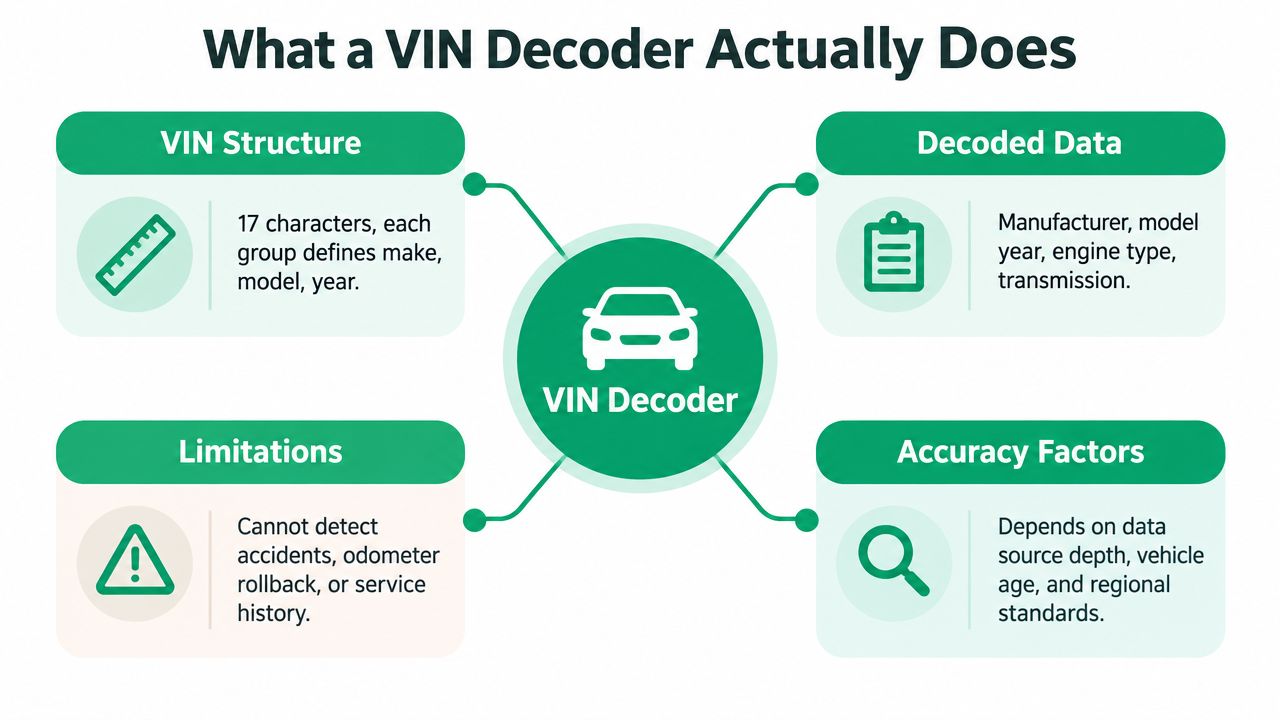
A VIN decoder reads the structure of the vehicle identification number itself. Under the modern framework, a VIN contains 17 characters divided into the World Manufacturer Identifier, Vehicle Descriptor Section, and Vehicle Identifier Section. That structure lets software interpret manufacturer identity, vehicle attributes, model year, assembly plant, and serial sequence from one code, as described by ISO 3779.
The VIN doesn't contain a complete life story. It won't independently reveal every accident, repair, title transfer, lien, ownership change, or service visit. Those details must come from external records, such as title systems, insurance reporting, salvage auctions, recall databases, and other participating data providers. A page that returns factory specifications has decoded the identifier, but it hasn't necessarily checked the vehicle's background.
The two checks buyers often confuse
Basic decoding is useful for confirming whether the seller's description matches the vehicle. It can help identify the manufacturer, model, body type, engine, model year, plant, and serial sequence. That's valuable for parts research, recall matching, insurance paperwork, and catching a simple listing error.
History reporting answers a different set of questions. It may show title brands, salvage or theft indicators, accident records, mileage entries, liens, auction activity, recalls, and other status signals, depending on what participating sources have reported. Even a detailed report can't prove that no unreported event ever occurred, so a clean result still needs to be matched against the car, paperwork, and inspection.
Practical rule: Use decoding to verify identity. Use history data, a physical inspection, and paperwork review to evaluate risk.
For a quick specification check, you can decode a Toyota Camry VIN, but don't treat the result as a substitute for a vehicle-history investigation. The distinction is the foundation of any honest comparison.
How We Evaluate the Best VIN Decoder Options
A polished interface can still return a wrong answer.
Accuracy starts before enrichment
The first test is structural. A dependable decoder should recognize the 17-character format, separate WMI, VDS, and VIS positions, reject invalid I, O, and Q characters, and calculate the check digit at position nine before adding any vehicle data. The NHTSA VIN decoder documentation explains this position logic and validation process.
Vehicle age affects the result. NHTSA reports decode confidence of about 99% for model years 1995 forward across most major brands and many unusual vehicles, compared with about 60–65% for 1980–1994 vehicles. Those figures appear in NHTSA's VIN decoder FAQ. An older vehicle may therefore return fewer details even when the VIN was entered correctly. A short decode is a limitation to investigate, not proof that the car is clean.
Data transparency outranks feature count
A useful service states whether each result comes from VIN parsing, government records, insurance reporting, auction data, manufacturer information, or another source. “Full history” says little without defined coverage.
The report also needs to address the risks at the point of purchase:
- Identity and specifications: Does the output match the vehicle in front of you?
- Title and brand information: Can it reveal salvage, rebuilt, flood, or other title indicators?
- Theft and lien signals: Does it distinguish a reported status from a guarantee?
- Mileage evidence: Does it display recorded entries or identify inconsistencies?
- Recall information: Can it flag unresolved safety concerns?
- Auction and image evidence: Does it provide context for earlier damage when records are available?
A basic decoder may confirm that the seller listed the correct engine and model year. It cannot establish that the car has no accident, title, lien, or mileage history.
Usability and price come last
Mobile access helps on a dealership lot, but convenience cannot compensate for weak records.
The right choice depends on the task. A mechanic checking a part number needs a clean decode. A buyer considering an expensive used vehicle needs identity confirmation alongside history evidence. A dealer or auction bidder may prioritize repeat access, multiple reports, valuation tools, and faster workflow. One service can suit one job and fall short on another.
Top VIN Decoder and Vehicle History Services Compared
The main distinction is simple. NHTSA's tool is an official decoder, while commercial services generally compete by adding broader records and decision tools. Those products shouldn't be judged as interchangeable.
| Service | Best For | Strengths | Pricing Model |
|---|---|---|---|
| NHTSA VIN Decoder | Official specification checks and recall-oriented research | Government-operated decoding reference, standardized position logic, useful starting point | Public online tool |
| VinCheck | Buyers who want decoding alongside history and valuation tools | Free initial VIN identification, history-focused records, salvage and theft indicators, recalls, value estimation, instant reports, mobile and desktop access | One-time reports from $19.99, or Subscribe & Save from $4.55/report |
| Commercial history-report services | Buyers seeking a broader paid history report | May combine title, accident, ownership, mileage, auction, and service signals, depending on coverage | Usually paid per report or through subscription plans |
| Manufacturer and model-specific tools | Recall and brand-specific verification | Useful for confirming manufacturer recall information and model details | Often public or account-based, depending on provider |
NHTSA is the clean baseline
NHTSA's decoder is the sensible first stop when you need an official interpretation of a VIN or want to check whether a vehicle's basic identity makes sense. Its limitation is scope. A factory decode doesn't automatically provide a complete accident, title, lien, ownership, or theft history.
That makes it strong for verification, not sufficient for a full purchase decision.
VinCheck combines decoding with risk-oriented records
VinCheck provides a free initial decoder and positions its paid history reports around NMVTIS-grade records and related datasets. Its product information describes coverage that can include accidents, title brands, salvage and flood records, theft status, liens, mileage anomalies, recalls, and prior sales or auction activity. It also combines tools for used-car value, safety ratings, recalls, window stickers where supported, and salvage-auction research.
The pricing structure has no trial: reports are $19.99 one-time, alongside multi-report packs starting from $7.00 per report, according to the publisher's provided product information. That makes the renewal condition important to read before starting, especially for a buyer who only needs one report.
A value lookup can add negotiation context through a Toyota Camry value estimate, but an estimate isn't proof of mechanical condition or a replacement for an inspection.
Commercial reports offer breadth, but coverage varies
Paid history-report providers can be useful when they disclose their record categories and limitations clearly. Their practical advantage is aggregation, but one provider may have an event another doesn't. Auction participation, state reporting, insurance reporting, service history, and regional coverage all affect the final result.
The wrong choice is a service that presents a thin VIN decode beside broad claims about “complete history” without identifying what records were searched. If the report can't tell you whether a result came from title data, an auction record, a recall database, or a simple specification parser, treat its conclusions cautiously.
Quick VIN Decoder Scorecard and Decision Guide
A scorecard is useful only if it reflects trade-offs rather than pretending every service serves the same purpose. The ratings below are practical fit assessments, not claims that one provider returns identical results for every VIN.
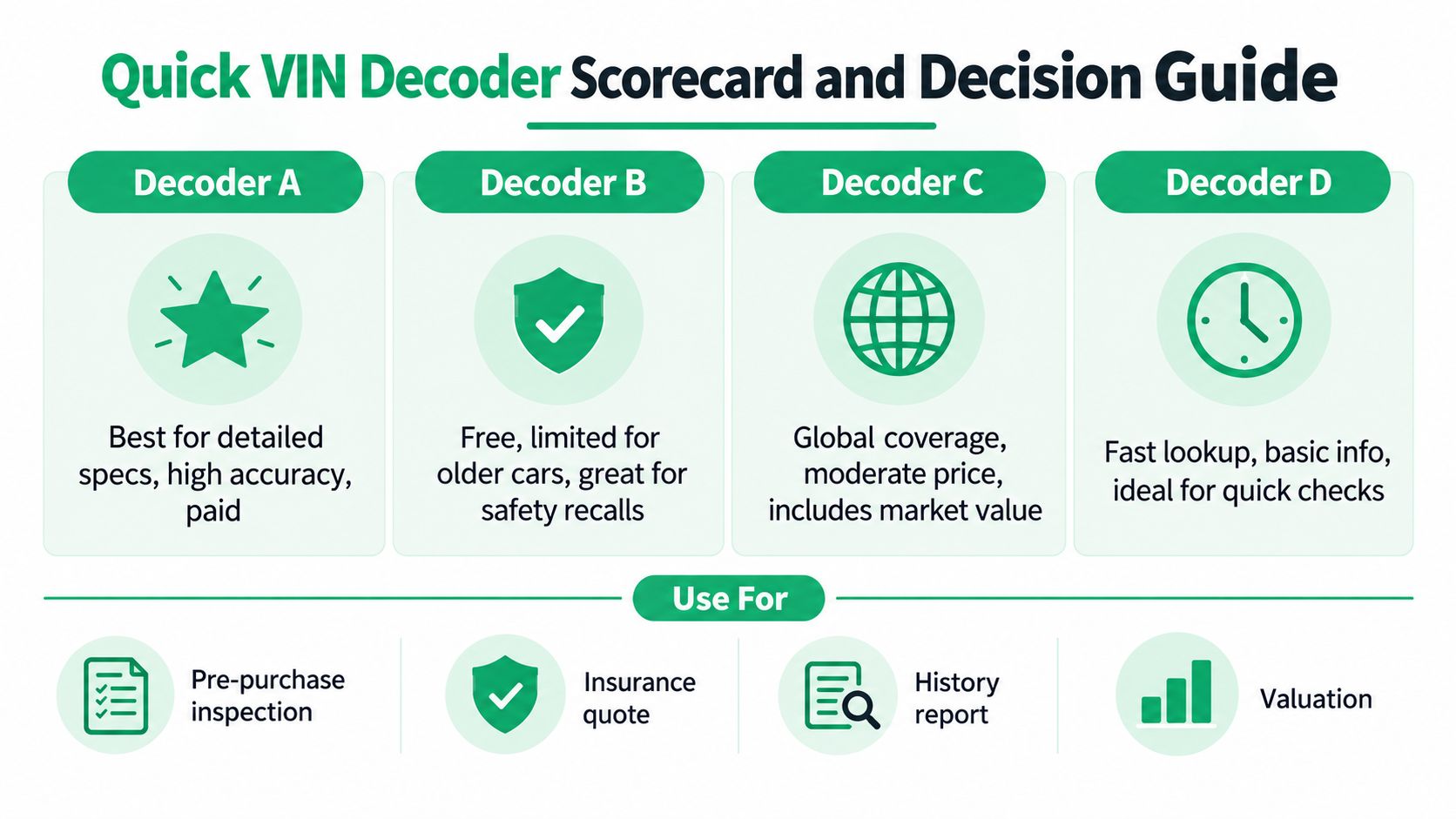
| Service type | Decode confidence and structure | Data-source strength | Feature depth | Mobile usability | Best overall use |
|---|---|---|---|---|---|
| NHTSA official decoder | Strong standardized baseline | Strong for its stated official scope | Focused | Practical | Identity and recall starting point |
| History-focused commercial report | Depends on vehicle age and source coverage | Potentially broad, must be disclosed | High when records and tools are combined | Usually convenient | Pre-purchase risk screening |
| Manufacturer lookup | Strong for supported brand data | Narrow but relevant | Focused | Varies | Recall and model confirmation |
| Basic free decoder | Useful for encoded specifications | Limited if no external records are shown | Low to moderate | Often fast | Quick listing or parts check |
Decision rule: If the vehicle is important enough that a hidden problem could change your purchase decision, basic decoding alone isn't enough. Add a history-enabled report and a physical inspection.
Choose the official decoder when you're checking the identity of a vehicle, confirming a model-year entry, or beginning recall research. Choose a history-enabled service when the car is being purchased, traded, financed, insured, or evaluated after a seller makes claims about its past.
Older vehicles deserve extra caution because NHTSA reports materially lower decode confidence for 1980–1994 models than for later model years. If the result is incomplete, don't fill the gaps with assumptions. Confirm the VIN characters, inspect the stamping, compare the paperwork, and contact the manufacturer or relevant authority when the vehicle's identity remains uncertain.
The scorecard also shows why “best” is situational. A fast free lookup may be entirely appropriate for a preliminary screen. It becomes inadequate when the next step is handing over money.
When VIN Decoding Results Change Everything
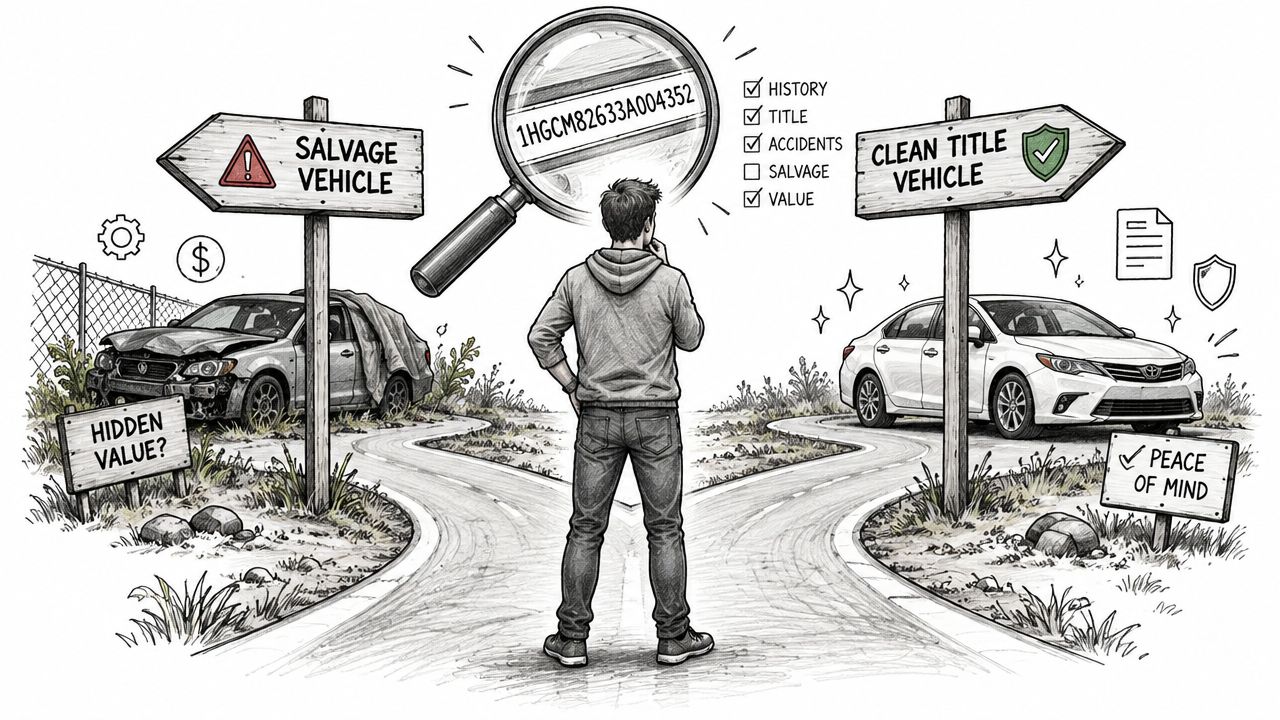
A buyer sees a clean-looking sedan with a seller's verbal assurance that it has never suffered serious damage. A basic decoder confirms the expected model, engine, and year. The buyer feels ready to negotiate, but the decode hasn't answered whether the vehicle carries a branded title or appeared at a salvage auction.
The salvage vehicle that looked ordinary
History records can change the conversation before the inspection begins. A salvage or rebuilt indicator may explain fresh paint, uneven panel gaps, replacement lights, or missing safety equipment. Auction records and prior images, where available, can show damage that a quick walkaround no longer reveals.
Without that context, a buyer may compare the car with ordinary clean-title examples and negotiate from the wrong baseline. With it, the buyer can ask for repair invoices, title documentation, an independent inspection, and a price that reflects the vehicle's actual risk.
The mileage story that doesn't line up
Mileage is another area where a decoder and a history report do different jobs. The VIN itself doesn't provide a complete odometer timeline. Recorded mileage entries must come from reporting sources, and missing entries don't prove that the odometer is accurate.
Suppose the dashboard reading is low, but a history record shows a materially higher earlier entry. That discrepancy doesn't automatically establish fraud, but it does require an explanation and supporting documents. A buyer who sees the issue before signing can pause the transaction. A buyer who discovers it afterward may have far less negotiating power.
The recall and theft checks that protect the transaction
A vehicle can match its listing and still need attention for an open recall. Recall lookup should be treated as a safety step, not a substitute for a history report. Buyers should confirm the result through an official or manufacturer resource when possible, then ask whether the repair was completed.
Theft status deserves the same discipline. A commercial report may surface a stolen-vehicle signal, but buyers should verify serious findings with the appropriate authority rather than relying on a single screen. If the VIN plate appears altered, the paperwork doesn't match, or the seller refuses a clear inspection, stop the deal until the identity is resolved.
Low-quality lookups create false confidence by placing a simple decode beside incomplete history language. The report may be technically correct about the vehicle's specifications while remaining silent about the risk that matters most.
How to Choose the Right VIN Decoder for Your Needs
Start with the decision you're trying to make, not with a tool's marketing headline. If you're ordering parts, confirming a listing, or identifying a vehicle for an insurance form, a basic decoder may be enough. If you're deciding whether to buy, finance, or resell a used vehicle, you need history evidence as well as factory data.
Match the service to the job
For a single purchase, prioritize a report that makes its record categories visible and gives you a clear total price. For multiple vehicles, look for report packs, repeat access, quick delivery, and an interface that lets you compare findings without losing the original VIN.
A service should make it easy to answer these questions:
- What was decoded directly from the VIN? Check the model, year, body, engine, plant, and serial details against the vehicle.
- Which history categories were searched? Look for title brands, salvage, theft, liens, mileage, recalls, accidents, and auction records.
- What does missing data mean? A blank field should not be presented as proof that no event occurred.
- What will the report cost later? Read trial renewal terms, subscription conditions, and pack pricing before entering payment details.
- Can you verify important findings? Use paperwork, an inspection, and official or manufacturer resources for high-consequence issues.
A safety lookup, such as a Toyota Camry safety and recall search, can support the evaluation, but safety information doesn't replace title and damage research.
Red flags deserve more weight than extra features
Be cautious when a site promises a complete history without naming its source categories, hides the renewal price, or shows a generic result that doesn't explain coverage. A long list of tools won't compensate for unclear provenance.
Before you buy, copy the VIN directly from the vehicle, not just the advertisement. Verify every character, compare it with the title and registration, and inspect the physical stamping for tampering. Then use the report to create questions for the seller and inspector, not to skip the inspection.
Frequently Asked Questions About VIN Decoders
Can a VIN decoder tell me whether a car has been in an accident?
A VIN identifies the vehicle and its encoded specifications. Accident information comes from external records, so a history report may show reported collisions while missing unreported repairs. Inspect the vehicle and request repair documentation.
Why do older vehicles return less information?
Older VINs can be harder for automated systems to decode consistently. As noted earlier, NHTSA reports higher confidence for newer VINs and lower confidence for vehicles from earlier model years. Recheck every character, confirm the format, and seek manufacturer or authority verification if the result is incomplete.
Does a clean decode mean the car has a clean title?
No. A decode confirms identity and specifications. Title brands, salvage status, liens, theft records, and accidents require separate records, and no database captures every event.
What should I do if the result looks wrong?
Pause before relying on it. Compare the VIN on the dashboard or frame stamping with the paperwork and listing. Check for invalid characters or a check-digit problem. If the identity still does not match, ask the seller and relevant authority for a credible explanation before proceeding.
Is a free VIN decoder enough before buying?
A free decoder works as an initial screen for confirming the advertised vehicle. It does not answer the history questions that can change a purchase decision, including title, damage, theft, liens, mileage, or recalls. Add a history report and independent inspection.
VinCheck combines free VIN decoding with history-focused checks for title brands, salvage, theft, liens, mileage issues, recalls, and related records, plus valuation and safety tools. Visit VinCheck to confirm the vehicle's identity, then select the level of history research the purchase requires.
About the author
VinCheck Editorial Team — Editorial Standards & Review
The VinCheck Editorial Team reviews every published article against NMVTIS data accuracy and NHTSA recall validity. This byline appears on collaborative pieces and quick-update posts.