 Vin
2001 Ford F150 Value
By VinCheck Editorial Team, Editorial Standards & Review · Published 2026-10-02 · Updated 2026-10-02 · Reviewed by VinCheck Editorial Standards
A 2001 Ford F-150 is worth around $2,275 in a private sale and $1,125 as a trade-in, though prices vary widely from under $2,000 to over $12,000 depending on condition. The right trim, mileage, title history, and mechanical state can move the truck far away from any generic average.
You may be staring at a dealer's trade-in worksheet right now, wondering how a truck that originally sold in the low-$20,000s or higher has been reduced to a number that barely covers a repair bill. Or perhaps you've found a clean-looking 2001 F-150 advertised for several thousand dollars and need to know whether it's fairly priced or just wearing fresh tires over old problems.
The straight answer is that there isn't one 2001 Ford F-150 value. There's a wholesale number, a guidebook resale estimate, a private-party asking price, and a transaction price after a buyer checks the truck's history. Those figures can be dramatically different. The biggest mistake is treating an average as a verdict instead of using it as a starting point.
Table of Contents
- Understanding the Current 2001 Ford F-150 Value
- How Trim and Mileage Impact Pricing
- The Reality of Depreciation and Trade-In Offers
- Using VinCheck to Verify Vehicle History
- Negotiation Strategies Based on Data
- Final Checklist for Buying a 2001 F-150
Understanding the Current 2001 Ford F-150 Value
A dealer trade-in offer and a private-party sale measure different things. The dealer has to account for inspection, reconditioning, storage, sales overhead, and the risk that the truck has a branded title or hidden mechanical defect. A private buyer may pay more because they want that exact cab, bed, drivetrain, or trim, but they'll also expect evidence that the truck is safe and accurately represented.
Kelley Blue Book puts the current resale value of a 2001 F-150 at $2,275 and the trade-in value at $1,125, while reporting a loss of $748, or 24%, over the last three years. Those figures come from Kelley Blue Book's 2001 Ford F-150 valuation, and they're useful as a baseline, not a guaranteed selling price.
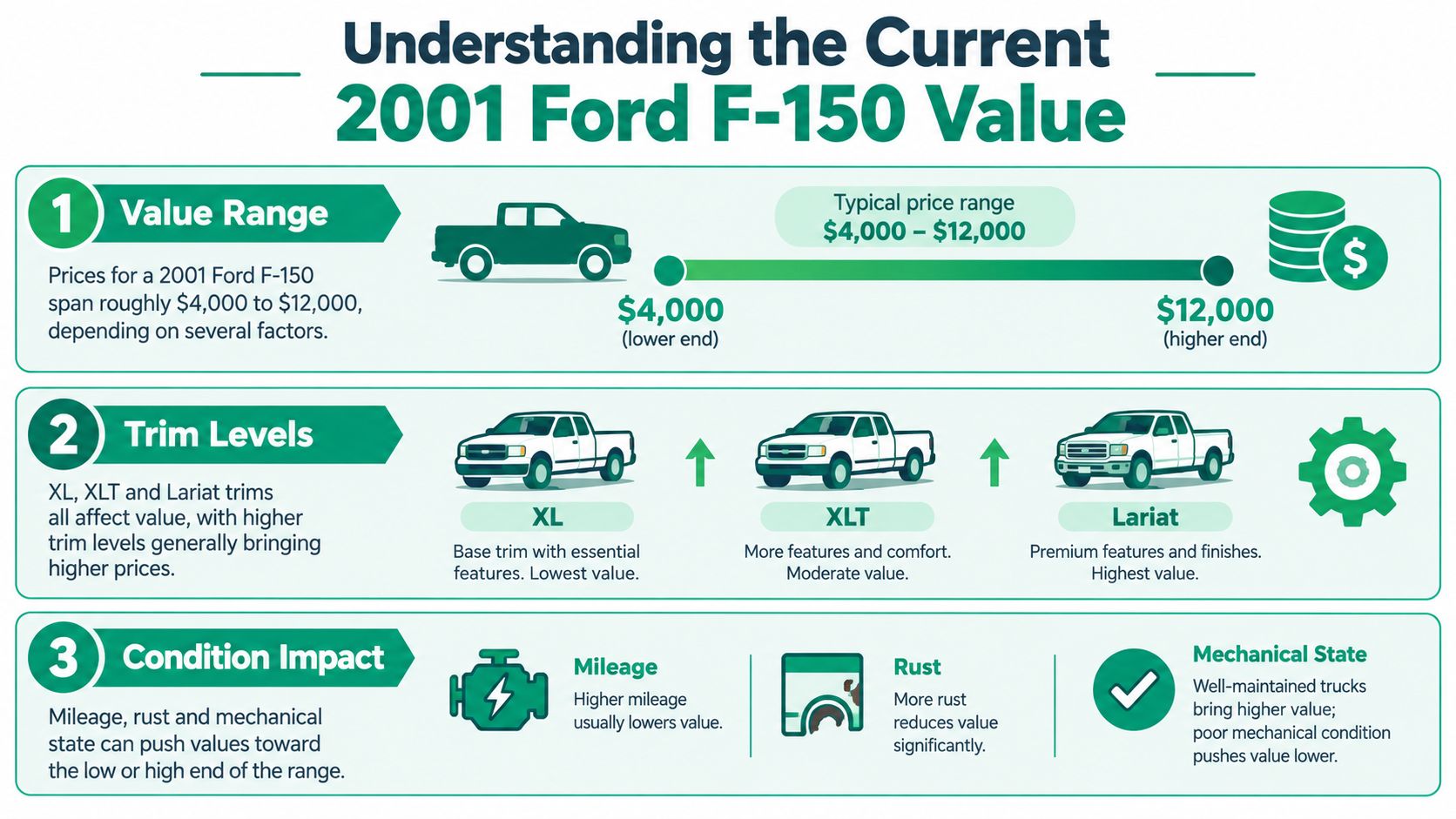
Guidebook values versus listing prices
Marketplace listings produce a wider and often higher retail picture. Cars.com reports a nationwide average listing price of $12,040, with listings starting at $1,495, while Edmunds places trade-in values between $341 and $5,035 and gives a typical estimated market value of $2,677. These figures are reported through Edmunds' 2001 F-150 appraisal page, which shows why a single search result can be misleading.
A high listing average doesn't mean every truck is worth five figures. Listings may include unusually clean examples, desirable configurations, restored trucks, or vehicles priced optimistically by sellers who expect negotiation. A basic work truck with severe rust belongs near the bottom of the market, even if a nicer SuperCrew appears beside it.
Baseline value comparison
| Metric | Value |
|---|---|
| KBB current resale value | $2,275 |
| KBB trade-in value | $1,125 |
| Edmunds typical estimated market value | $2,677 |
| Edmunds trade-in range | $341 to $5,035 |
| Cars.com nationwide average listing price | $12,040 |
| Cars.com lowest reported listing price | $1,495 |
Use a 2001 Ford F-150 vehicle valuation reference to organize the truck's year, model, and configuration before comparing it with similar listings. Then adjust the number for what's in front of you. A clean title, straight frame, working four-wheel drive, documented maintenance, and low rust can justify a premium. A salvage title, odometer inconsistency, fluid leaks, or structural corrosion can erase that premium immediately.
Practical rule: A dealer's offer tells you what the truck is worth to that dealer today. It doesn't automatically tell you what a qualified private buyer will pay.
How Trim and Mileage Impact Pricing
The 2001 F-150 was sold in enough configurations that comparing trucks by model year alone is poor buying practice. A Regular Cab work truck, a Super Cab, a SuperCrew, an SVT Lightning, and a King Ranch Crew Cab can carry very different market expectations. The original price ladder helps explain why.
Kelley Blue Book lists the Regular Cab starting MSRP at $20,170 and the Regular Cab Lightning Short Bed at $32,460. The Super Cab started at $22,855, and SuperCrew configurations included versions above $30,000, as shown in the KBB model-year valuation information. CarGurus lists a historical MSRP as high as $34,910 for a King Ranch Crew Cab 4WD Short Bed, while its average listing price for the model is $6,853.03, according to the market figures included in Edmunds' appraisal reference.
That original price difference matters, but it doesn't guarantee a premium today. A premium trim with neglected maintenance is still a bad truck. A plain Regular Cab with a solid frame, clean title, and strong drivetrain may be the smarter purchase.
Trim and mileage comparison
| Trim or condition | Estimated market value | Key factor |
|---|---|---|
| Basic Regular Cab work truck | Usually toward the lower end of the market | Utility, rust, and mechanical condition matter more than equipment |
| Super Cab configuration | Variable, generally stronger than a basic work truck when clean | Extra cab space expands private-buyer demand |
| SuperCrew configuration | Can command a premium over basic cabs | Larger cabin and higher original specification |
| King Ranch Crew Cab 4WD Short Bed | Historical MSRP up to $34,910 | Premium equipment can support stronger asking prices, but age still dominates |
| Over-105,000-mile example | Around $5,707 in one listing dataset | High mileage narrows the buyer pool |
| 75,000 to 90,000-mile example | Around $9,500 in one listing dataset | Lower mileage creates a meaningful retail premium |
| Salvaged or high-mileage auction truck | About $1,825 to $3,525 ACV | Damage history and use history heavily affect the bid |
The mileage spread is not subtle. One marketplace dataset places the median asking price around $5,995 to $6,450, with trucks showing more than 105,000 miles centered near $5,707 and examples with 75,000 to 90,000 miles near $9,500. The same dataset implies a price difference of roughly $1,300 per 10,000 miles, though that should be treated as a market indication rather than a precise formula. See the 2001 F-150 pricing data by mileage and condition for the listing and auction comparisons.
What buyers should compare
Start with cab and drivetrain, then inspect the truck. Don't pay a premium for leather or a special badge if the frame is scaling, the transmission slips, or the title is branded. Conversely, don't dismiss a plain XL if it has documented care and the exact utility you need.
Mileage deserves close attention, but it isn't enough by itself. A high-mileage truck with consistent records can be safer to buy than a low-mileage truck with gaps, inconsistent odometer readings, or years of outdoor storage. Use a Ford F-150 value reference for model comparisons as a research aid, then verify the actual truck's history and condition before making an offer.
The Reality of Depreciation and Trade-In Offers
The 2001 F-150 demonstrates why original MSRP and current value must be kept in separate columns. KBB's original pricing shows a truck range beginning at $20,170 for a Regular Cab and reaching $32,460 for a Regular Cab Lightning Short Bed. Today, KBB reports a resale value of $2,275 and a trade-in value of $1,125, based on its 2001 F-150 valuation data.
That's not just depreciation from age. The truck has moved from a new vehicle purchase with factory warranty support into an old used vehicle category where buyers expect repairs. Rust, worn suspension parts, aging seals, neglected cooling systems, and transmission concerns carry more weight because replacement costs can approach or exceed the truck's value.
Why trade-in offers come in low
A dealer buying the truck has to protect against unknowns. The dealer may need to correct warning lights, replace tires, address leaks, repair air-conditioning faults, detail the interior, and handle title or history problems before retailing it. Even when the truck is sound, the dealer is buying at a wholesale level and must leave room for business costs and profit.
Auction data shows how sharply condition can alter the floor. Salvaged or high-mileage examples in one dataset sold at approximately $1,825 to $3,525 ACV, depending on condition and use history, as reported in the 2001 F-150 market listing analysis. A dealer sees those risks before a private buyer does, so the offer reflects uncertainty as much as the truck's visible appearance.
A low trade-in offer isn't always a rip-off. It becomes a bad deal when you accept it without comparing the likely private-party price and without understanding what the dealer has deducted.
Sell privately when the truck earns it
Selling privately makes more sense when the F-150 has a clean title, credible mileage, usable tires, limited rust, and no major warning signs. You'll need to answer questions, allow inspections, and wait for the right buyer, but a work-truck buyer may value the configuration more than a dealership does.
If convenience matters more than extracting the maximum price, compare the dealer's figure with a dedicated Motor Sportsland trade-in tool and other guidebook references. Don't use any tool blindly. Your final number should reflect the VIN history, the truck's mechanical condition, and comparable listings for the same cab and drivetrain.
Using VinCheck to Verify Vehicle History
A cheap 2001 F-150 can become expensive the moment its history reveals a flood record, salvage title, stolen status, lien, or mileage problem. A seller's description can tell you what the truck looks like today. It can't prove what happened before the current owner bought it.
Start by copying the VIN from the dashboard and comparing it with the door-jamb label, title, registration, and seller's listing. The identifiers should match. If the seller refuses to provide the VIN before you travel or pay a deposit, walk away.
Run the history check before negotiating
Use the VIN to confirm the truck's basic identity, including year, make, model, and available configuration information. Then review the history record before discussing a final price. A Ford F-150 VIN check resource can help you organize the vehicle identification and report process.
VinCheck provides NMVTIS-grade records covering accidents, title brands, salvage and flood records, theft status, liens, and mileage anomalies. Reports are delivered instantly, which lets buyers investigate the vehicle before committing to a purchase.
Read the report as a pricing document
A history report isn't a substitute for a physical inspection. It's a way to identify questions that the inspection must answer.
Title brands: Salvage, rebuilt, flood, or other brands can reduce buyer demand and complicate insurance or registration. Treat a branded title as a major value adjustment, not a minor bargaining point.
Mileage records: Compare reported mileage entries for a logical progression. An anomaly doesn't prove fraud by itself, but it means the odometer reading shouldn't be treated as verified.
Accident and auction activity: Prior damage may have been repaired well, poorly, or only cosmetically. Auction photos and records can reveal damage that no longer appears in a seller's pictures.
Theft and lien status: A stolen-vehicle record or unresolved lien can create a legal and financial problem even if the truck runs perfectly. Resolve those issues before money changes hands.
Flood exposure: Water damage can affect wiring, sensors, connectors, and corrosion over time. Look for damp odors, unusual electrical faults, corrosion in hidden areas, or mismatched interior components.
Inspection rule: If the report changes your understanding of the truck, change your offer or leave. Don't let a seller's urgency override evidence.
Negotiation Strategies Based on Data
Negotiation works when you bring evidence, not when you just ask for a lower number. Start with a market baseline, identify the truck's exact configuration, and then separate normal age-related wear from defects that create immediate cost or risk.
A seller asking $9,500 for a lower-mileage truck may have a defensible retail position if the truck has a clean title, strong body, desirable cab, and convincing records. A seller asking the same amount for a high-mileage or branded-title truck needs to explain the gap. The mileage-based listing data places lower-mileage examples near $9,500 and over-105,000-mile examples near $5,707, so configuration and condition must explain any difference, as shown in the marketplace pricing dataset.
Build your offer in layers
Use the KBB resale and trade-in figures as reference points, not as a script. The private-party number should sit above a dealer trade-in offer when the truck is clean and saleable, but the exact difference depends on how much work the buyer must assume.
Bring these items to the conversation:
Comparable listings: Show trucks with similar cab style, mileage, drivetrain, and title status. Don't compare a clean SuperCrew with a rusty Regular Cab and call the difference trim value.
History findings: A salvage brand, mileage anomaly, flood record, lien, or major accident record deserves a direct adjustment. Ask the seller to explain it, then price the risk rather than accepting a vague reassurance.
Mechanical inspection: Put oil leaks, overheating, transmission behavior, brake condition, frame rust, and suspension wear into writing. Concrete defects support a concrete reduction.
Ownership records: Service receipts and consistent registration history strengthen the seller's position. Missing records don't automatically make the truck bad, but they increase uncertainty.
Use the dealer offer correctly
The trade-in quote gives you a useful floor for convenience, but don't let a dealer blend the truck's value into a monthly payment. Ask for the trade value, purchase price, fees, and financing terms as separate figures. A higher trade allowance can be offset by a higher vehicle price or additional charges.
For a private purchase, make the offer conditional on a clean title transfer and a satisfactory inspection. If the seller rejects an inspection, refuses to share the VIN, or insists on cash before paperwork is complete, the right negotiation strategy is to leave.
The strongest offer is simple: “This is what comparable trucks show, this is what the history report says, and these are the repairs the truck needs.” That approach gives both sides a factual basis and exposes inflated pricing quickly.
Final Checklist for Buying a 2001 F-150
A 2001 F-150 can still be useful, but age makes inspection discipline more important than a polished listing. The truck's value comes from the combination of identity, history, structure, drivetrain, and price. Ignore one of those categories and you can turn a cheap purchase into a repair project.
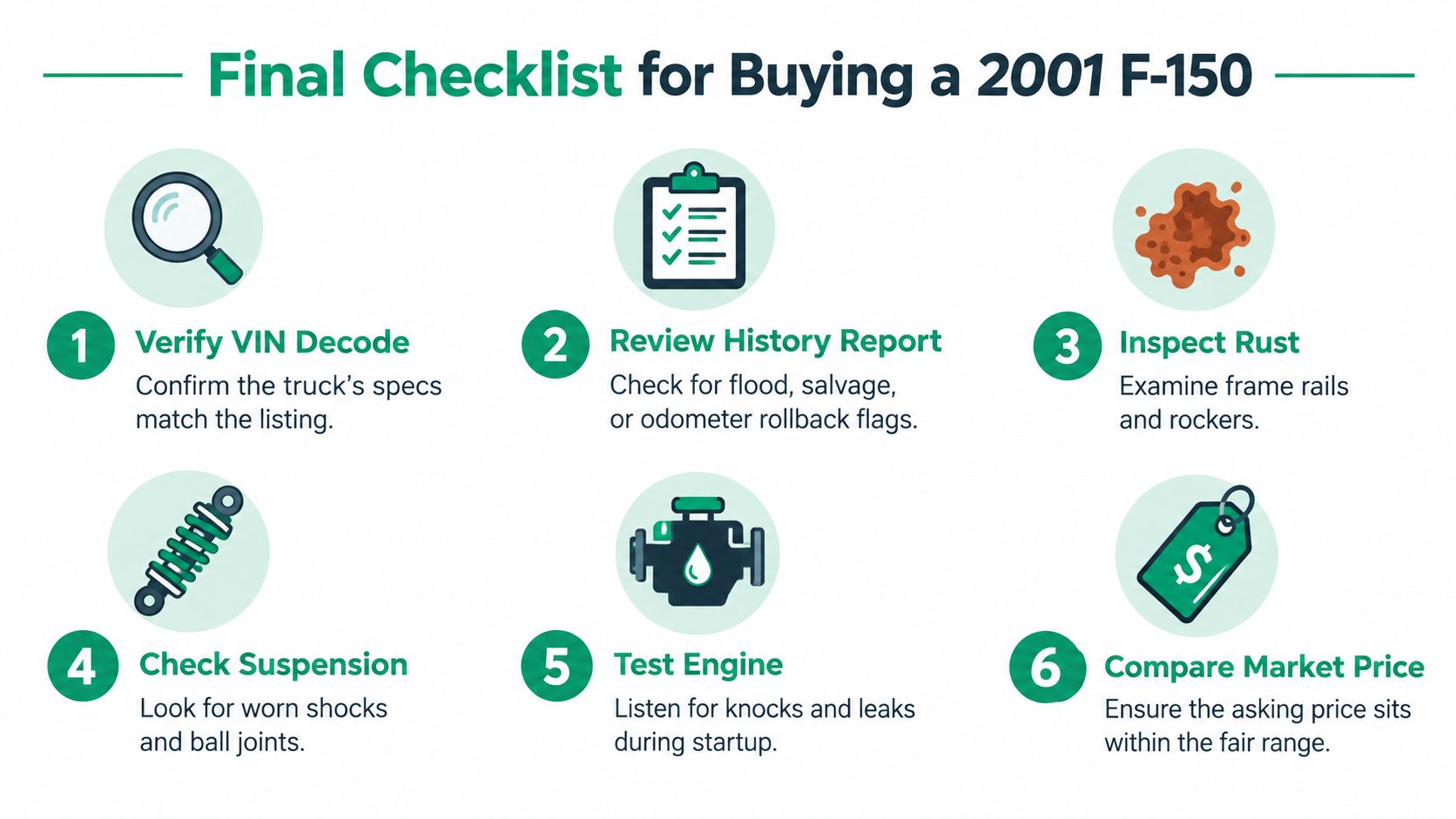
Six checks before payment
Verify the VIN: Match the dashboard VIN with the door label, title, registration, and listing. Confirm that the truck's cab, bed, drivetrain, and trim match the seller's description.
Review the history: Check accidents, title brands, flood records, theft status, liens, auction activity, and mileage anomalies. Don't negotiate seriously until you know what the record contains.
Inspect the frame: Look closely at frame rails, crossmembers, spring mounts, cab mounts, and rocker panels. Surface rust is one issue. Structural scaling, perforation, or poorly repaired damage is another.
Test the drivetrain: Start the engine cold if possible. Listen for abnormal knocks, watch for smoke, check fluid condition, and verify that the transmission shifts cleanly. Test four-wheel drive if equipped.
Check the running gear: Inspect brakes, tires, steering, ball joints, shocks, wheel bearings, and suspension bushings. A truck can look straight while carrying a long list of worn chassis components.
Compare the price: Use KBB, Edmunds, and comparable listings, then adjust for mileage, title status, trim, rust, records, and immediate repairs. The cheapest truck isn't the best value if it needs structural or drivetrain work.
Use the inspection as a decision point, not a formality. If the frame is solid and the history is clean, age-related repairs may be manageable. If the title is branded, the mileage is inconsistent, and the truck has serious rust, no attractive asking price can make it a dependable buy.
The practical target is a truck whose price matches its evidence. A clean, documented example can justify paying more than a guidebook trade-in figure, while a questionable truck should be priced below ordinary market references or rejected entirely. Don't confuse a low purchase price with low ownership cost.
VinCheck offers VIN decoding and vehicle history reporting for accidents, title brands, salvage and flood records, theft status, liens, and mileage anomalies. Before you buy a 2001 F-150, run the VIN, compare the report with the seller's claims, and visit VinCheck to check the truck's history before making your offer.
About the author
VinCheck Editorial Team — Editorial Standards & Review
The VinCheck Editorial Team reviews every published article against NMVTIS data accuracy and NHTSA recall validity. This byline appears on collaborative pieces and quick-update posts.